Two ordinary letters have an unusually precise origin story
OK can mean yes, acceptable, safe, understood, adequate or simply a pause before the next sentence. It works as an adjective, adverb, noun, verb and conversational signal. Because it is so short and widespread, people have attached it to dozens of older languages and historical figures. The best-supported origin is much more playful.
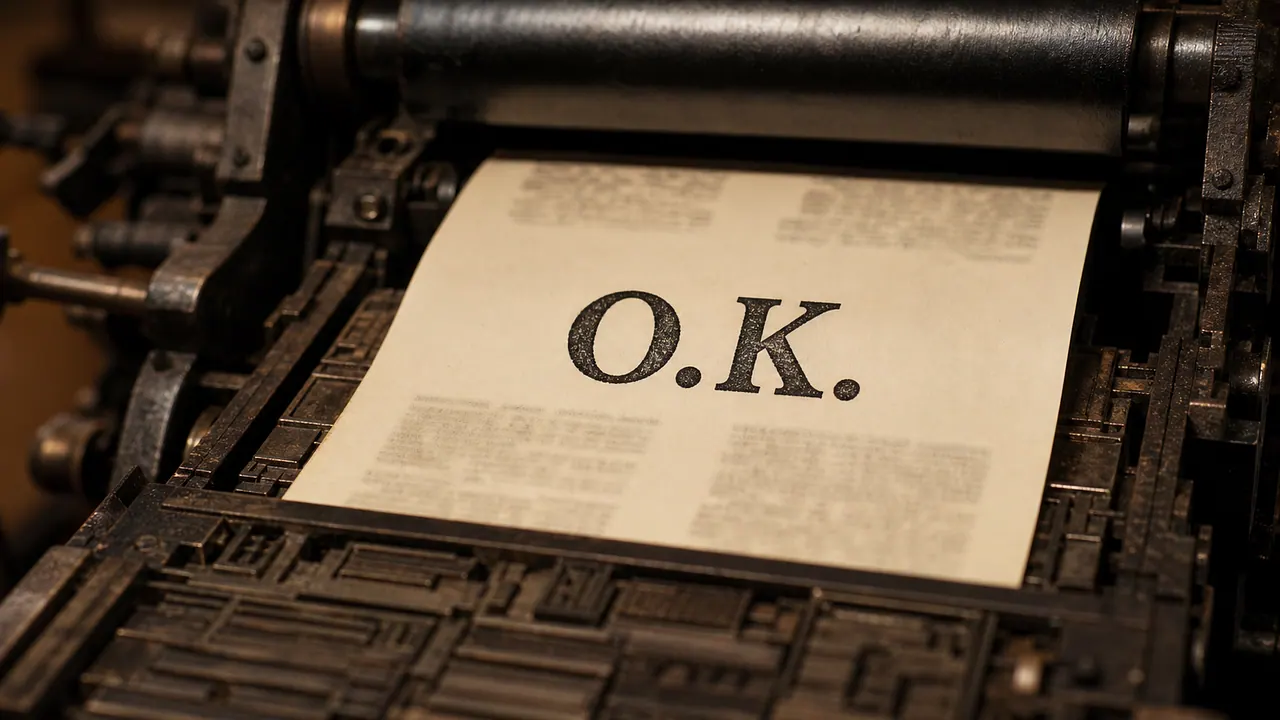
On 23 March 1839, the Boston Morning Post printed 'o.k.' and explained it as an abbreviation of 'oll korrect', a deliberately misspelled version of 'all correct'. Lexicographer Allen Walker Read traced this and related newspaper evidence in the twentieth century. Later discoveries have refined details, but the 1839 American abbreviation remains the account accepted by major dictionaries.
The misspelling was the joke
Readers in the late 1830s were seeing a fashion for comic abbreviations. Writers shortened phrases and sometimes spelled the words incorrectly on purpose before taking their initials. 'No go' could become K.G. for 'know go', while 'all right' could be written O.W. for 'oll wright'. The humour depended on recognising both the intended phrase and the absurd spelling.
O.K. survived while most of its companions disappeared. To a modern reader, 'oll korrect' can look like ignorance or a transcription error. In its original setting it was wordplay. The abbreviation was memorable because the letters looked official while the expanded phrase was knowingly wrong.
A presidential campaign gave the joke a second life
In 1840, United States president Martin Van Buren ran for re-election. He came from Kinderhook, New York, and supporters called him 'Old Kinderhook'. His initials conveniently produced O.K. Democratic campaign clubs used the letters, while opponents made their own jokes about them. The political fight pushed an already existing abbreviation into wider public view.
This is why two origin stories are often blended together. Van Buren did not invent OK, and it did not originally stand for Old Kinderhook. The campaign acted more like an amplifier. A newspaper joke from the previous year suddenly had a famous person, slogans, clubs and controversy carrying it across the country.
Why the other colourful explanations are weaker
Proposed origins have connected OK with a Choctaw expression, Scottish 'och aye', Greek 'ola kala', German proofreading marks, West African languages and initials supposedly stamped on goods or documents. Some sound plausible because the sounds or meanings overlap. Plausibility, however, is not the same as a dated chain of evidence showing how a form entered print and spread.
The newspaper explanation has an advantage: it appears in a documented abbreviation fad immediately before the expression became politically prominent. Earlier lookalikes can still be interesting, and different languages may have influenced how speakers received the term. They do not displace the well-evidenced sequence from 'oll korrect' to Old Kinderhook to broader American use.
Telegraphy made short confirmation valuable
As telegraph networks expanded, compact signals were valuable because messages took time and money to transmit. OK was already available as a quick confirmation that a message or instruction had been received correctly. It did not need a long grammatical frame and was hard to confuse with an ordinary word inside a sentence.
The expression also became useful in business, transport, military communication and eventually computing. A button labelled OK can confirm a choice without specifying whether the user means 'yes', 'continue', 'close this message' or 'I understand'. The context supplies the missing detail. That efficiency helped the term survive changes in technology.
Its vagueness is a feature
Many words lose usefulness when their meaning becomes broad. OK gained usefulness from controlled ambiguity. 'The engine is OK' means it is functioning. 'The meal was OK' can be faint praise. 'OK, I will do it' signals agreement, while a hesitant 'okay...' can signal doubt. Tone and context change the force without changing the letters.
That flexibility makes OK easy to borrow. Speakers do not have to abandon their own words for yes, good or correct. They can add OK as a neutral signal for acknowledgement or acceptance. Its simple vowel-and-consonant pattern is also easy to recognise in writing, even where pronunciation varies.
The tiny joke outlived the campaign
Martin Van Buren lost the 1840 election, the abbreviation craze faded and most of its comic inventions vanished. OK remained. It had gained enough exposure to escape the joke that created it, then found practical jobs in new systems of communication. Today many people use it without knowing that the spelling was once the punchline.
The complete story is a useful warning about word histories. The oldest-sounding explanation is not always the best one, and a later event that popularises a word is not necessarily its origin. In this case the paper trail points to an 1839 newspaper gag, boosted by an 1840 campaign and preserved because two letters proved astonishingly adaptable.
Sources and further reading
This article was written for Curiosity Desk. We do not copy other publishers or invent quotes. If a material error is found, we correct it openly.
Read the full standards →One answer should lead to a better question
Bring your curiosity to the group
Curious Minds is our public Facebook community for surprising science, strange history, Australian wildlife and everyday questions. No copied posts, no personal-friend invitations and no link dumping.
- Three self-contained discussion prompts each week
- Sourced answers and honest uncertainty
- Respectful conversation without spam