The rocks in the water are still being assembled
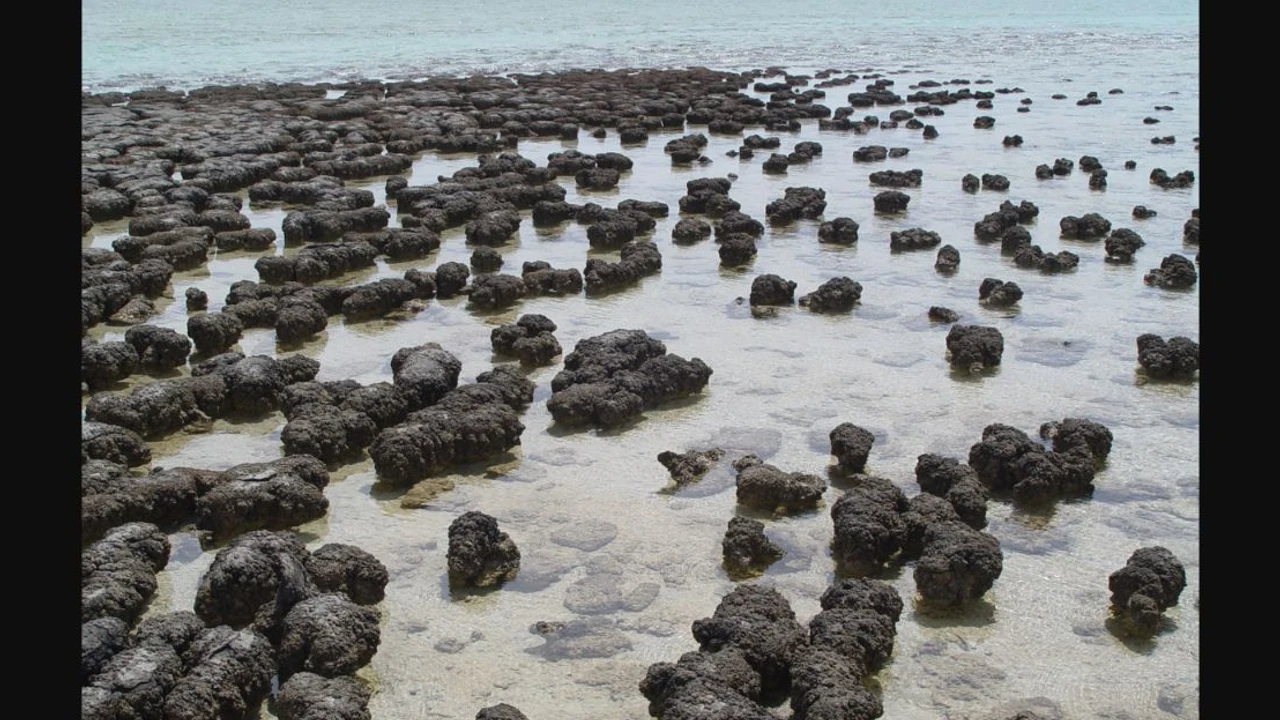
At Hamelin Pool, dark rounded mounds rise through water shallow enough to reveal their rough surfaces. They look like ordinary coastal rocks, but active microbial communities help build them. Microbes living in surface mats trap and bind particles, alter the chemistry around them and promote the precipitation of carbonate minerals.
Microbialite is the broad name for a sedimentary structure formed through those microbial processes. A stromatolite is a layered kind of microbialite. The distinction matters because Hamelin Pool contains flat mats, weakly lithified sheets and several mound shapes, not one identical population of stone columns. Even within a mound, the most active community is concentrated near the surface while older material beneath has already become part of the structure.
A salty barrier changed who could live here
Hamelin Pool is partly cut off from the rest of Shark Bay. Banks of seagrass and sediment restrict water exchange, while strong evaporation concentrates the salts. The Western Australian environment department describes the pool as extremely salty, hot and exposed. Those conditions exclude many organisms that would graze on, compete with or disturb microbial mats.
That does not make the pool lifeless. It changes the competition. Communities that tolerate the harsh water can spread across intertidal and shallow subtidal zones, where tides, depth and wave energy shape different textures and forms. UNESCO recognises Hamelin Pool for the diversity and abundance of these structures and for their resemblance to forms preserved in the geological record.
The builders are a community, not one ancient species
The familiar shorthand says cyanobacteria build stromatolites. Photosynthetic cyanobacteria are important, but genetic sampling has revealed a much broader consortium. A study of two Hamelin Pool stromatolites found communities made up of roughly 90 per cent Bacteria and 10 per cent Archaea, including many lineages that were only distantly related to sequences already known at the time.
The same study found different communities at the surface and inside the structures. That vertical organisation allows photosynthesis, sulfur cycling and other metabolisms to operate in closely packed layers. A mound is therefore less like one giant organism and more like a neighbourhood whose residents, chemistry and sediments collectively leave a rock record.
A window into deep time is not a time machine
Stromatolite-like structures occur in rocks about 3.5 billion years old, long before animals or land plants appeared. Modern Hamelin Pool structures give researchers a place to observe how microbial mats, sediment and mineral precipitation can create repeated layers and mound shapes. Those observations help scientists develop and test explanations for parts of the ancient record.
The comparison has limits. Today's microbes have billions of years of evolutionary history, and Hamelin Pool has its own modern water chemistry, food web and geology. Similar shapes do not prove identical organisms or conditions. That is why researchers call these structures analogues: they demonstrate plausible processes, while evidence inside each ancient rock still has to support a biological interpretation.
The quiet pool is also a carbonate factory
Recent mapping has complicated the postcard view of isolated domes. Researchers found that prominent stromatolite buildups cover less than two per cent of Hamelin Pool, while broad weakly lithified mats and microbial pavements cover much larger areas. As those softer mats grow, break down and erode, they release tiny carbonate grains into the sediment.
The same study estimated that this microbial system could produce about 24,000 metric tonnes of sand-sized carbonate sediment each year. Microbes are not merely decorating rocks; they are helping manufacture part of the landscape. The structures are delicate, so visitors must obey reserve rules: walking below the high-water mark and swimming or snorkelling inside Hamelin Pool Marine Nature Reserve are not permitted.
Sources and further reading
- Western Australian DBCA - Stromatolites and microbial mats fact sheet ↗
- UNESCO World Heritage Centre - Shark Bay, Western Australia ↗
- Applied and Environmental Microbiology - Composition and structure of Hamelin Pool stromatolite communities ↗
- Scientific Reports - The microbial carbonate factory of Hamelin Pool ↗
- Explore Parks WA - Hamelin Pool Stromatolites visitor guidance ↗
This article was written for Curiosity Desk. We do not copy other publishers or invent quotes. If a material error is found, we correct it openly.
Read the full standards →One answer should lead to a better question
Bring your curiosity to the group
Curious Minds is our public Facebook community for surprising science, strange history, Australian wildlife and everyday questions. No copied posts, no personal-friend invitations and no link dumping.
- Three self-contained discussion prompts each week
- Sourced answers and honest uncertainty
- Respectful conversation without spam