The pink is in the water, but the answer is not singular
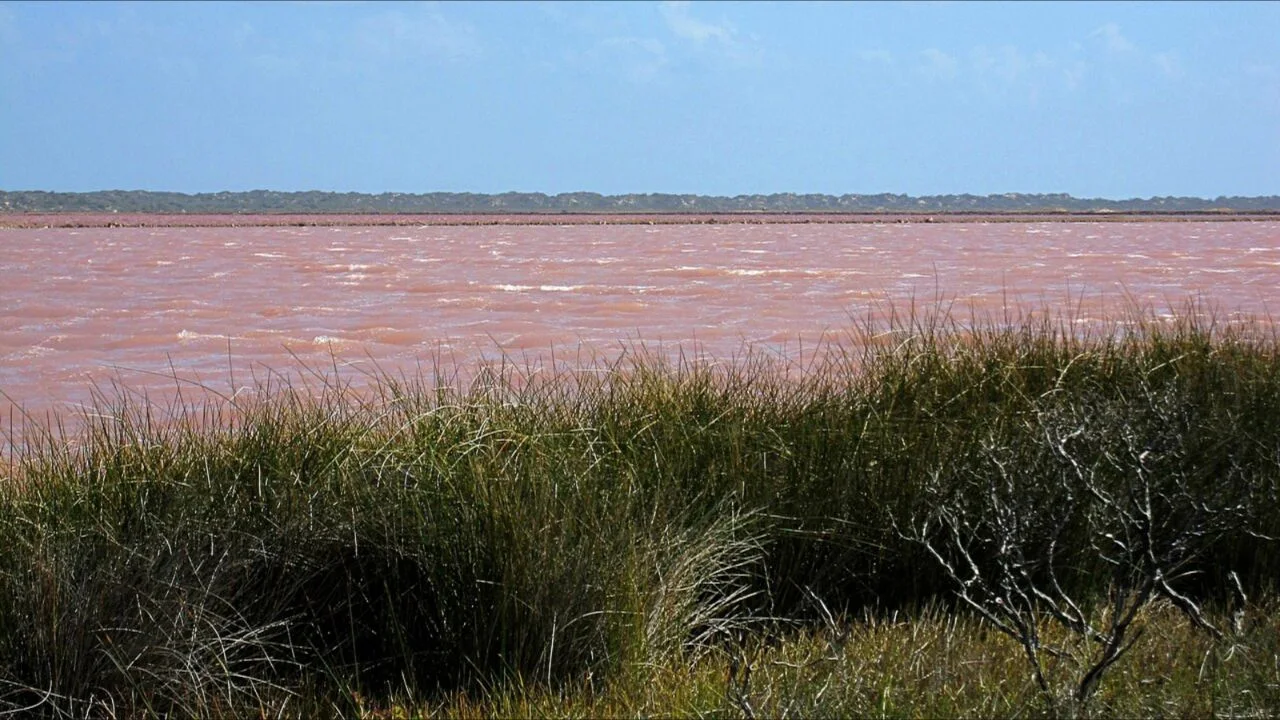
Hutt Lagoon can look as though someone mixed strawberry paint into the Western Australian coast. The photograph on this page records the colour from its shore, not through a social-media filter. Yet the phrase pink lake covers several different places, and scientists do not assume that the same organism controls every one of them.
NASA's description of Hutt Lagoon links its colour to beta-carotene-producing microalgae. A separate genetic study of Lake Hillier, off Western Australia's south coast, found a much broader consortium of pigment-producing life. The two examples point in the same direction while warning against a one-microbe answer for every lake.
Salt changes which organisms can dominate
As water evaporates, dissolved salts become more concentrated. Most familiar freshwater organisms struggle with the resulting osmotic stress, but halophiles are adapted to salty conditions. Australian salt-lake researchers note that the microalga Dunaliella can thrive in hypersaline water and give lakes a characteristic pink hue.
Dunaliella can accumulate orange-red carotenoid pigments, including beta-carotene, that help protect its cells under intense light. Other salt-loving microbes make their own red or orange pigments. When enough of those cells and pigments are suspended in water, a microscopic survival response becomes visible across kilometres.
Lake Hillier's DNA revealed a crowded colour workshop
For the first metagenomic study of Lake Hillier, researchers sampled water and sediment, sequenced genetic material and used culture-based methods. They detected archaea, bacteria, algae and viruses rather than a lake ruled by one famous alga. The listed pigment producers included Dunaliella, Salinibacter, Halobacillus, Psychroflexus and Halorubrum.
The team also reconstructed 21 bacterial and archaeal genomes, many of which could not be matched neatly to a previously observed species. Pigment-related metabolic pathways appeared throughout the data. Their conclusion was a microbial consortium of pigment makers, which is more interesting and more accurate than imagining a single species pouring colour into the lake.
Why the same lake can look like a different colour
A lake is not a fixed colour sample. Rain and inflow can dilute salinity, while heat and evaporation concentrate it again. Nutrients, microbial abundance, depth and suspended material can also change. Those shifts alter which organisms flourish and how strongly their pigments influence the water seen from above or from the shore.
Viewing conditions matter too. Sun angle, cloud, surface glare and reflected sky change the light that reaches a camera or an eye. That is why a lake can appear bubblegum pink in an aerial photograph, muted rose at ground level or far less colourful at another time. A vivid image can be genuine without promising the same view every day.
The colour is a clue to an extreme ecosystem
The best part of a pink lake is not that it resembles a fantasy. Its colour exposes the chemistry of survival. Pigments, salt tolerance and unusual metabolisms let communities persist where many organisms cannot. Metagenomics turns that visible clue into a catalogue of life, including organisms that may still be new to science.
That does not make every pink lake safe for swimming or collecting. Salinity, access rules and ecological sensitivity differ by site, so visitors should follow local guidance and leave water and shoreline undisturbed. The photograph creates the first question; the living community beneath the colour supplies the deeper answer.
Sources and further reading
This article was written for Curiosity Desk. We do not copy other publishers or invent quotes. If a material error is found, we correct it openly.
Read the full standards →One answer should lead to a better question
Bring your curiosity to the group
Curious Minds is our public Facebook community for surprising science, strange history, Australian wildlife and everyday questions. No copied posts, no personal-friend invitations and no link dumping.
- Three self-contained discussion prompts each week
- Sourced answers and honest uncertainty
- Respectful conversation without spam