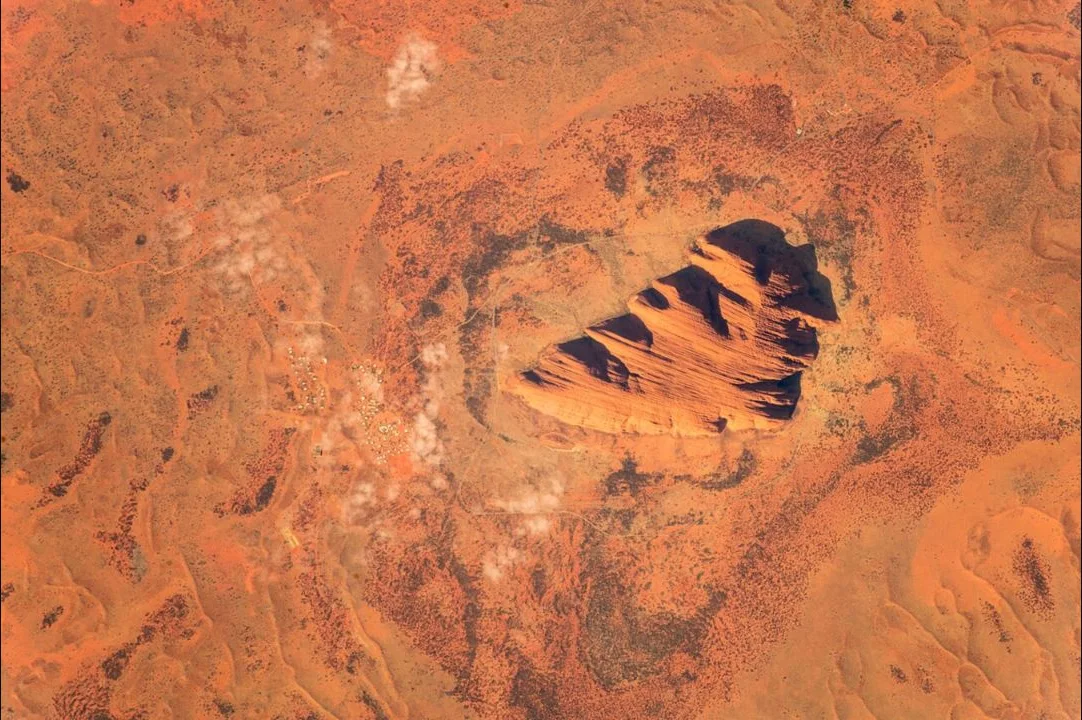
The red surface is a skin of rust
Uluṟu looks red enough to have been built from one solid block of crimson stone. Parks Australia's geology fact sheet gives a more surprising answer. The exposed flakes have a rusty colour because iron in the arkose reacts with oxygen. Fresh, less-weathered arkose is greyish.
This does not mean Uluṟu is hollow or neatly divided into a red shell and grey centre. Weathering works wherever rock is exposed to air and moisture, including cracks and newly opened surfaces. The useful distinction is between weathered material at the surface and fresher rock that has not undergone the same oxidation.
Before it was a monolith, it was mountain debris
Uluṟu is made of arkose, a coarse sandstone rich in feldspar. About 550 million years ago, mountains created during the Petermann Ranges Orogeny began eroding. With little land vegetation to hold the surface together, rain carried enormous volumes of sand and gravel away from the ranges.
That sediment accumulated in broad alluvial fans. The sand that would become Uluṟu contained abundant material from granite mountains and eventually hardened into arkose. The landmark therefore began as countless transported grains, not as magma rising in its present shape from deep underground.
Earth movements turned the layers almost upright
The sedimentary layers were originally deposited much closer to horizontal. During the Alice Springs Orogeny roughly 300 to 400 million years ago, folding and faulting raised the region. Parks Australia reports that Uluṟu's arkose layers were rotated nearly 90 degrees into their present steep orientation.
Erosion then removed surrounding material and left the resistant remnant exposed. Geoscience Australia describes Uluṟu as the surface expression of a much larger rock volume, while Parks Australia says the formation may extend as much as six kilometres below ground. The word may matters: the visible rock is a tip, but its exact buried geometry is not laid bare for inspection.
Light changes the view without changing the mineral in minutes
At sunrise, sunset, under cloud or after rain, the same surface can appear orange, deep red, brown or purple. The illumination and moisture change which wavelengths reach an observer and how strongly the surface reflects them. The visual transformation is real, but it is not rapid chemical recolouring of the entire rock.
Long-term weathering is slower and more physical. Moisture drives chemical decay in minerals, helping create the flaky surface, while rain runoff cuts channels, potholes and plunge pools. Wind-blown sand can affect rock near ground level, but Parks Australia says wind alone does not explain Uluṟu's larger sculpted forms.
A geological explanation is only one way of knowing the place
Uluṟu-Kata Tjuṯa National Park is Aṉangu land, leased to Parks Australia and managed jointly with Traditional Owners. It is recognised for cultural and natural values. In 2021, a World Heritage statement included Pitjantjatjara and Yankunytjatjara words from Aṉangu Elders, a first for such a statement.
Geology can test how arkose formed, tilted, weathered and rusted. It cannot replace Tjukurpa, the law, stories, relationships and obligations through which Aṉangu understand and care for Country. Holding both truths avoids a common mistake: treating an extraordinary living cultural landscape as if it were only an unusual object made of stone.
Sources and further reading
This article was written for Curiosity Desk. We do not copy other publishers or invent quotes. If a material error is found, we correct it openly.
Read the full standards →One answer should lead to a better question
Bring your curiosity to the group
Curious Minds is our public Facebook community for surprising science, strange history, Australian wildlife and everyday questions. No copied posts, no personal-friend invitations and no link dumping.
- Three self-contained discussion prompts each week
- Sourced answers and honest uncertainty
- Respectful conversation without spam