The fifth leg appears when the hopping stops
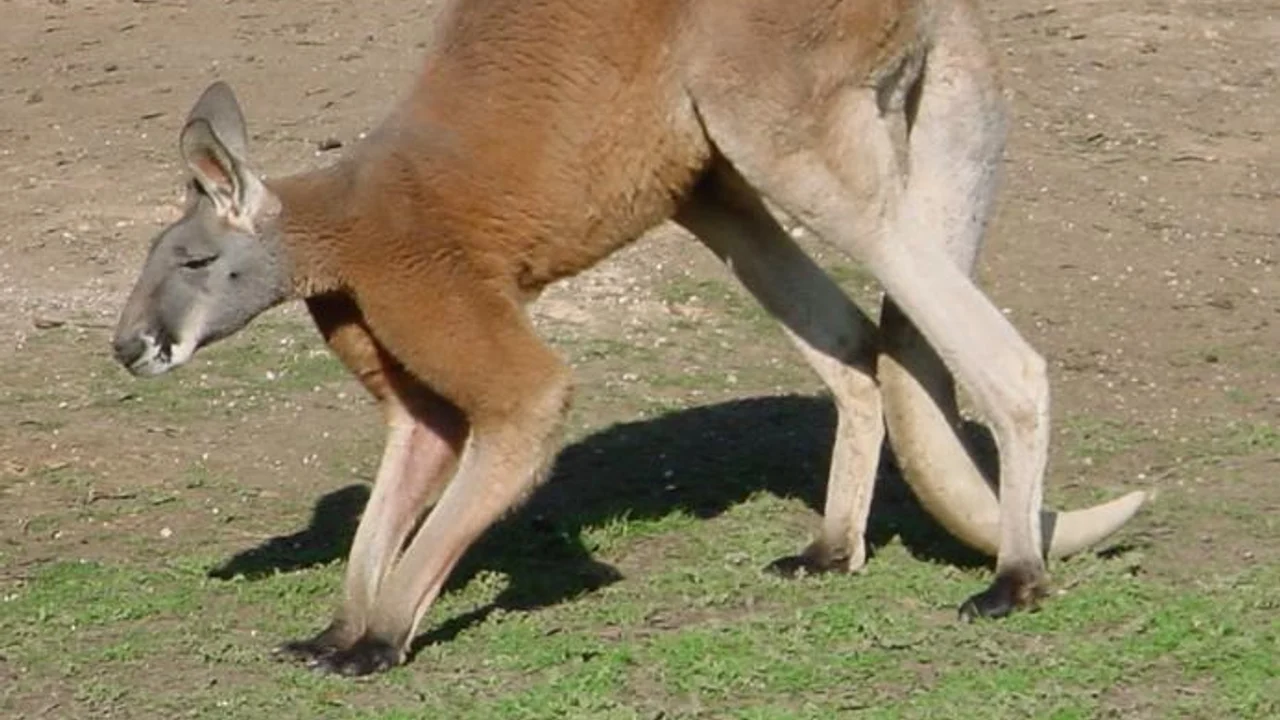
A red kangaroo grazing across short grass does not launch into a full hop for every step. At low speed it plants its forelimbs, braces the tail on the ground, swings both large hind feet forward and then moves its body over them. The sequence creates five points of contact across the stride, which is why the gait is called pentapedal locomotion.
For years the tail was often described as a support or counterbalance. That description fits a still image but misses the force being applied to the ground. The experiment used five trained red kangaroos crossing a force-measuring platform while the team calculated how each part of the body contributed to forward motion and mechanical work.
The tail pushes as hard as the four legs together
The measured tail force was not a minor assist. During pentapedal walking, the tail generated as much propulsive force as the forelimbs and hind limbs combined. It contributed less to average vertical support than the legs, but it became especially important while the huge hind feet were being repositioned.
This is the difference between a kickstand and an engine. A kickstand holds weight without driving a machine forward. The kangaroo tail pushes backward against the ground, and the ground reaction force moves the body ahead. In functional terms, the tail behaves like a powerful limb.
It performs real mechanical work
Force alone is only part of locomotion. The researchers also calculated mechanical power and found the tail performed substantial positive work, helping lift and accelerate the body. Per kilogram of body mass, the tail did about as much positive work as one human leg walking at the same speed.
The result is striking because tails are usually imagined as steering devices, display structures or passive balances. In the kangaroo, a thick mass of muscle has been recruited into the slow walking cycle. The animal is not merely resting on its tail between steps; it is using the tail to complete the step.
The same tail changes jobs at speed
During hopping, the tail is usually off the ground. It helps counter the movement of the legs and body, stabilises posture and can contribute to manoeuvring. When standing, it can brace the animal. During slow walking, it becomes the propulsive fifth contact. One structure performs different jobs as speed and posture change.
Calling it a fifth leg is therefore a functional comparison, not a claim that the tail contains the same bones and joints as a hind limb. Its anatomy is a tail; its role in this particular gait is leg-like. That careful distinction keeps the astonishing part intact without turning it into a biological myth.
Movement reveals what a photograph hides
A photograph of a standing kangaroo encourages one simple story: enormous hind legs, small arms and a tail for balance. Watch the animal move slowly and the body becomes a changing machine. The small forelimbs place the body, the hind feet swing together and the tail supplies the shove that joins the phases.
Australia is full of facts that deepen when the mechanism is added. A platypus closes familiar senses and reads the river with its bill. A wombat shapes cubes inside a flexible intestine. The best next click is not another disconnected fact; it is another example of anatomy doing something a still image never showed you.
Sources and further reading
This article was written for Curiosity Desk. We do not copy other publishers or invent quotes. If a material error is found, we correct it openly.
Read the full standards →One answer should lead to a better question
Bring your curiosity to the group
Curious Minds is our public Facebook community for surprising science, strange history, Australian wildlife and everyday questions. No copied posts, no personal-friend invitations and no link dumping.
- Three self-contained discussion prompts each week
- Sourced answers and honest uncertainty
- Respectful conversation without spam