The rainbow is a structure, not a stain
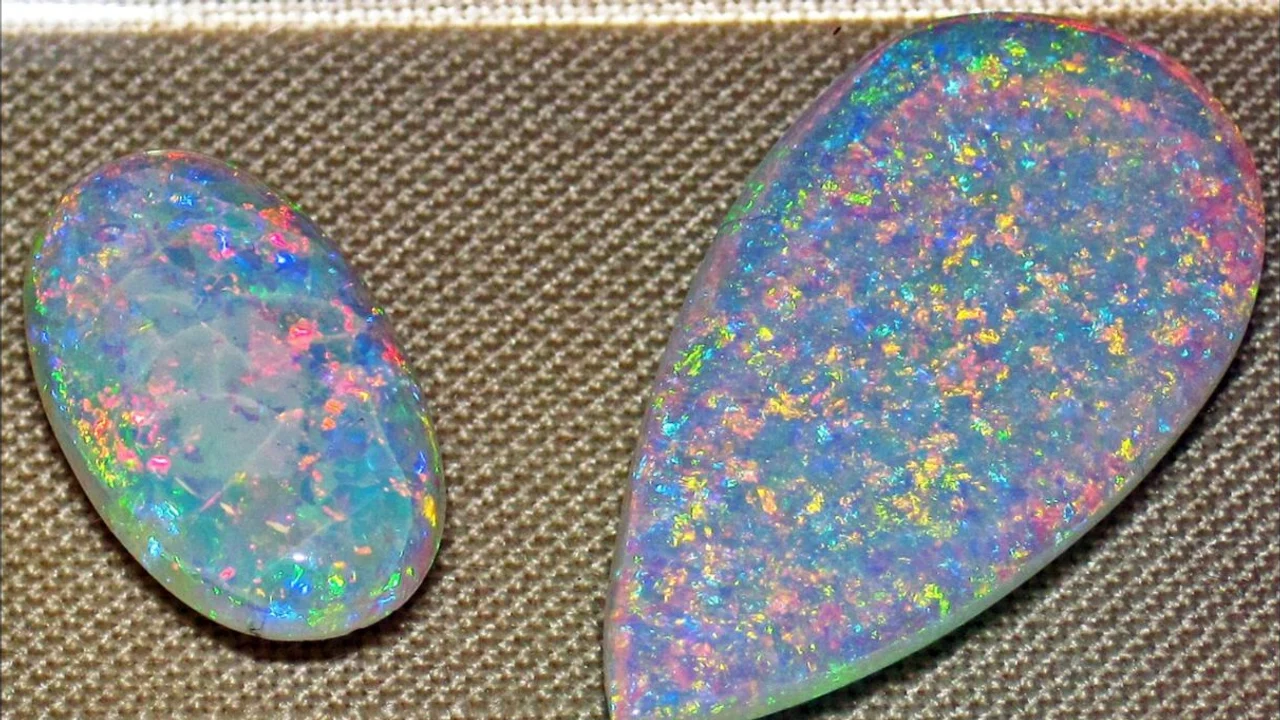
Tilt a good opal and a red spark may disappear while a green patch flares somewhere else. The colour can seem to float beneath the polished surface, yet the stone does not contain little pockets of red, blue and green dye. In precious opal, the display comes from the way a highly ordered microscopic structure interacts with ordinary white light. Gemologists call that changing spectral display play-of-colour.
Opal is hydrated silica, written approximately as SiO2 with water, and it is amorphous rather than a conventional crystal with atoms repeating in one fixed lattice. The Australian Museum reports that opal commonly contains about six to ten per cent water. The apparent contradiction is the first surprise: the material can lack a crystal structure at the atomic scale while still arranging its much larger silica particles into a regular three-dimensional pattern.
A hidden grid behaves like a photonic crystal
Electron microscopy shows that precious opal can contain silica particles packed into orderly layers, with water or silica-rich material occupying the spaces between them. A peer-reviewed study describes natural precious opal as a photonic crystal whose particles are typically about 150 to 400 nanometres across. That is close to the scale of visible wavelengths, so the spacing can redirect light instead of merely letting it pass through as a neutral glow.
Light reflected from successive planes in the array travels slightly different distances. At certain angles, waves of a particular wavelength reinforce one another while others partly cancel. Diffraction and interference therefore select colours from the incoming white light. The effect belongs to the whole repeating structure, not to any single silica sphere. Cracks, imperfect domains and changes in spacing help divide the display into the shifting patches, bars and pinpoints seen in different opals.
Turning the stone changes which colour reaches you
The path difference between reflected waves changes when the light, stone or viewer moves. A wavelength that was strongly reinforced in one position may no longer be favoured after a small tilt, while another wavelength becomes bright. That is why play-of-colour appears to move. The gem is not changing its ingredients in your hand; the viewing geometry is changing which part of the spectrum the internal pattern sends toward your eye.
Particle size and spacing influence the possible colours. Geoscience Australia notes that larger spheres can produce red, whereas smaller spheres tend to produce blue and green. Red play-of-colour is less common because it needs larger particles arranged with enough regularity to work across longer visible wavelengths. Size alone does not determine beauty or value, however. Order, orientation, pattern, brightness, body colour, fractures and the amount of precious material all affect the final appearance.
Most opal never makes a rainbow
Common opal, often called potch in Australian fields, has the same broad silica-and-water chemistry but does not show strong play-of-colour. Its particles may vary in size or lack the long-range order needed to act as an effective diffraction grating. Light then scatters without separating into clean, angle-dependent flashes. The Australian Museum says potch makes up most Australian opal, while precious opal forms only a small fraction of the material miners uncover.
Body colour is a different feature from play-of-colour. Iron compounds, carbonaceous material and other inclusions can make the background appear white, grey, brown or dark even before spectral flashes are considered. A black opal is therefore not a stone that produces only black light. It has a dark body tone that can make the moving spectral colours look especially vivid. Fire opal, meanwhile, is named for a yellow-to-orange body colour and may or may not show play-of-colour.
Australian weather left spaces where silica could settle
A widely used model begins with silica-bearing water moving through cracks and pore spaces in weathered sedimentary rocks. As conditions change and water is lost, silica gel can accumulate in seams, cavities, fossils and nodules before hardening into opal. The Australian Museum links major deposits to intensely weathered rocks of the Great Artesian Basin. Researchers still investigate why some fields produced ordered precious opal while so much nearby material became ordinary potch, so one simple evaporation story should not be treated as the complete recipe for every deposit.
Water remains part of the finished mineraloid, which helps explain why opal needs gentler care than many crystalline gems. The Australian Museum warns that sudden or extreme changes in temperature and humidity can contribute to cracking or crazing. That fragility makes the optical trick even stranger: an apparently solid stone carries water and a nanoscale architecture precise enough to sort white light, yet the display vanishes the moment those particles lose their remarkable order.
Sources and further reading
This article was written for Curiosity Desk. We do not copy other publishers or invent quotes. If a material error is found, we correct it openly.
Read the full standards →One answer should lead to a better question
Bring your curiosity to the group
Curious Minds is our public Facebook community for surprising science, strange history, Australian wildlife and everyday questions. No copied posts, no personal-friend invitations and no link dumping.
- Three self-contained discussion prompts each week
- Sourced answers and honest uncertainty
- Respectful conversation without spam