The panel above the stove is doing a real job
Cooking does not release only steam and smell. Frying, grilling, sautéing and food that begins to burn can create an airborne mixture of grease droplets, moisture, gases and fine particles. A rangehood tries to draw that rising plume through a grease filter before the air is exhausted outdoors or returned to the room.
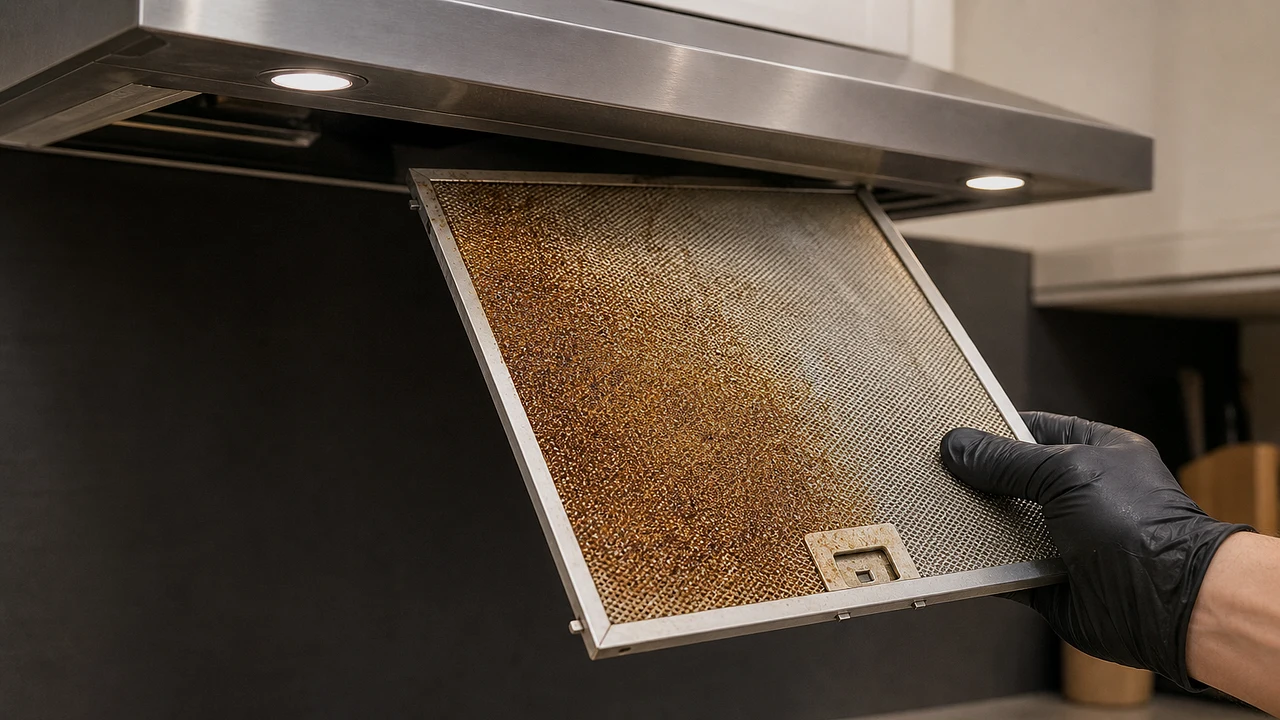
The reusable metal filter is a maze of mesh or baffles. Grease droplets collide with its surfaces and collect instead of continuing into the fan, duct or kitchen. That is why a neglected filter becomes sticky and brown. The deposit is evidence that the filter captured material, but it is also a maintenance load that eventually has to leave the appliance.
A saturated filter changes more than the smell
Miele's rangehood guidance says a heavily soiled grease filter hinders air extraction and increases soiling in the appliance and kitchen. Less effective extraction leaves more opportunity for greasy material to settle on splashbacks, cupboards, lights and the top of the refrigerator. Old deposits can also become a persistent odour source when the hood warms during later cooking.
A dirty filter is not the only reason a kitchen feels smoky. Hood shape, installation, fan setting, burner position, duct resistance and the cooking method all matter. Cleaning therefore restores a necessary part of the system; it does not turn a poorly designed or incorrectly installed hood into a perfect collector.
Cooking particles can travel beyond the kitchen
The US Environmental Protection Agency identifies cooking as an important indoor source of particulate matter. Burning food can create especially high particle levels, but ordinary cooking methods and fats also change how much is produced. Fine particles can remain suspended and move into adjoining living areas rather than forming a visible layer immediately.
The EPA recommends using a rangehood whenever cooking, preferably one that vents outdoors. Its 2026 guidance also advises keeping the hood on for 10 to 20 minutes after cooking and using rear burners where possible because the rising plume is often captured more effectively there. These actions reduce exposure; they do not make ventilation unnecessary once a filter is loaded with grease.
The hood cannot capture what never reaches it
Lawrence Berkeley National Laboratory measured enormous differences among residential hoods. In one laboratory study, pollutant capture ranged from below 15 per cent to above 98 per cent depending on the hood, airflow and burner position. Rear burners were usually captured better than front burners because many hoods did not fully cover the front of the cooktop.
Those results explain why airflow alone is not the whole story. A fan can move plenty of air while the cooking plume escapes around a shallow hood. Use a rear burner when practical, switch the hood on before smoke becomes visible and choose a fan setting strong enough for the cooking task. If noise makes everybody turn the hood off, installation or equipment advice may be more useful than simply buying the highest advertised airflow.
Ducted and recirculating hoods solve different parts of the problem
A ducted hood sends captured air outside. A recirculating hood passes air through filters and returns it to the kitchen. Both commonly use a grease filter, while recirculating models often add activated charcoal or another odour-control filter. The EPA says outdoor-venting hoods are the preferred choice for reducing cooking particles when installation is possible.
A charcoal filter can reduce some odours, but it is not a substitute for removing every particle, gas or water vapour outdoors. NSW Health advises using an externally exhausting hood or opening a window when gas cooking adds combustion pollutants. Do not assume that a recirculating fan removes carbon monoxide or makes a faulty gas appliance safe.
Metal and charcoal filters are not interchangeable
Many aluminium or stainless steel grease filters are designed to be removed and washed. Standard charcoal cartridges are commonly replaced rather than washed. Some newer long-life charcoal filters can be regenerated in an oven using a precise maker procedure. Appearance alone does not reliably tell you which kind is fitted.
Find the model number and parts diagram before putting anything in water. Bosch's general guidance says its metal grease filters can be washed while its standard active-carbon filters need replacement. Miele documents both disposable and reactivatable charcoal products for different models. Washing the wrong cartridge can destroy its odour-control material or create a wet component that should never return to the hood.
The calendar belongs to the model and the cooking
There is no trustworthy universal interval such as every Sunday or every six months. A home that fries daily loads a filter differently from one that boils pasta twice a week. Some hoods have operating-hour counters or filter warning lights. Their manuals may allow the interval to be adjusted to the type of cooking.
Manufacturer examples show the range rather than a rule. One Bosch manual recommends cleaning its grease filter every two months. A Miele manual tells owners to clean at regular intervals and treats an oversaturated filter as a fire hazard. Check earlier when suction seems weaker, the filter is visibly sticky, grease appears around the hood or odour remains after cooking.
Grease accumulation is a fire issue
Fire and Rescue NSW warns that grease and fat buildup in an oven, rangehood or grill can ignite. The ignition usually begins with unattended cooking or overheated oil, but stored grease gives a flame additional fuel and a path into the hood. Cleaning cannot replace the first rule: stay in the kitchen while frying or using high heat.
If oil in a pan ignites, turn off the heat only if it is safe and cover the pan with a lid. Never throw water on a fat or oil fire. Leave, close the door and call Triple Zero on 000 if the fire cannot be controlled immediately and safely. A dirty filter is maintenance evidence, not an invitation to test a fire blanket or extinguisher without training.
Make the appliance safe before touching the filter
Let the cooktop, lamps and hood cool. Turn the rangehood off and isolate power if the manual requires it. Protect the cooktop with a folded towel or board only after it is cold, because a metal filter can drop when its latch releases. Support the filter with one hand while operating the latch with the other.
Wear gloves if the frame has sharp edges or the grease is heavy. Photograph the filter orientation before removal and do one panel at a time if several look similar. Stop if the filter is wired, screwed into a sealed assembly or does not release using the documented method. Forcing it can bend the frame, damage the latch or drop it onto glass.
Clean a washable metal filter by its manual
Bosch's current model guidance gives a typical hand-cleaning sequence: soak the removed grease filter in hot soapy water, use a brush, rinse thoroughly and let it drain. The exact water temperature, cleaner and dwell time still belong to the product manual because filter metals, coatings and adhesives vary.
Use a soft brush that can reach the mesh without crushing it. Avoid caustic oven cleaner, chlorine bleach, abrasive powder and improvised solvent unless the manufacturer explicitly approves that product. Do not mix degreaser with another cleaner. More aggressive chemistry can discolour aluminium, damage a coating or leave residue in a part that sits directly above heat.
Dishwasher safe does not mean every dishwasher load
Some metal filters are dishwasher safe and others are not. The Bosch manual used for this article permits its filters in a dishwasher at no more than 70 degrees Celsius, placed loosely rather than squeezed. It also says heavily soiled filters should not be washed with utensils and notes that light discolouration does not affect function.
Treat that as one model's instruction, not a universal setting. Grease can transfer to dishes or the dishwasher interior, aluminium may darken and a crowded rack can distort the frame. If the manual is missing, the safer step is to obtain it from the manufacturer rather than infer compatibility from a social-media demonstration.
Dry and reinstall before testing the fan
Rinse away detergent where directed and allow the filter to dry completely. Inspect the frame for bends, torn mesh and a damaged latch. A gap around a warped panel lets air bypass part of the filtering surface. Replace a damaged filter with the part specified for the model rather than trimming generic mesh to fit.
Reinstall it in the original orientation and confirm every latch is engaged before removing the cooktop protection. Restore power, run the fan and listen for rattling. A new vibration can mean the panel is not seated correctly. Do not cook beneath a loose filter while hoping airflow will hold it in place.
Clean what you can reach without entering the machine
With the filter removed and power isolated as directed, the manual may allow the accessible housing to be wiped with a soft cloth and mild soapy water. Prevent liquid from entering the motor, electrical controls, lights and duct. Stainless steel, black stainless, painted panels and control labels can require different products.
Domestic filter cleaning is not the same as cleaning a grease-loaded duct, fan or inaccessible cavity. Dripping residue, a hot electrical smell, a fan that slows or stops, grease beyond the removable filter, unusual noise or external duct damage justifies qualified appliance or ventilation service. Renters should report a fixed hood that does not work or vent as expected instead of dismantling building services.
The one-minute rangehood check
With the appliance cold, look up. Is the filter sticky, dark, unevenly seated or showing a warning light? Does the model have washable metal, disposable charcoal or reactivatable charcoal filters? Is the hood ducted outdoors or recirculating? Does its manual specify a cleaning or replacement interval that has already passed?
Then change the cooking routine as well as the filter. Use the hood for every cooking session, prefer rear burners when practical, keep it running after the heat stops and clean before the grease becomes saturated. The filter is a small removable part, but what passes around or through it can settle across the whole kitchen.
Sources and further reading
- US EPA: Cooking as a source of indoor particulate matter and rangehood-use guidance ↗
- US EPA: 2026 strategies for cooking ventilation, rear burners and grease-filter cleaning ↗
- Fire and Rescue NSW: Cooking fire safety and rangehood grease buildup ↗
- NSW Health: Gas cooking pollutants and externally exhausting rangehood advice ↗
- Bosch: Current extractor-hood manual with filter cleaning and dishwasher limits ↗
- Bosch: Grease-filter hand cleaning and charcoal-filter replacement guidance ↗
- Miele Australia: Grease-filter saturation, extraction and filter maintenance guidance ↗
- Miele: Disposable and reactivatable charcoal filter differences ↗
- Lawrence Berkeley National Laboratory: Performance assessment of residential rangehoods ↗
- Lawrence Berkeley National Laboratory: Installed cooking-exhaust performance and capture efficiency ↗
This article was written for Curiosity Desk. We do not copy other publishers or invent quotes. If a material error is found, we correct it openly.
Read the full standards →One answer should lead to a better question
Bring your curiosity to the group
Curious Minds is our public Facebook community for surprising science, strange history, Australian wildlife and everyday questions. No copied posts, no personal-friend invitations and no link dumping.
- Three self-contained discussion prompts each week
- Sourced answers and honest uncertainty
- Respectful conversation without spam