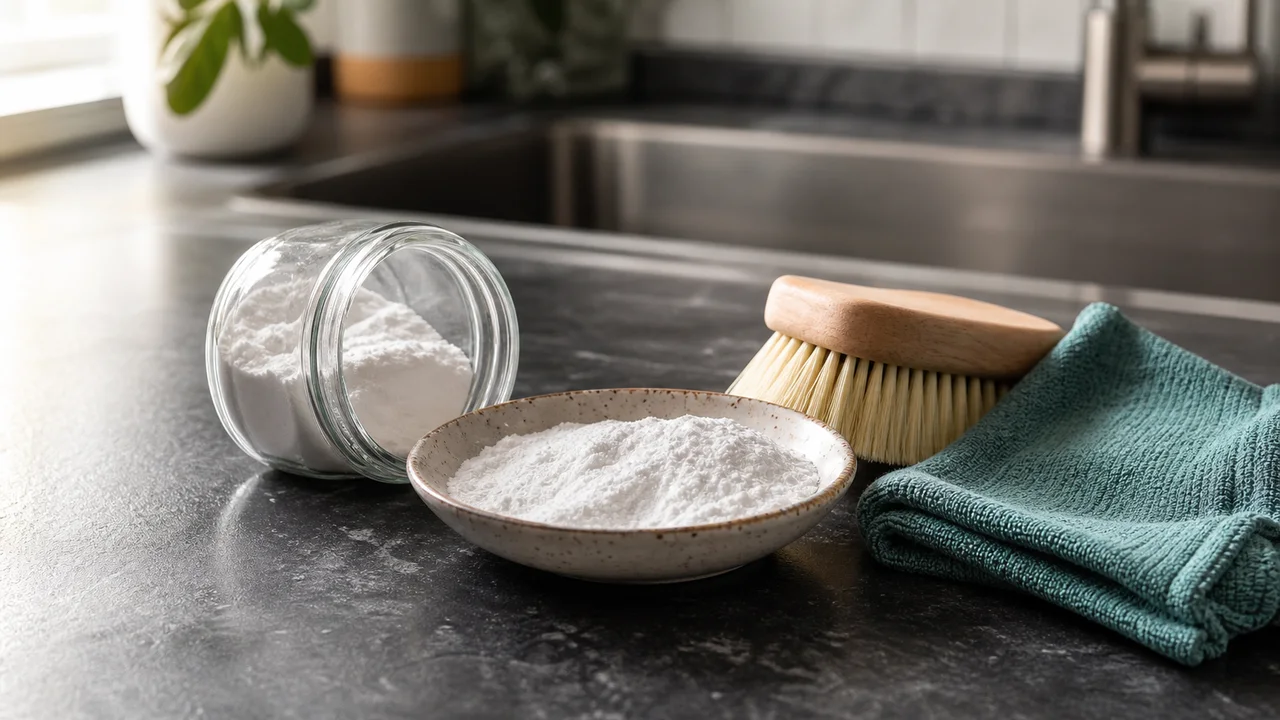
One white powder brings two modest cleaning tools
Baking soda is sodium bicarbonate, NaHCO3. In a cleaning job it can contribute mild alkalinity when dissolved and fine solid particles when rubbed. Those are useful properties, but they are not a universal cleaning system. The powder contains no built-in instruction telling it the difference between baked food, limescale, a delicate coating, a virus or a musty carpet.
That is why lists of one hundred baking-soda uses are a poor substitute for diagnosis. First identify the soil, then the surface and finally the level of hygiene required. A small paste may help with a compatible hard surface and stubborn residue. The same paste may leave a haze, scratch a finish or give false confidence where detergent or a tested disinfectant was needed.
The pH number explains why it is mild, not why it is magic
The National Library of Medicine's PubChem record gives a pH of about 8.3 for a freshly prepared 0.1 molar solution. Australia's drinking-water guidance reports about 8.4 for a ten-gram-per-litre solution. Seven is neutral, so dissolved baking soda is alkaline, but far less alkaline than many heavy-duty degreasers or sodium carbonate solutions.
Mild alkalinity can help change or loosen some acidic food residues and oily films. It does not make sodium bicarbonate a surfactant. Detergents contain molecules that help water spread across a surface and carry oily soil away. For ordinary kitchen grease, warm water and an appropriate detergent often do the main work more reliably than a bowl of bicarbonate paste.
The gritty part may be doing more work than the alkaline part
A damp paste holds fine crystals against a mark while the cloth or brush supplies movement. That physical action can remove residue from durable glazed ceramic, some enamel and other manufacturer-approved hard surfaces. Time and a soft tool usually matter more than pressing as hard as possible.
Mild is a comparison, not a guarantee. Any loose particle can behave as an abrasive when it is trapped beneath pressure, and the risk depends on particle shape, the surface finish and the force used. A glossy coating, soft plastic, screen, polished metal or sealed surface can show damage before a sink or tile does. Test a hidden spot and inspect it under good light before treating the visible area.
A paste can help a spot without becoming an all-purpose cleaner
Use the smallest useful experiment. Remove loose crumbs, wash away easy soil, then place a small amount of paste only on the remaining mark. Let moisture soften the residue briefly, use a soft cloth or brush, rinse and dry. If the mark lifts without scratching or leaving a film, repeat gently rather than increasing pressure immediately.
This is a spot-treatment method, not proof that the powder belongs on the whole appliance. Self-cleaning oven liners, induction and ceramic cooktops, non-stick coatings, grout sealers, composite benchtops and appliance finishes can have specific care rules. The maker's instructions outrank a viral recipe because they describe the actual material in front of you.
Odour control works only when the chemistry matches the smell
Sodium bicarbonate can react with acids, so it may reduce an acidic odour compound that reaches the powder. That narrow mechanism is often expanded into the claim that an open bowl automatically absorbs every smell in a room. Odours come from many different volatile chemicals, and a small dry surface cannot remove an ongoing source that is trapped in porous material or continually releasing gas.
Clean the source first. Remove spoiled food, wash the bin, extract a spill and dry damp material. Do not use fragrance or powder to disguise mould, sewage, smoke damage, gas or an electrical smell. If bicarbonate is tried after cleaning, treat any improvement as a result for that particular situation, not evidence that it neutralises all odours.
The famous fizz proves a reaction, not superior cleaning
Vinegar supplies acetic acid and baking soda supplies bicarbonate. The American Chemical Society shows that the reaction produces sodium acetate, water and carbon dioxide. The bubbles are carbon dioxide escaping. They prove that reactants are being consumed, not that invisible dirt or microbes are being destroyed.
During the first moments, moving bubbles can disturb loose material in a cup or open drain. Chemically, however, the acid and alkali are neutralising each other. The remaining liquid may be closer to a dilute sodium-acetate solution than to either useful starting condition. If an acid is appropriate for mineral scale, or mild alkali is appropriate for a food residue, combining them can spend the property you wanted.
Never turn a fizz demonstration into a sealed pressure test
Carbon dioxide needs somewhere to go. Do not combine acid and bicarbonate in a sealed bottle, capped sprayer or blocked container. Gas accumulation can increase pressure and force liquid or a closure outward. Keep any educational reaction open, small and away from eyes, and do not shake it.
A drain may already contain bleach, acid, caustic drain opener or another product that cannot be identified by looking. Do not add a homemade mixture on top. The US Environmental Protection Agency advises never mixing cleaning products unless the label specifically directs it. Stop, ventilate and follow the existing product's instructions or obtain professional help for a persistent blockage.
Looking clean and being disinfected are different claims
Cleaning removes dirt, organic matter and many germs through water, detergent and physical action. Disinfecting uses a product tested to inactivate specified microorganisms under stated conditions. The US Centers for Disease Control and Prevention says ordinary cleaning is enough in many homes, while disinfection becomes more relevant when someone is sick or especially vulnerable.
A spoonful of baking soda has no organism claim, dilution, contact time or tested surface directions. Australia's Therapeutic Goods Administration requires household disinfectants and their microorganism claims to meet defined standards. National health guidance for education and care services specifically says not to substitute vinegar or bicarbonate of soda for labelled cleaning products because they are not as effective against germs.
When disinfection is needed, the label is the method
Clean visible soil first unless the product label says it combines cleaning and disinfection. Then use a disinfectant approved for that surface and purpose. Apply the stated dilution, keep the surface wet for the complete contact time, provide ventilation, wear any required protection and follow directions for rinsing food-contact surfaces.
More chemical is not automatically safer or more effective. Do not add bicarbonate, vinegar, fragrance, detergent or another cleaner to a disinfectant unless its label instructs you to do so. Mixing can change the active ingredient, create irritating or dangerous vapours, damage the surface or make the tested contact-time claim meaningless.
Natural stone exposes the problem with universal surface lists
The Natural Stone Institute recommends a neutral cleaner, stone soap or mild dishwashing detergent for routine natural-stone care and warns that scouring powders can scratch some stones. It also notes that acids such as vinegar can etch calcareous stone. Putting vinegar and baking soda together therefore does not create a universally safe marble cleaner; it combines an abrasive powder with an acid before the neutralisation is complete.
Stone is only one example. Painted finishes, acrylic baths, stainless-steel grain, appliance coatings, laminate, sealed timber and grout all vary. Check the supplier's care guide, start with the least aggressive method and use a soft tool. A successful test on a ceramic plate does not authorise the same paste on every pale, hard-looking surface.
Residue can become the next cleaning problem
Sodium bicarbonate dissolves in water, but a thick paste can dry into white crystals in joints, texture, fabric or the edge of a fitting. On a dark surface the residue may look like damage or create streaks. Repeated dry powder can also become airborne or remain where children and pets can reach it.
Use less than the dramatic photographs suggest. Lift excess paste with a damp cloth, rinse with clean water when the surface allows it and dry completely. Avoid flooding seams, electronics or porous material. If a large amount has been scattered, collect it without raising dust and follow the appliance or flooring maker's guidance before vacuuming fine powder through a machine that may not be designed for it.
Baking soda, baking powder and washing soda are not interchangeable
Baking soda is sodium bicarbonate. Baking powder contains bicarbonate plus one or more dry acids and other ingredients so it can release gas during baking. Washing soda is sodium carbonate, a different and more strongly alkaline chemical used in some detergents and degreasers. A recipe that names one does not automatically work with another.
PubChem lists sodium carbonate separately and identifies it with names including soda ash. Sodium bicarbonate can also convert toward sodium carbonate when strongly heated. Do not heat a homemade cleaning powder to make it stronger, and do not transfer any white powder into an unlabelled container. Keep the original label because the name, hazards and first-aid directions matter when products look alike.
Use a six-question check before reaching for the box
Ask: what is the soil? What is the surface? Does the manufacturer allow mild abrasive cleaning? Would detergent and warm water remove it first? Is disinfection actually required? Can the residue be rinsed away? If any answer is unknown, test a safer method or find the care guide before spreading powder across the area.
Baking soda earns a useful but limited place in the cleaning cupboard. It can provide mild alkalinity, local scrubbing and acid neutralisation in the right job. It cannot diagnose the stain, protect a delicate finish, replace detergent molecules, prove disinfection or turn two reacting pantry ingredients into a universally better cleaner. The interesting truth is smaller than the internet myth and far more useful.
Sources and further reading
- PubChem: Sodium bicarbonate identity, solution pH and physical properties ↗
- Australian Drinking Water Guidelines: Sodium bicarbonate chemistry and acid reaction ↗
- American Chemical Society: Products of the baking soda and vinegar reaction ↗
- CDC: Cleaning, sanitising and disinfecting in the home ↗
- Therapeutic Goods Administration: Regulation of cleaners and disinfectants in Australia ↗
- Therapeutic Goods Administration: Appropriate use, contact time and surface compatibility ↗
- NHMRC: Cleaning-product requirements in education and care services ↗
- Natural Stone Institute: Care, cleaning and abrasive risks for natural stone ↗
- US EPA: Surface compatibility and why cleaning products should not be mixed ↗
- New Mexico State University: Cleaning roles of mild alkalis and detergents ↗
- PubChem: Sodium carbonate is a separate, more strongly alkaline cleaning chemical ↗
This article was written for Curiosity Desk. We do not copy other publishers or invent quotes. If a material error is found, we correct it openly.
Read the full standards →One answer should lead to a better question
Bring your curiosity to the group
Curious Minds is our public Facebook community for surprising science, strange history, Australian wildlife and everyday questions. No copied posts, no personal-friend invitations and no link dumping.
- Three self-contained discussion prompts each week
- Sourced answers and honest uncertainty
- Respectful conversation without spam