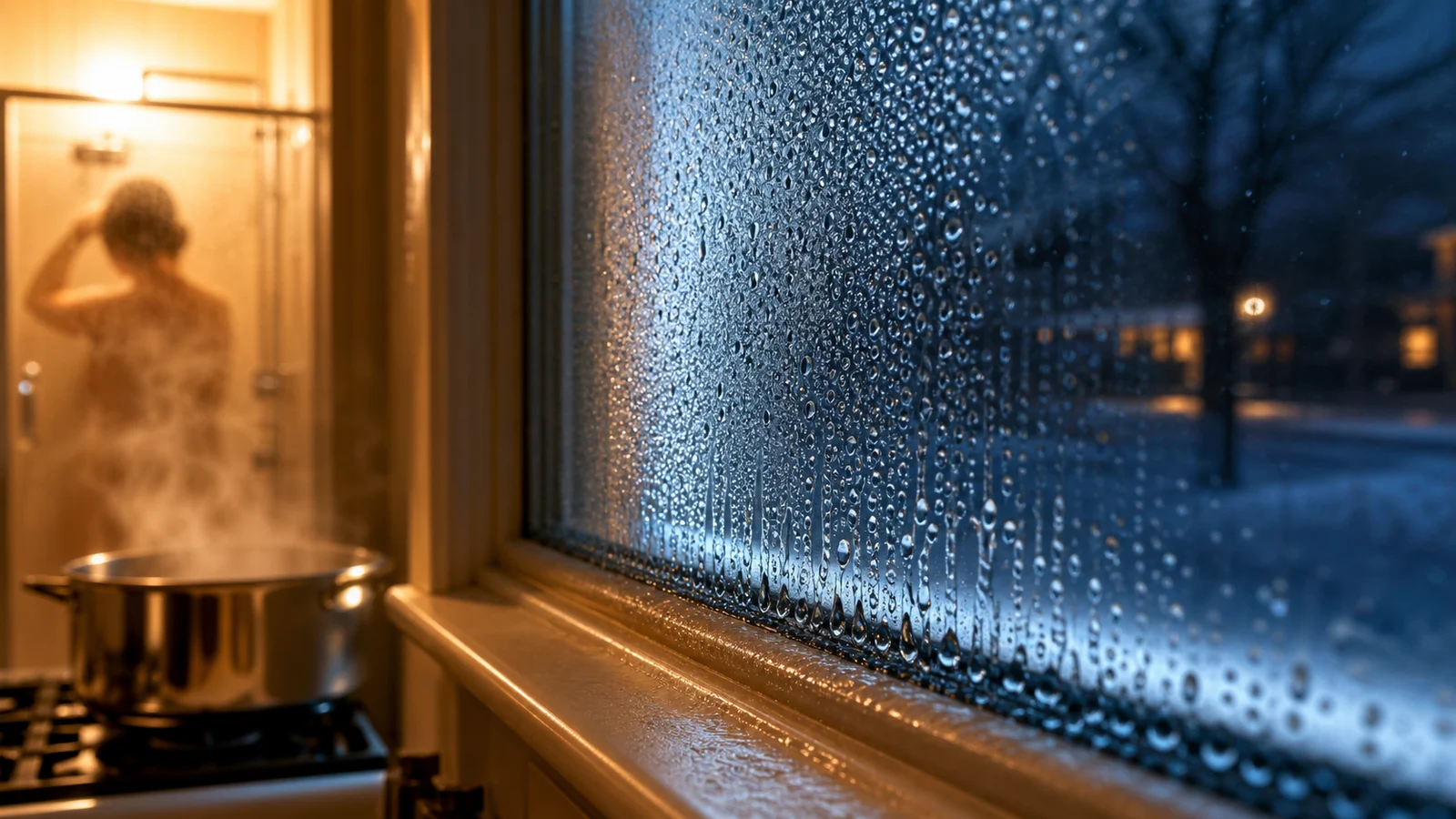
Two conditions must meet
Winter condensation in one minute
- Water source
- Moisture already present in indoor air
- Trigger
- A surface below the air's dew point
- Common sources
- Breathing, showers, cooking, washing and indoor drying
- Common cold surfaces
- Glass, frames, walls and thermal bridges
- Immediate step
- Dry repeatedly wet glass, frames and sills
- Longer-term approach
- Control moisture and improve cold surfaces
- Hidden risk
- Condensation can also form inside walls, roofs and floors
The droplets need moisture in the indoor air and a surface cold enough to cool that air below its dew point. Removing only one symptom may leave the cause unchanged.
The water was already in the room
Indoor air contains invisible water vapour. Warm air can hold more vapour than cold air, so when warm humid indoor air touches cold glass, the thin layer beside the surface cools sharply.
If that layer reaches its dew point, some vapour changes into liquid droplets. The glass appears to be making water, but it is revealing moisture that was already present in the indoor air.
Winter creates the temperature difference
A cold outdoor night lowers the inside surface temperature of the glazing and frame. Single glazing, metal frames, weak insulation and uncovered windows can create especially cold surfaces.
The warmer and more humid the room is relative to the glass, the easier it becomes to cross the dew point. That is why droplets often appear overnight or early in the morning when the window has been cold for hours.
Dew point changes with temperature and humidity
Dew point is not one fixed household temperature. It rises as indoor air becomes more humid, which means a surface does not have to be extremely cold before droplets can appear.
Your Home gives an example: air at 20 degrees Celsius and 80 percent relative humidity has a dew point of about 17 degrees. If a window surface falls below that temperature, the air touching it can release liquid even though the room itself still feels warm.
Everyday activities supply the moisture
Breathing, showering, cooking, washing and drying clothes all add water vapour indoors. Your Home identifies these ordinary activities as important sources, especially when a tightly closed winter house has limited effective ventilation.
A busy household can therefore see much more condensation than a lightly occupied one in the same building. The pattern may also be concentrated near bedrooms, bathrooms, kitchens and indoor drying racks.
Surface and hidden condensation are different warnings
Droplets on a window are surface condensation and are easy to see. Interstitial condensation forms inside a wall, ceiling, roof or floor when moisture reaches a cold layer within the construction.
Hidden condensation can wet insulation or building materials before a household sees an obvious drip. Persistent musty smells, staining, peeling finishes, damp patches or recurring mould require investigation rather than assuming that wiping the nearest window has solved the problem.
Ventilation and insulation solve different parts
Exhausting steam from bathrooms, kitchens and laundries directly outdoors reduces the moisture available to condense. Short, purposeful ventilation can help when outdoor conditions allow, rather than leaving a moisture source trapped inside.
Better glazing, insulation and well-designed window coverings can raise the interior surface temperature. These building improvements reduce the chance that room air will be cooled below its dew point at the surface.
Window frames can be the coldest thermal bridge
Condensation may begin around the frame even when most of the glass remains clear. Aluminium conducts heat readily, so an unbroken metal frame can become a colder interior surface than timber, uPVC or a properly thermally broken frame.
That pattern is useful evidence, but it does not automatically mean the whole window must be replaced. Check indoor moisture, seals, glazing, coverings and frame condition together before comparing larger building upgrades.
Use a simple diagnostic order
First, note where and when the water appears. Next, identify nearby moisture events such as showers, cooking or drying clothes. Confirm that designed exhaust systems discharge outdoors and operate while the moisture is being created.
Then dry affected surfaces and observe whether a single change alters the pattern over several comparable cold days. If the same area remains wet despite moisture control, the surface temperature, insulation, glazing or hidden construction may need professional assessment.
Avoid fixes that hide the evidence
Painting over staining, repeatedly wiping mould without finding the moisture source or sealing a required vent can disguise the symptom while leaving the wetting process in place. Unflued combustion heaters can also add indoor moisture and require careful safety consideration.
A dehumidifier may remove water from room air when correctly sized and used, but it cannot repair missing insulation, a leak or an unsafe ventilation system. Match the response to the cause and seek qualified advice when building fabric or health concerns are involved.
Do not ignore repeated wetting
Wipe persistent liquid from glass, frames and sills so it does not repeatedly soak paint, timber or nearby finishes. Then identify both the likely moisture source and the cold surface instead of treating droplets as an isolated cleaning problem.
Condensation can also occur inside walls or roofs where it is harder to see. Persistent dampness, mould, staining or building damage deserves advice from an appropriately qualified professional rather than a cosmetic cover-up.
Sources and further reading
This article was written for Curiosity Desk. We do not copy other publishers or invent quotes. If a material error is found, we correct it openly.
Read the full standards →One answer should lead to a better question
Bring your curiosity to the group
Curious Minds is our public Facebook community for surprising science, strange history, Australian wildlife and everyday questions. No copied posts, no personal-friend invitations and no link dumping.
- Three self-contained discussion prompts each week
- Sourced answers and honest uncertainty
- Respectful conversation without spam