The first instinct can make the wet area larger
A fresh drink spill creates an urgent-looking patch, so rubbing feels like action. It also moves the cloth sideways through the pile. Shaw Floors warns that abrasive rubbing or scrubbing can fray carpet fibres, while the Carpet and Rug Institute tells owners to work gently from the spill's edges toward the centre to reduce spreading.
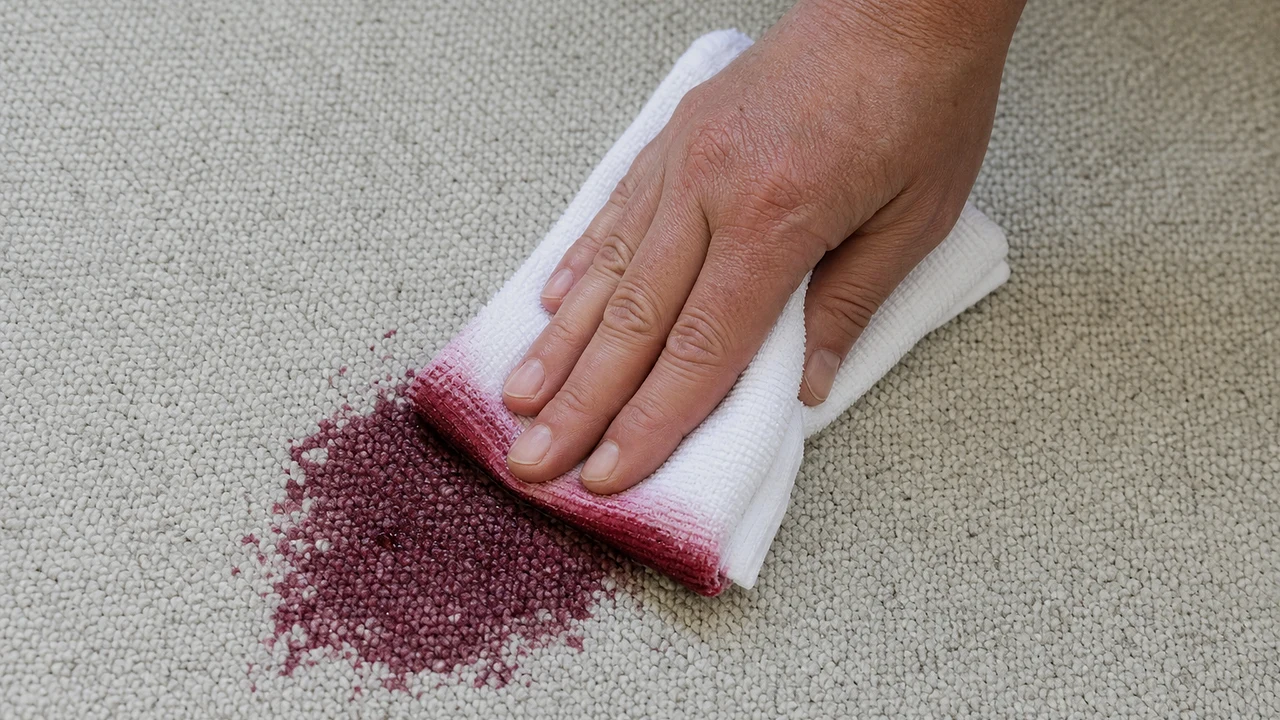
Blotting changes the movement. A dry absorbent cloth touches the liquid, pressure holds the two materials together and the cloth takes up moisture. You then lift rather than drag, expose a clean part of the cloth and repeat. The goal in the first minute is not to solve every type of stain. It is to remove as much free liquid as possible while keeping the affected area contained.
Begin with what can be lifted without smearing
Pick up solid pieces first. Use a spoon or a blunt scraper to lift food, waxy material or thick residue without pushing it into the pile. Work carefully from the outside. A vacuum is appropriate for dry loose material, but not for a wet spill unless the machine is specifically designed and approved for liquid extraction.
Place a folded white absorbent cloth or plain white paper towel over the liquid and press straight down. Body weight is not required. Firm hand pressure with repeated fresh cloths gives you more control than standing on a towel, twisting the pile or grinding the spill into the backing.
Press, lift, rotate and repeat
Hold the cloth in place long enough to see transfer, then lift it. Rotate or replace the cloth so a dry clean section meets the carpet on the next press. Continue while the spill is still transferring. This makes progress visible and stops a saturated towel from putting liquid back down.
Start at the outside boundary and move toward the centre. That direction is recommended by both the Carpet and Rug Institute and WoolSafe because it helps keep the spot from expanding. Do not saw the cloth back and forth. If the carpet pile has become flattened, leave grooming until the liquid has been removed and the care instructions say it is safe.
A white cloth is a simple diagnostic tool
A clean white cloth does not add its own dye to the job. It also lets you see whether the red, brown or oily material on the cloth is still coming from the spill. If the carpet's own colour appears to be transferring, stop adding product and seek advice from the carpet supplier or a qualified cleaner.
Avoid printed paper towels and coloured rags when you cannot confirm that their dyes are stable. Keep several cloths ready so there is no temptation to continue with a saturated one. A clean tool is part of the treatment, not an optional finishing detail.
Identify the carpet before choosing the chemistry
Carpets and rugs can be made from nylon, polyester, polypropylene, wool, plant fibres or blends, with different dyes, backings and protective treatments. Two beige carpets can therefore react differently to the same bottle. Look for the purchase record, fibre label, warranty and maker's maintenance guide before applying a home remedy.
Fine and plant-based fibres need particular caution. WoolSafe says sisal, seagrass, coir, viscose, Tencel and bamboo can be sensitive to moisture and warns against spraying water-based spot removers directly onto them. Valuable handmade rugs, old dyes and unknown fibres are poor places to experiment.
Match the treatment to the spill
Oil, protein, tannin, dye, paint, rust and chewing gum do not share one removal process. Heat can make some protein stains harder to remove. A solvent suitable for one oily spot may damage a backing or finish if it is poured directly onto the carpet. Search the carpet maker's spill guide for the exact substance and follow the product label.
This is why a universal vinegar, detergent or peroxide recipe is unreliable. A treatment that appears dramatic in a short video may have been used on a different fibre, colour system and backing. The safest useful instruction is specific: this spill, this carpet, this approved product and this amount.
Test the product where failure will not become the headline
The Carpet and Rug Institute recommends pretesting a spot solution in an inconspicuous area for colour transfer or damage. Use the same concentration, contact time and drying conditions you plan to use on the visible spot. Check the test after it has dried, because a wet carpet can temporarily look darker even when no dye has changed.
A successful patch test reduces uncertainty but does not overrule the maker's care guide. Stop if the test produces colour loss, a sticky feel, pile distortion, bleaching or a visible ring. Moving to a stronger concentration after a failed test is not a rescue plan.
Use a small controlled amount, not a second spill
Apply the approved treatment exactly as its label and carpet guide direct. Some methods put solution onto a cloth rather than directly onto the carpet. That makes the amount and boundary easier to control and reduces the chance of saturating the backing. WoolSafe recommends small quantities and says two or three light applications are more effective than one drastic application.
More liquid can carry dissolved material into a larger area or into the backing and pad. It can also leave the surface feeling dry while hidden layers remain damp. If the spot keeps returning after drying, material may be moving back toward the surface as moisture evaporates, or residue may still be present. Repeated flooding is unlikely to solve that diagnosis.
Remove the cleaner as carefully as the stain
After a compatible treatment removes the spill, follow its directions for rinsing or extraction. The Carpet and Rug Institute advises blotting with clear water after spot removal to take out remaining product. Cleaning residue can make an area resoil quickly, creating a grey patch that is mistaken for the original stain returning.
Rinsing does not mean pouring a jug over the carpet. Use the controlled quantity and method in the care guide, then blot or extract it with equipment approved for the carpet. Keep moving to dry white cloth until transfer and excess moisture are reduced.
Dry the carpet, backing and pad
A small surface spill still deserves ventilation and prompt drying. For larger clean-water events, the US Environmental Protection Agency says carpet, backing and padding must all be dried, not just the pile you can touch. Its guidance aims to dry water-damaged materials within 24 to 48 hours because persistent moisture raises the risk of mould growth.
The EPA suggests water extraction, lower humidity and increased air movement for clean-water damage. That is different from aiming a fan at sewage or unknown contaminated water. If liquid has reached the pad, the area smells musty, remains cool and damp, or is too large to dry promptly, a water-restoration or carpet professional should assess the hidden layers.
Contaminated water is not an ordinary spot-cleaning job
Water from sewage, flooding, a backed-up drain or an unknown chemical source can contain biological or chemical hazards. The EPA says contaminated-water situations require appropriate personal protective equipment and containment, and recommends an experienced professional when the people involved do not have that expertise.
Do not use a household towel and routine stain recipe on a contaminated area, and do not run a fan until the source is known to be clean or sanitary. Keep children and pets away. If a chemical has been spilled, use the product's safety instructions and contact the relevant poisons service or emergency service rather than trying to neutralise it with another cleaner.
Never mix products to chase the last shadow
One product may leave enough chemical behind to react with the next. Do not combine bleach, ammonia, acids, solvents, detergents or stain removers unless the carpet and product manufacturers explicitly provide that sequence. Keep products in their original labelled containers and use separate clean tools.
If cleaners are accidentally mixed and there is an irritating smell, coughing, chest tightness or breathing difficulty, move away to fresh air without leaning over the spill. Call Triple Zero on 000 for severe breathing trouble or collapse. In Australia, the Poisons Information Centre provides 24-hour advice on 13 11 26.
Know when another attempt costs more than a professional
Call a qualified carpet or rug cleaner for a large spill, repeated colour transfer, an unknown fibre, a valuable rug, persistent odour, visible mould, a stain that reappears, or liquid that has entered the padding. Tell the cleaner what was spilled and every product already used. That history changes what treatment remains safe.
Permanent dye loss, bleach damage, pile abrasion and some set stains are damage rather than removable soil. A trustworthy professional may explain that repair, recolouring or replacement is more realistic than another chemical. That is useful information, even when it is not the instant transformation a social post promised.
The thirty-second spill plan
Lift solids. Press a clean white absorbent cloth onto the liquid. Lift, rotate and repeat. Work from the edge toward the centre. Identify the carpet and spill. Use only the approved treatment in a tested, controlled amount. Remove residue as directed and dry every layer that became wet.
Stop when colour transfers from the carpet, the area is contaminated, the pad is wet, the fibre is unknown or the approved method is not improving the mark. The most important difference between blotting and scrubbing is control. One keeps the spill within a measured process. The other can turn a small accident into a larger area of wet, damaged pile.
Sources and further reading
- Carpet and Rug Institute: Spot Solver method, white cloth, pretesting and edge-to-centre blotting ↗
- Carpet and Rug Institute: Home carpet cleaning and removal of cleaning-product residue ↗
- Shaw Floors: Carpet care, immediate blotting and fibre damage from abrasive scrubbing ↗
- Shaw Floors: Example of an outside-in carpet treatment and warning not to rub or scrub ↗
- WoolSafe: Spot removal for wool, fine fibres and moisture-sensitive plant-based fibres ↗
- US EPA: Water-damage response for carpet, backing, clean water and contaminated water ↗
- US EPA: Why carpet backing and padding must also be dried ↗
- Healthdirect: First aid after inhaling cleaning fumes ↗
- Queensland Poisons Information Centre: 24-hour Australian poisons advice ↗
This article was written for Curiosity Desk. We do not copy other publishers or invent quotes. If a material error is found, we correct it openly.
Read the full standards →One answer should lead to a better question
Bring your curiosity to the group
Curious Minds is our public Facebook community for surprising science, strange history, Australian wildlife and everyday questions. No copied posts, no personal-friend invitations and no link dumping.
- Three self-contained discussion prompts each week
- Sourced answers and honest uncertainty
- Respectful conversation without spam