Higher clocks gain an almost impossibly small amount of time
General relativity says gravity and time are linked. Closer to a massive body, where gravitational potential is lower, a clock accumulates slightly less time than an otherwise identical clock higher up. The difference is far too small to notice in daily life, yet navigation systems must account for relativistic clock shifts to remain accurate.
Height on Earth therefore has a time signature. Raising a clock does not make its mechanism run faster through heat or motion; it changes the spacetime path the clock follows. Compare stable enough clocks and their frequency difference becomes a measurement of gravitational potential, which is related to height but also to the distribution of mass.
An optical clock uses atoms as identical frequency references
An atomic clock does not watch atoms orbit like tiny planets. It uses electromagnetic radiation tuned to a transition between precisely defined atomic energy states. In an optical clock that transition has a very high frequency, allowing the clock to divide time into extremely fine, repeatable intervals when lasers and environmental effects are controlled.
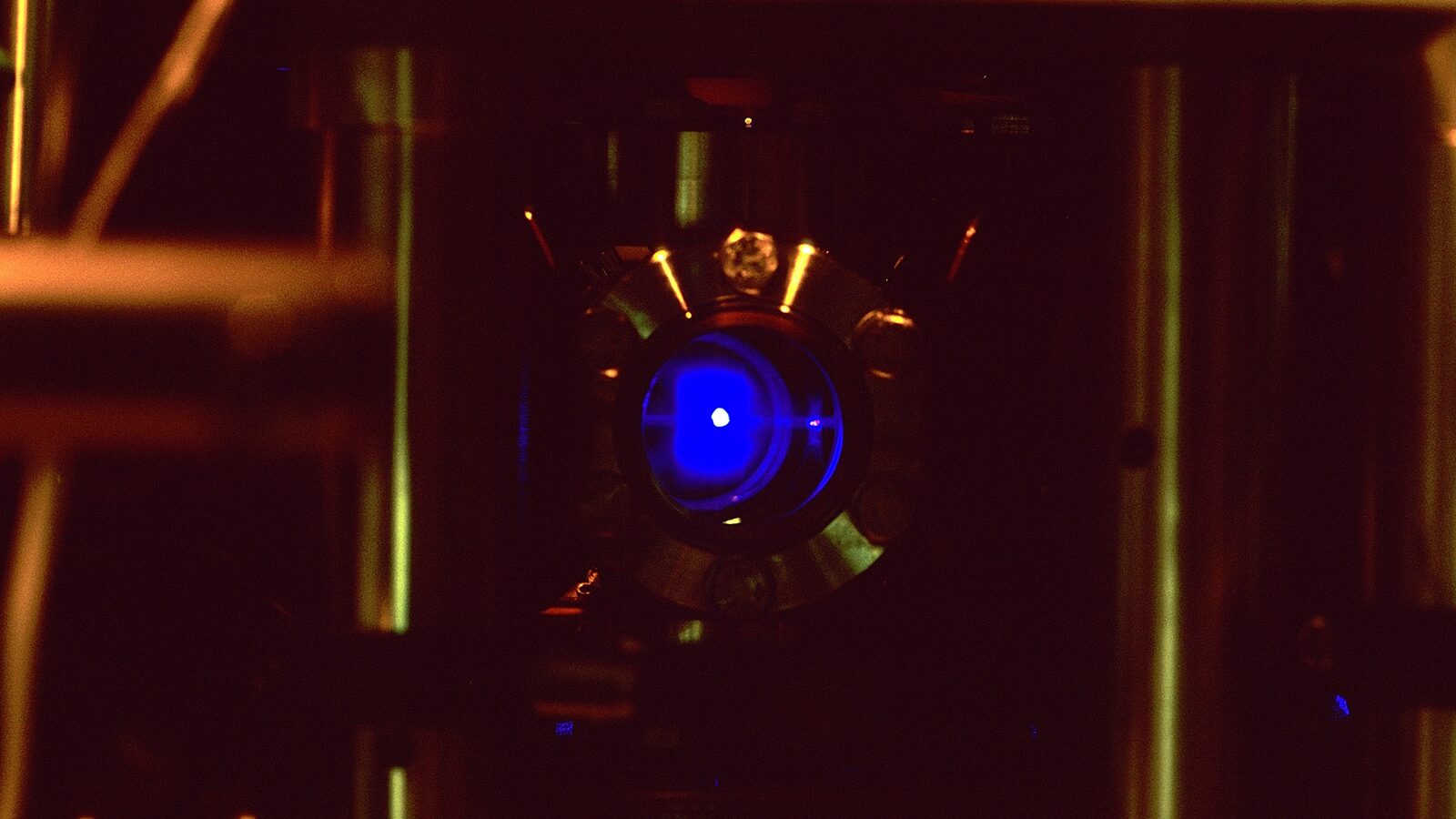
The JILA experiment trapped about 100,000 ultracold strontium atoms in an optical lattice formed by laser light. Cooling reduces motion that would blur the signal, while the lattice holds atoms in an organised sample. The atoms can then act as a shared reference whose transition frequency is mapped across different vertical regions.
The comparison happened inside one millimetre-high atomic sample
Researchers did not build two separate clocks the size of grains of sand. They imaged frequency differences between the top and bottom of one elongated cloud of trapped atoms. According to JILA, the atoms remained coherent—ticking in unison between energy levels—for 37 seconds, helping the team resolve an exceptionally small gradient.
The reported fractional shift across the sample was around one part in ten quintillion, consistent with relativity. The Nature study and NIST publication record describe resolving gravitational redshift across a millimetre-scale atomic sample. Repeating and averaging the measurement allowed a predicted difference far below direct human perception to emerge statistically.
A clock can sense gravitational potential, not height in isolation
Calling the instrument a height sensor is useful but incomplete. A clock responds to gravitational potential. Local geology, groundwater, tides and large moving masses can slightly change that potential even when the laboratory floor stays in place. To convert a frequency difference into height, researchers need models, reference clocks and careful control of other shifts.
That sensitivity is exactly why optical clocks could contribute to relativistic geodesy: mapping gravity-linked elevation through time comparisons. Future clock networks might complement traditional levelling and satellite measurements, or monitor slow changes. Laboratory resolution does not yet mean a rugged clock can be carried anywhere and instantly read altitude to one millimetre.
The same precision makes the clock a test bench for deeper physics
More precise clocks improve timekeeping, but their scientific value comes from noticing influences that ordinary instruments average away. Researchers can test relativity at new scales, search for drifts in fundamental constants and examine how quantum coherence behaves when parts of a system occupy slightly different gravitational potentials.
Those possibilities are research directions, not discoveries already contained in one experiment. The demonstrated result is narrower and remarkable enough: atoms at the top and bottom of a millimetre-high sample produced measurably different clock frequencies. The clock did not merely tell time. It detected that spacetime itself was uneven across the width of a pencil tip.
The gravitational signal appears only after larger clock shifts are controlled
Atomic transitions are stable, but a laboratory clock is not immune to its environment. Magnetic fields, black-body radiation, laser intensity, collisions and motion can all shift or broaden the measured frequency. Clock builders characterise these effects and design comparisons that make the gravitational gradient distinguishable from experimental systematics.
Using regions of the same atom cloud helps common disturbances cancel, yet it also demands imaging fine enough to resolve vertical frequency differences. The achievement is therefore not just an accurate atom. It is an engineered measurement in which preparation, coherence, spatial readout and uncertainty accounting all become quiet enough for one millimetre of gravity to speak.
Sources and further reading
This article was written for Curiosity Desk. We do not copy other publishers or invent quotes. If a material error is found, we correct it openly.
Read the full standards →One answer should lead to a better question
Bring your curiosity to the group
Curious Minds is our public Facebook community for surprising science, strange history, Australian wildlife and everyday questions. No copied posts, no personal-friend invitations and no link dumping.
- Three self-contained discussion prompts each week
- Sourced answers and honest uncertainty
- Respectful conversation without spam