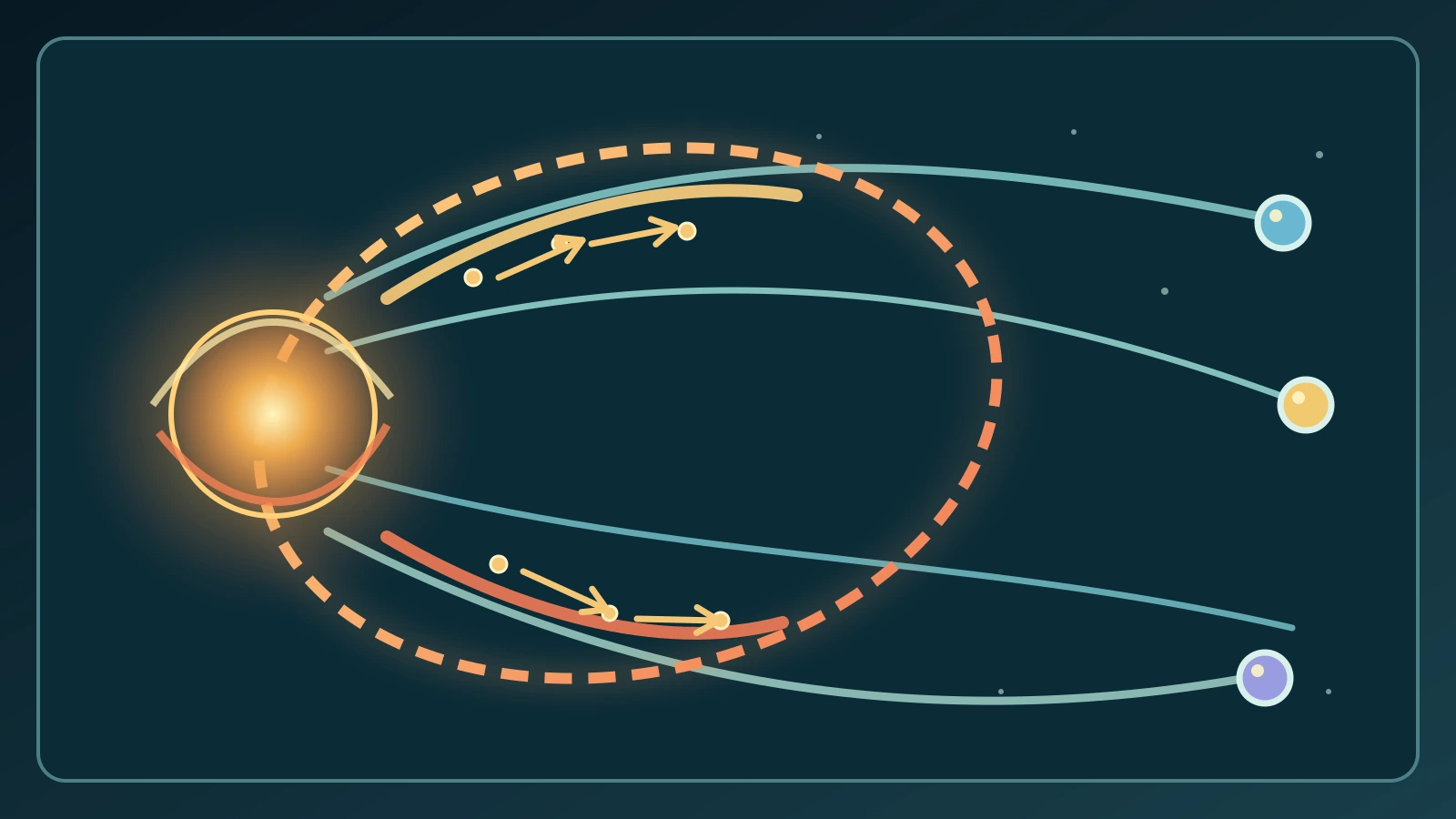
What can Messier 30 preserve about the Milky Way?
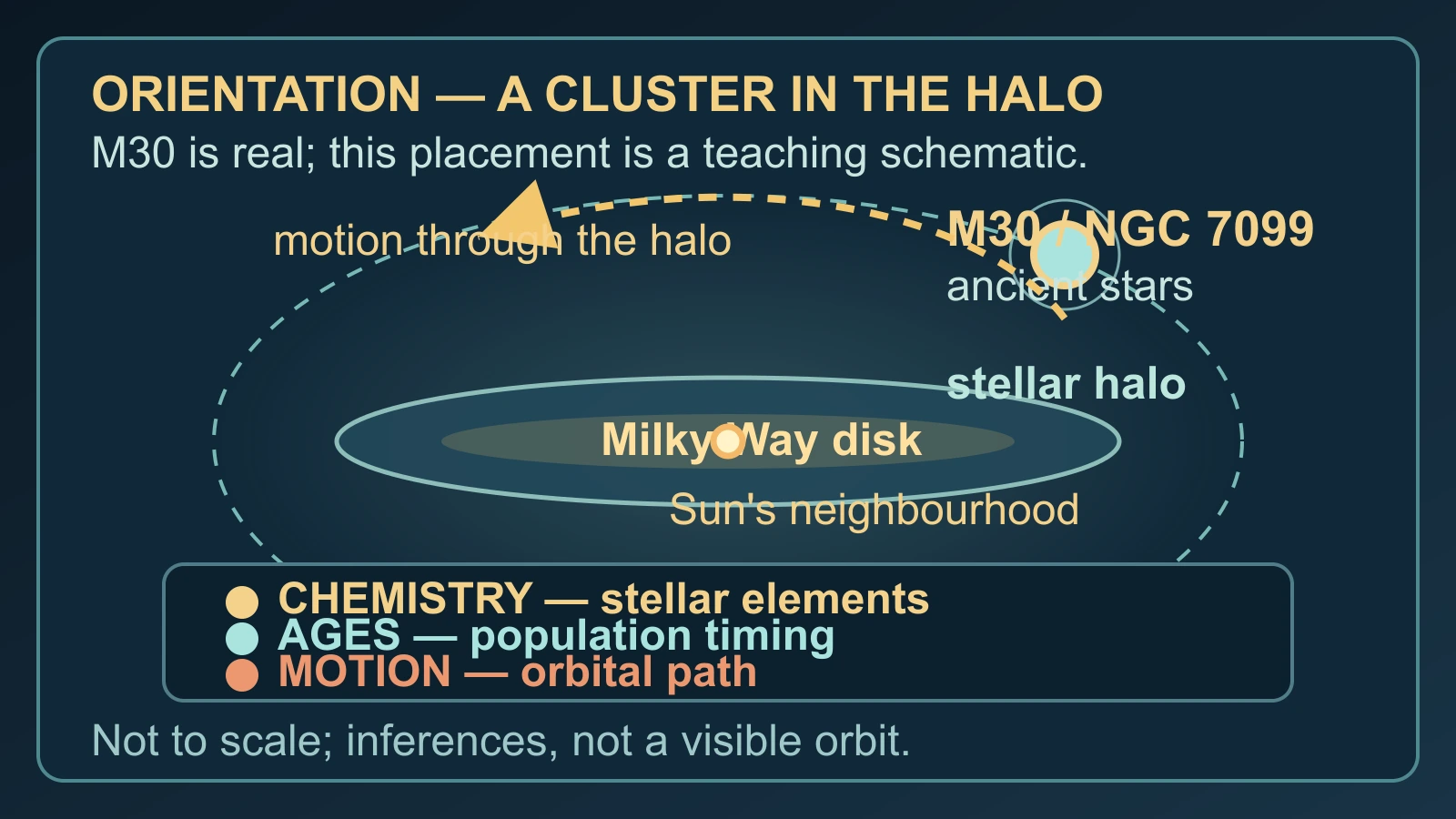
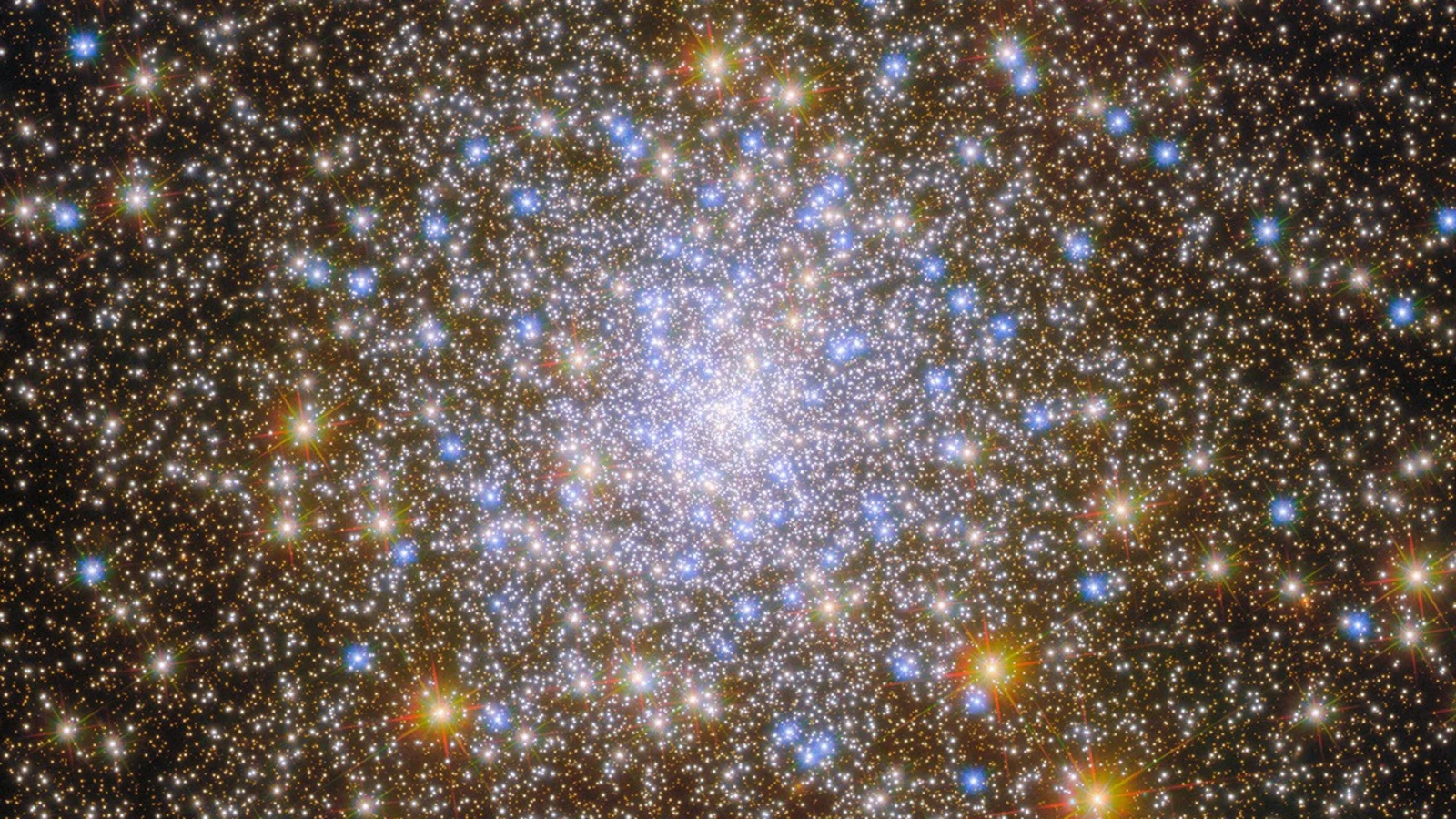
Messier 30, or NGC 7099, is a globular cluster: a dense, ancient group of stars orbiting in the Milky Way's halo. The NASA Hubble image is a real composite made from ultraviolet, visible and near-infrared observations. It shows the cluster we can observe now, not a photograph of the Galaxy's past unfolding.
The useful metaphor is a time capsule with the lid open but the labels incomplete. Stars preserve measurable properties—how bright and colourful they appear through different filters, how their populations divide by age and chemistry, and how the cluster moves. Astronomers compare those clues with models to ask how M30 formed and travelled.
The cluster is useful because its stars are observed as a group rather than as isolated points. Their shared distance and crowded setting let researchers compare patterns across many stars, while the halo location supplies context. Those comparisons narrow possible histories; they do not recover missing observations.
How do stellar light, ages and chemistry act as a time capsule?
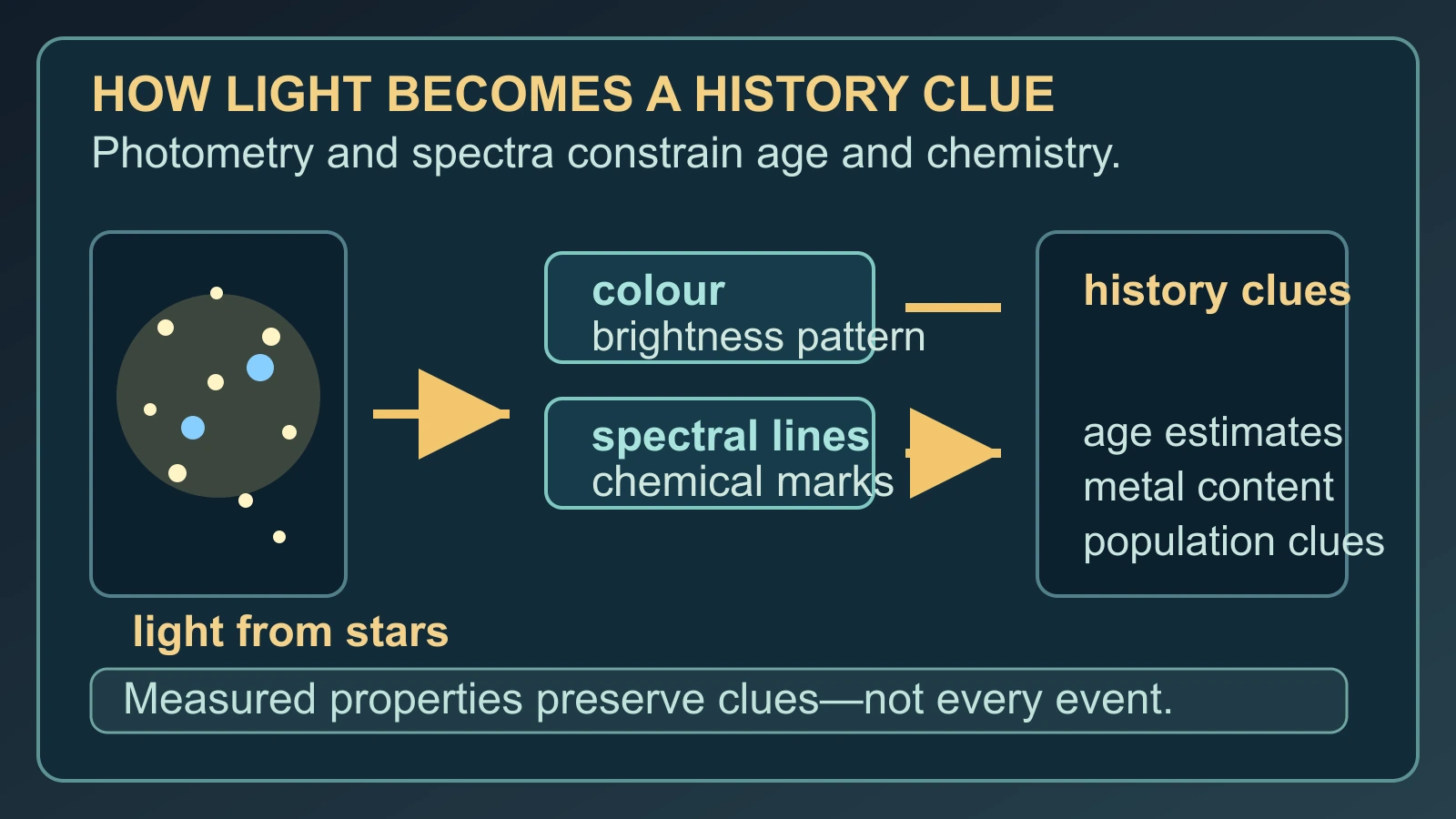
A star's measured light is not a diary entry, but it carries physical information. Brightness and colour across filters help place stars on population diagrams; age and metal-content estimates then constrain which stars formed together and which generations may have followed. The pattern is evidence about conditions, not a frame-by-frame recording of every event.
That distinction matters for M30. A compact cluster can keep related stars together long enough for their shared properties to be compared, while later analysis adds chemical and kinematic context. The result is a set of constraints on a possible history: useful for ruling out some stories, rarely enough to select one story without models and independent measurements.
Researchers therefore combine several measurements instead of treating one colour or one age estimate as decisive. Filters sample different parts of a star's light, and models translate those measurements into population clues. The translation is powerful but conditional: assumptions about distance, dust, stellar evolution and chemical mixtures affect the result.
Why can a retrograde orbit hint at capture?
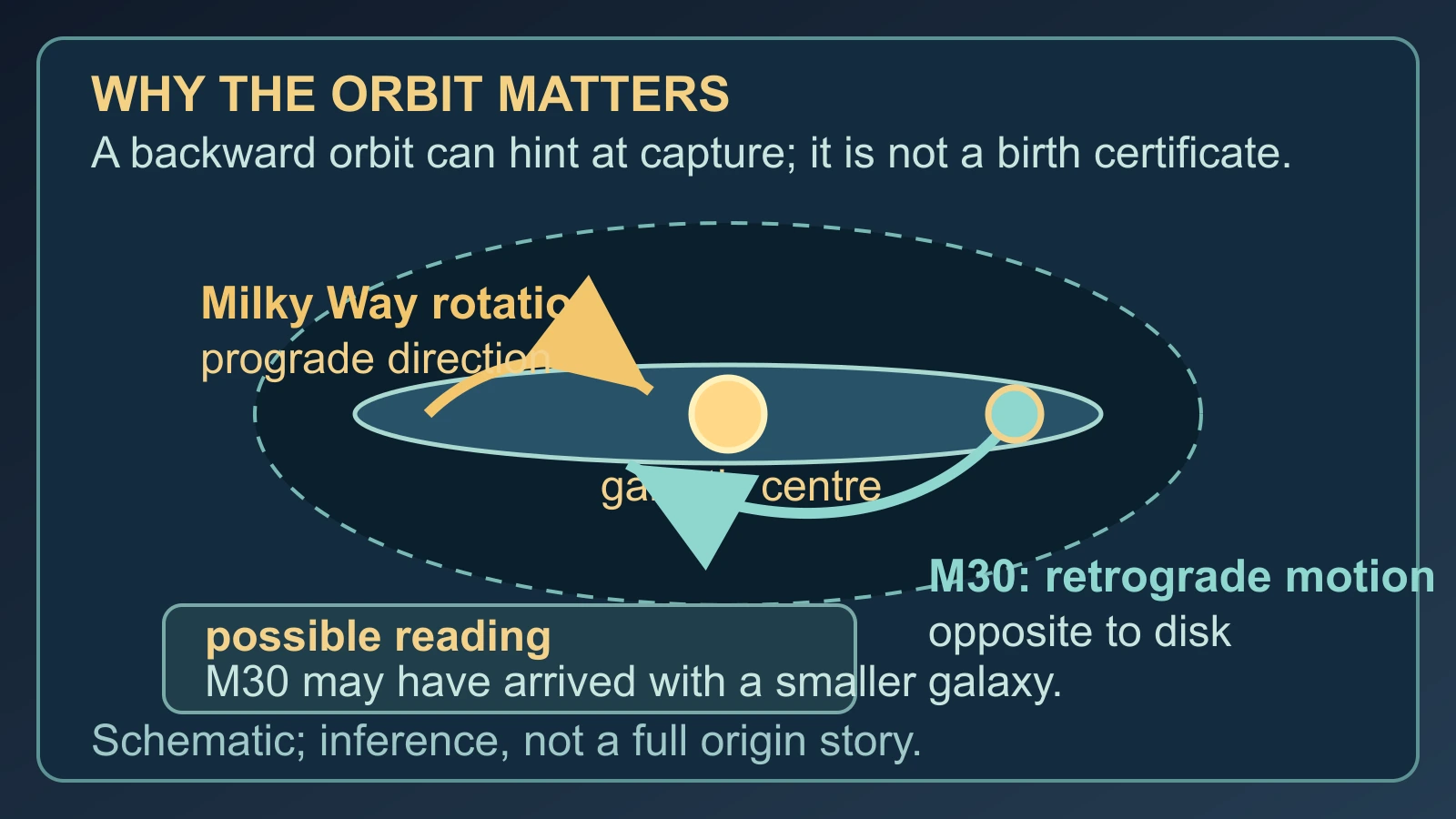
The Milky Way's disk has a prevailing direction of rotation. If a globular cluster travels around the Galaxy in the opposite sense, that motion can be harder to explain as material that formed quietly inside the same rotating system. For M30, the retrograde orbit is therefore a clue that the cluster may have arrived through an accretion event rather than being born in the disk's ordinary flow.
But an orbit is a clue, not a certificate. The interpretation depends on the measured motion, the Galaxy model and the other evidence in the cluster's stars. M30 may have arrived with a smaller galaxy, yet the cited records do not name one certain parent or prove that every globular cluster with unusual motion shares the same route.
An unusual orbit becomes more useful when it agrees—or disagrees—with the cluster's other clues. Proper motions and radial motion are measured quantities, but turning them into a long-term Galactic path requires a model of the Milky Way's mass distribution. The path is therefore evidence with uncertainty attached.
What do repeated Hubble observations reveal—and what can they not prove?
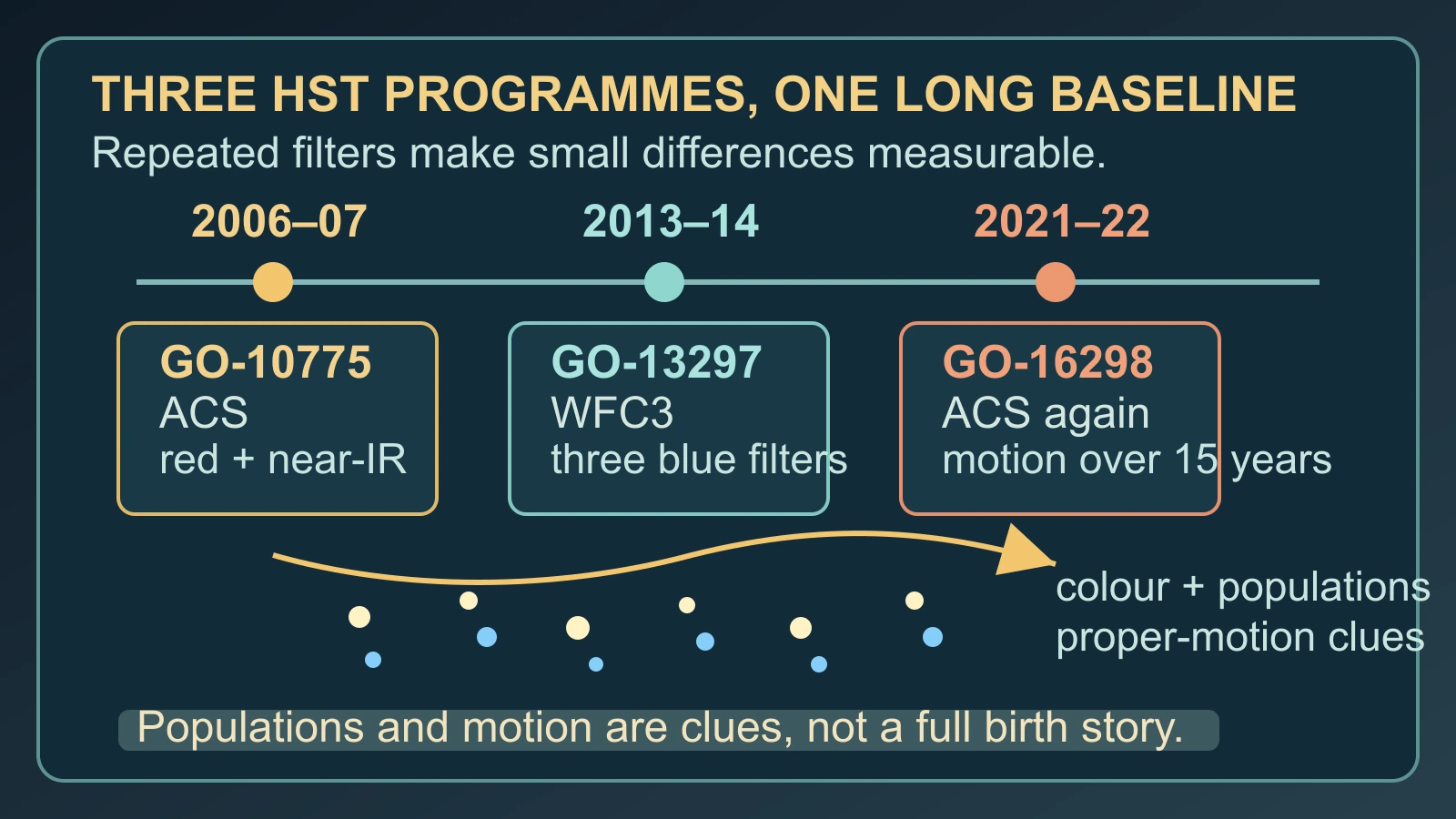
Hubble's M30 record is a sequence of measurements rather than one magical exposure. GO-10775 used ACS observations in red and near-infrared bands; GO-13297 used WFC3 through three blue filters; GO-16298 returned with ACS roughly 15 years after the earlier data. Together, the programmes help researchers compare stellar colours, populations and small motions across a longer baseline.
That repeatability improves the measurement of differences between stars, but it does not turn the cluster into a complete historical film. Hubble can reveal population structure and motion clues that feed an origin model. It cannot, from the image alone, prove M30's exact birthplace, recover every merger or establish a single finished account of the Milky Way.
The value of the Hubble sequence is cumulative. A later image can be aligned with earlier data so tiny shifts and population differences become measurable, but the instrument, filters and analysis choices still define what comparison is possible. More epochs improve a question; they do not erase its limits.
Sources and further reading
- NASA Science — Hubble Learns Galactic History From Stars ↗
- NASA Science — Messier 30 ↗
- Arellano Ferro et al. — Estimating the parameters of globular cluster M 30 (NGC 7099) ↗
- Nardiello et al. — Hubble Space Telescope UV Legacy Survey of Galactic Globular Clusters XVII ↗
- Watkins et al. — Hubble Space Telescope Proper Motion Catalogs of Galactic Globular Clusters II ↗
- MAST — HST proposal 10775 ↗
- MAST — HST proposal 13297 ↗
- MAST — HST proposal 16298 ↗
- NASA — Guidelines for using NASA Images and Media ↗
- ESA/Hubble — Copyright information ↗
This article was written for Curiosity Desk. We do not copy other publishers or invent quotes. If a material error is found, we correct it openly.
Read the full standards →One answer should lead to a better question
Bring your curiosity to the group
Curious Minds is our public Facebook community for surprising science, strange history, Australian wildlife and everyday questions. No copied posts, no personal-friend invitations and no link dumping.
- Three self-contained discussion prompts each week
- Sourced answers and honest uncertainty
- Respectful conversation without spam