Why ESCAPADE returns to Earth before heading to Mars
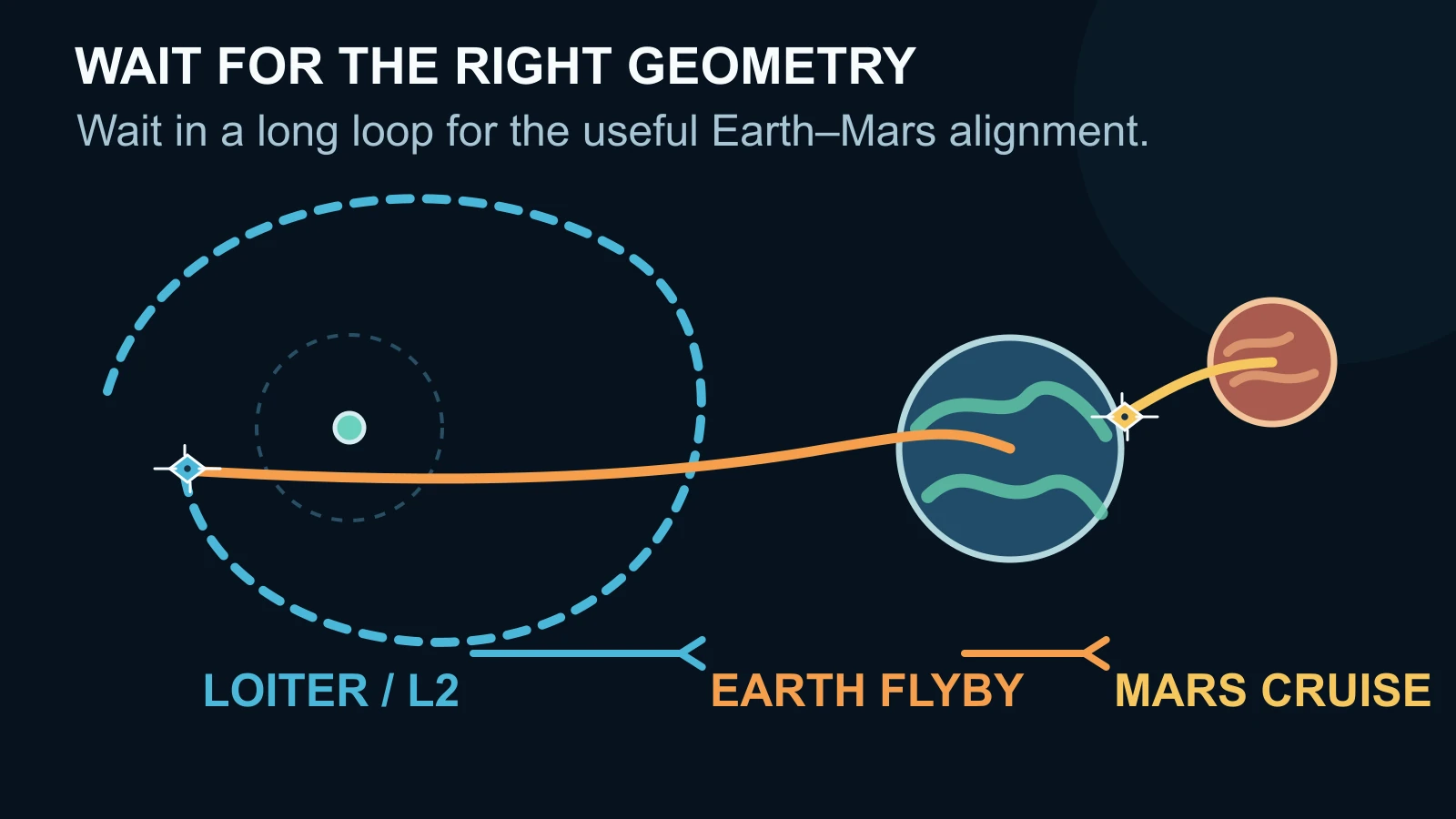
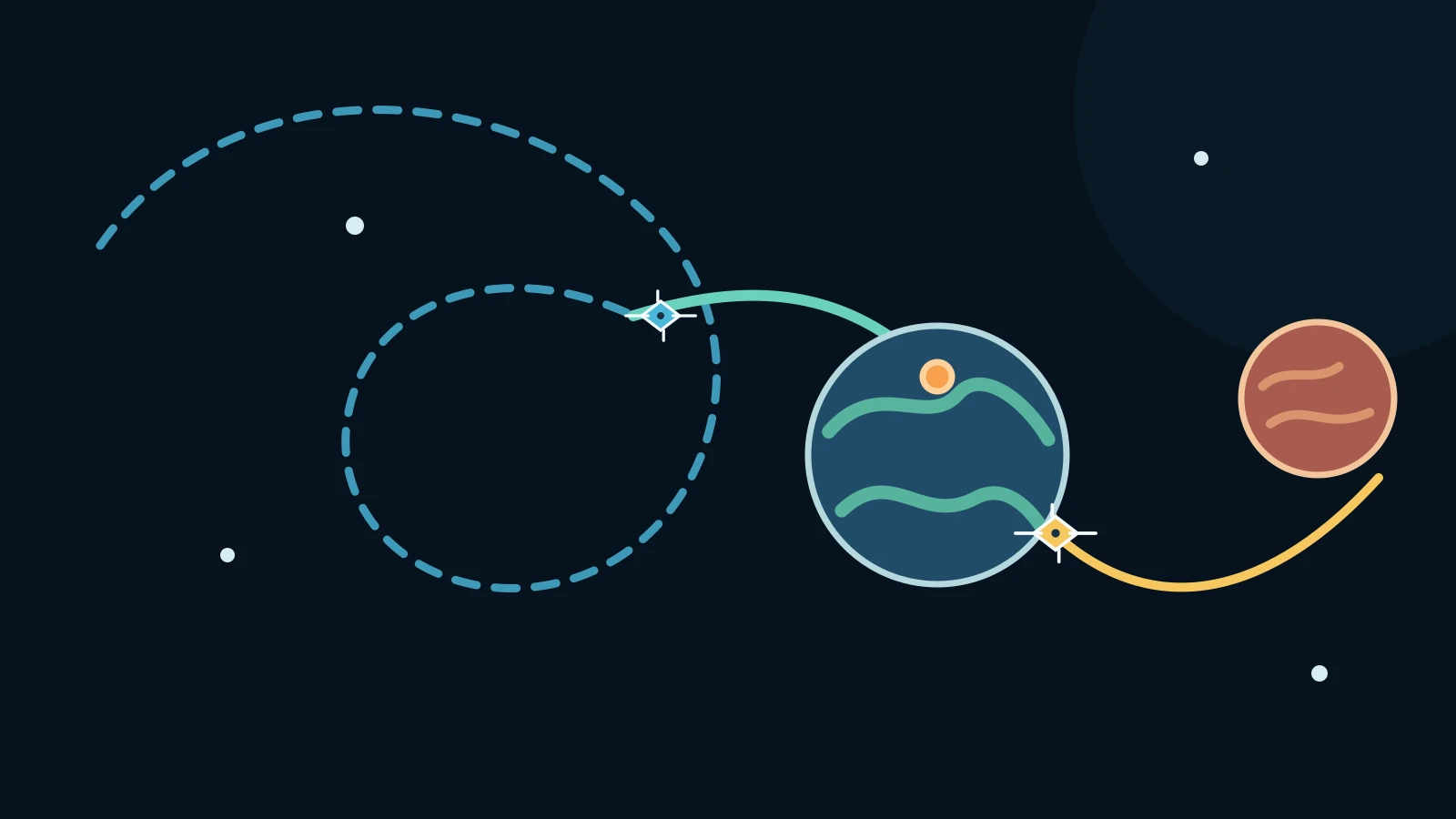
ESCAPADE is taking a long way around because the launch date and the useful Earth–Mars geometry did not line up. NASA launched the twin spacecraft in November 2025, when a direct Mars departure was not the practical route. Instead, Blue and Gold entered an Earth-proximity, or loiter, trajectory that looped around the Sun–Earth L2 region, roughly a million miles from Earth.
That loop is not a detour with no purpose. It let the mission wait in space for the planets to return to a geometry that made the Mars transfer useful. As the spacecraft come back toward Earth in November 2026, the planet can do two jobs at once: its moving gravity field can bend the spacecraft's Sun-relative path, and the spacecraft can fire their engines at the right moment to add an extra change in orbital energy.
The result is a transfer that separates the launch date from the Mars-departure date. NASA's current account schedules the first powered flyby for November 7 and the second for November 9, followed by a roughly ten-month cruise. The dates and trajectory are the mission plan at this evidence boundary, not a claim that the later Mars arrival or science has already happened.
What gravity changes—and what the engine burn adds
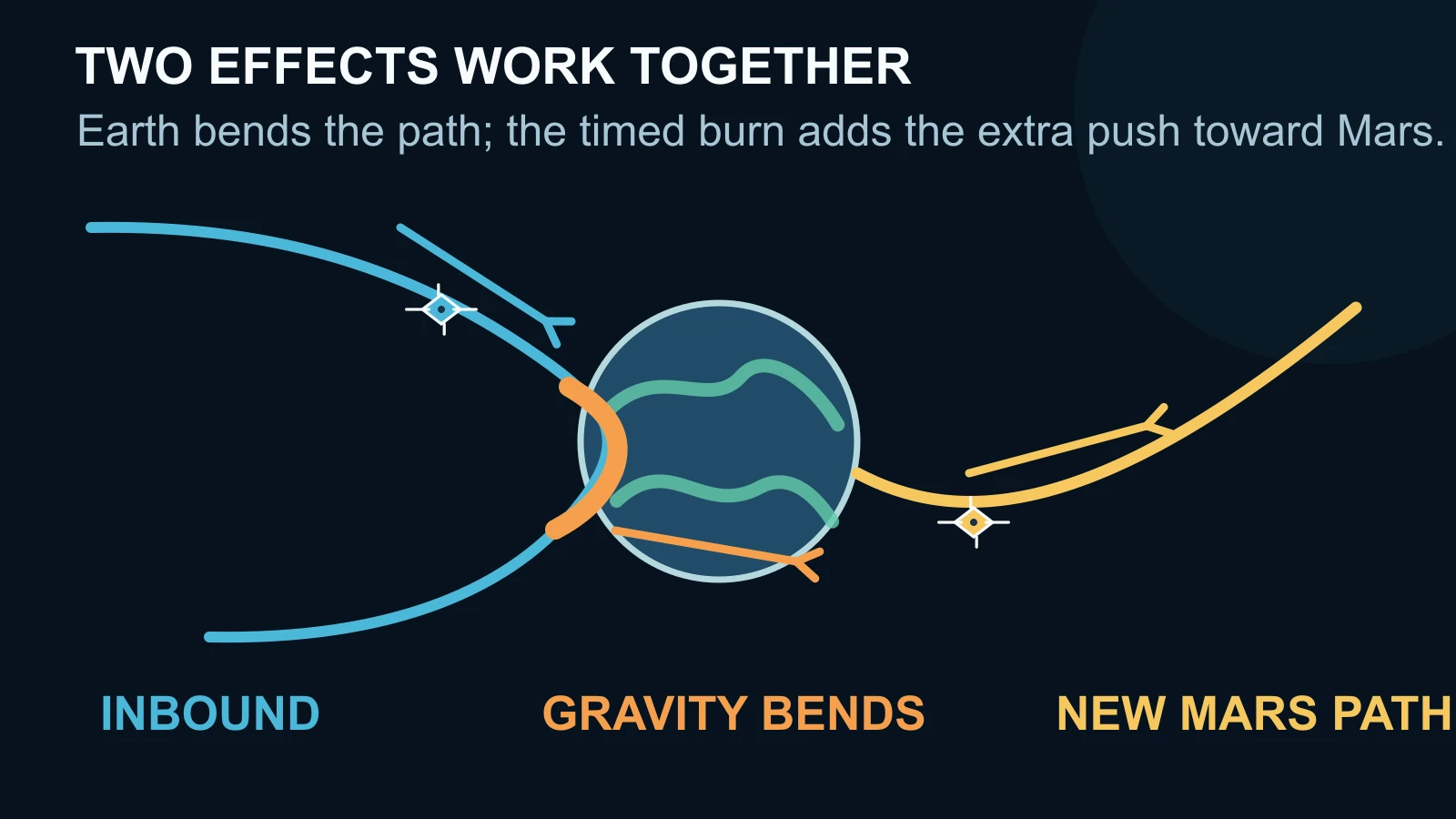
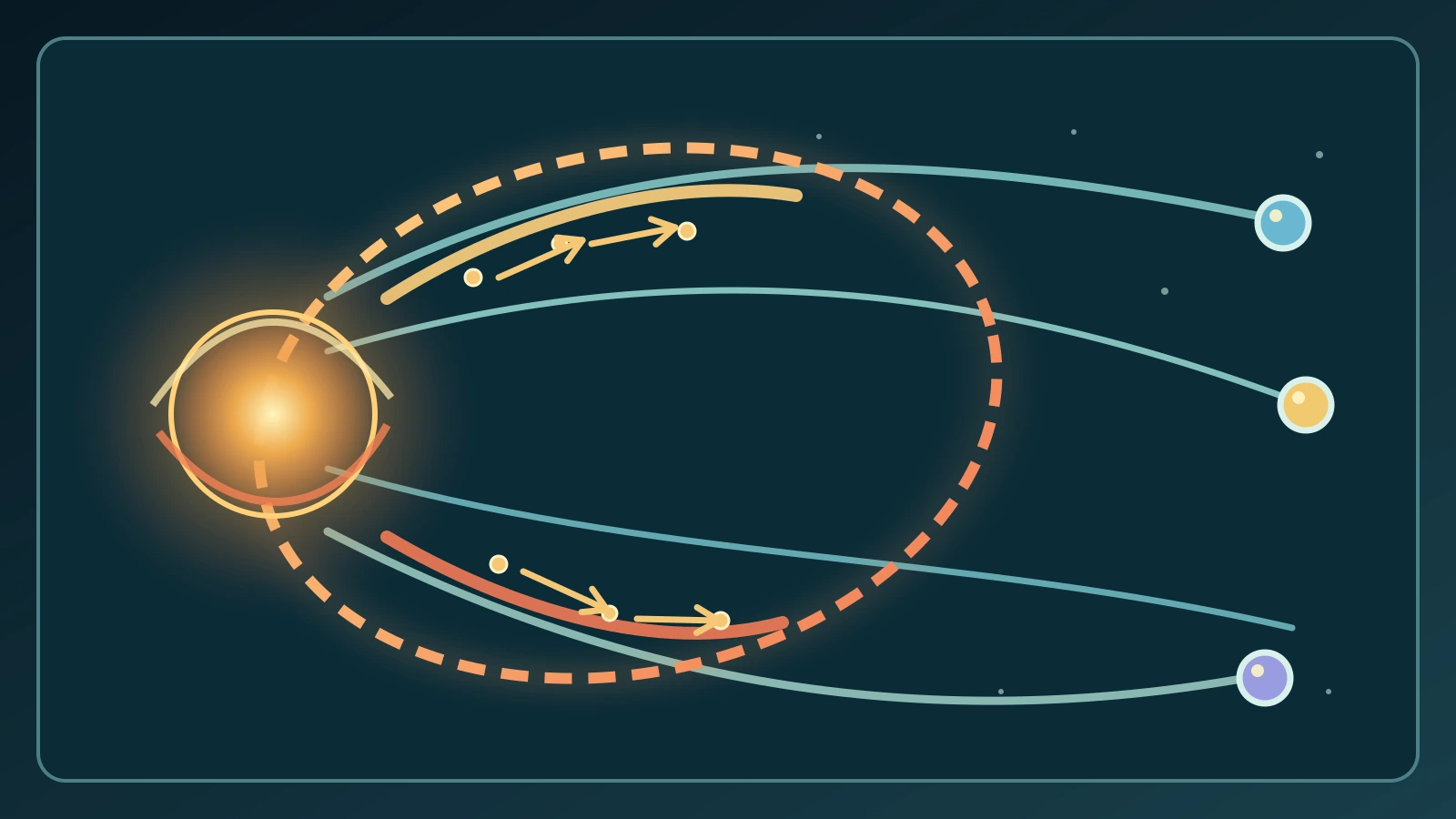
A gravity assist is easiest to understand as a change in direction that also changes the spacecraft's velocity relative to the Sun. In the planet's own frame, a nearly ideal flyby bends the path while the spacecraft speeds up on approach and slows again on departure. But Earth is moving around the Sun, so the new direction changes how the spacecraft's velocity combines with Earth's orbital motion. That is the source of the lasting Sun-relative boost or slowdown.
ESCAPADE adds propulsion during that encounter. NASA calls the maneuver a powered flyby because each spacecraft will perform a trans-Mars-injection burn near closest approach instead of relying on gravity alone. The current mission update says the roughly nine-minute burn should raise the speed by more than 1,000 miles per hour, from about 6.3 to 6.7 miles per second, while Earth redirects the outbound path toward Mars.
Those are complementary effects, not one magical slingshot. Gravity supplies the carefully timed bend and the planet's orbital-momentum exchange; the engine supplies an intentional impulse. The exact flight path still depends on the spacecraft's approach, the burn execution and later trajectory-correction maneuvers, so the explanatory arrows here show the mechanism rather than measured navigation data.
Why firing near closest approach matters
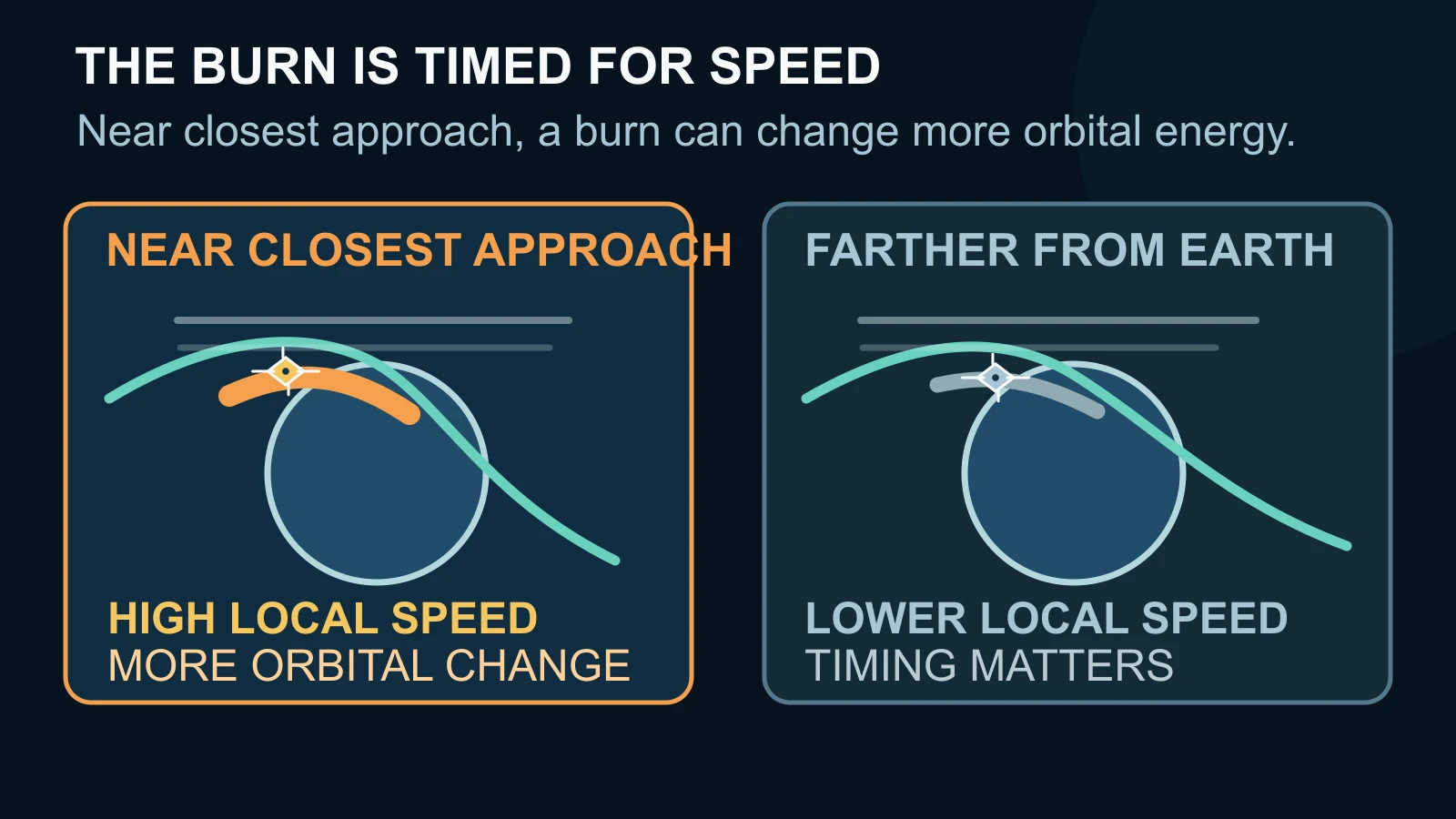
The unusual timing is an application of the Oberth effect. A rocket burn changes a spacecraft's orbit more effectively when the spacecraft is already moving quickly deep inside a gravity well. ESCAPADE first gains speed as it falls toward Earth; firing near closest approach lets the same engine impulse act while the spacecraft is at that high local speed.
That does not mean the engine suddenly makes more thrust, and it does not mean NASA has published a simple fuel-saving percentage for this mission. The point is orbital energy: the burn changes the spacecraft's path and energy by an amount that depends on both the engine impulse and the spacecraft's existing velocity. NASA's deployment account describes the pre-burn speed as what lets ESCAPADE take advantage of the Oberth effect.
The burn therefore has to be timed and aimed, not merely switched on somewhere near Earth. The current NASA update places it at closest approach and describes each spacecraft's engine firing as it passes over southern Australia. The public evidence supports the timing principle and the planned duration; it does not provide the full navigation solution, engine telemetry or a post-burn performance result.
What the maneuver establishes—and what remains open
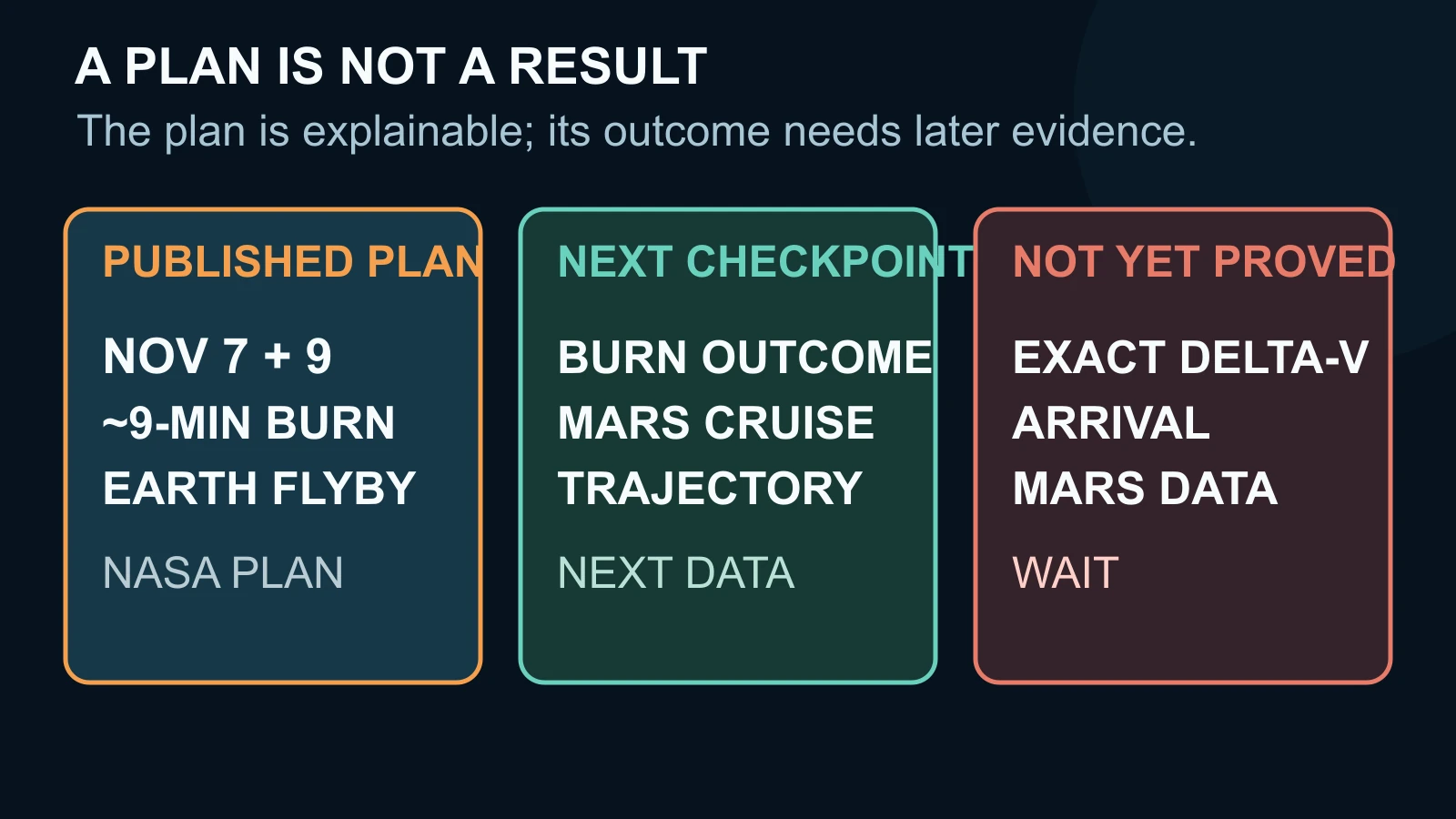
At this stage, NASA has published a concrete transfer design: two spacecraft launched in 2025, waited in a long Earth-proximity loop, returned near Earth when the planets were better aligned, and were scheduled to combine a gravity assist with a roughly nine-minute trans-Mars-injection burn. NASA's trajectory material also shows that later course corrections are part of the route to Mars.
What the maneuver should establish is an outbound trajectory that can carry Blue and Gold to Mars. NASA's current mission record expects arrival in September 2027, followed by Mars-orbit insertion and later science operations. Those are planned phases. They become historical facts only when current mission evidence reports that the burns occurred and the spacecraft entered the corresponding path or orbit.
So the answer to the headline is a method with a clear boundary: ESCAPADE uses Earth's gravity to reshape its Sun-relative route, then fires its engines near closest approach to add the energy needed for the Mars transfer. The exact burn outcome, arrival, orbit insertion and the mission's Mars measurements remain open evidence questions rather than details this package can fill in by inference.
Sources and further reading
- NASA Science — NASA's Twin ESCAPADE Spacecraft to Slingshot Past Earth on Way to Mars ↗
- NASA Science — ESCAPADE mission ↗
- NASA SVS — ESCAPADE Trajectory Animations ↗
- NASA Science — NASA's Twin ESCAPADE Spacecraft Have Deployed ↗
- NASA Science — A Gravity Assist Primer ↗
- NASA — Guidelines for using NASA Images and Media ↗
This article was written for Curiosity Desk. We do not copy other publishers or invent quotes. If a material error is found, we correct it openly.
Read the full standards →One answer should lead to a better question
Bring your curiosity to the group
Curious Minds is our public Facebook community for surprising science, strange history, Australian wildlife and everyday questions. No copied posts, no personal-friend invitations and no link dumping.
- Three self-contained discussion prompts each week
- Sourced answers and honest uncertainty
- Respectful conversation without spam