The photograph looks worse than the engineering reality
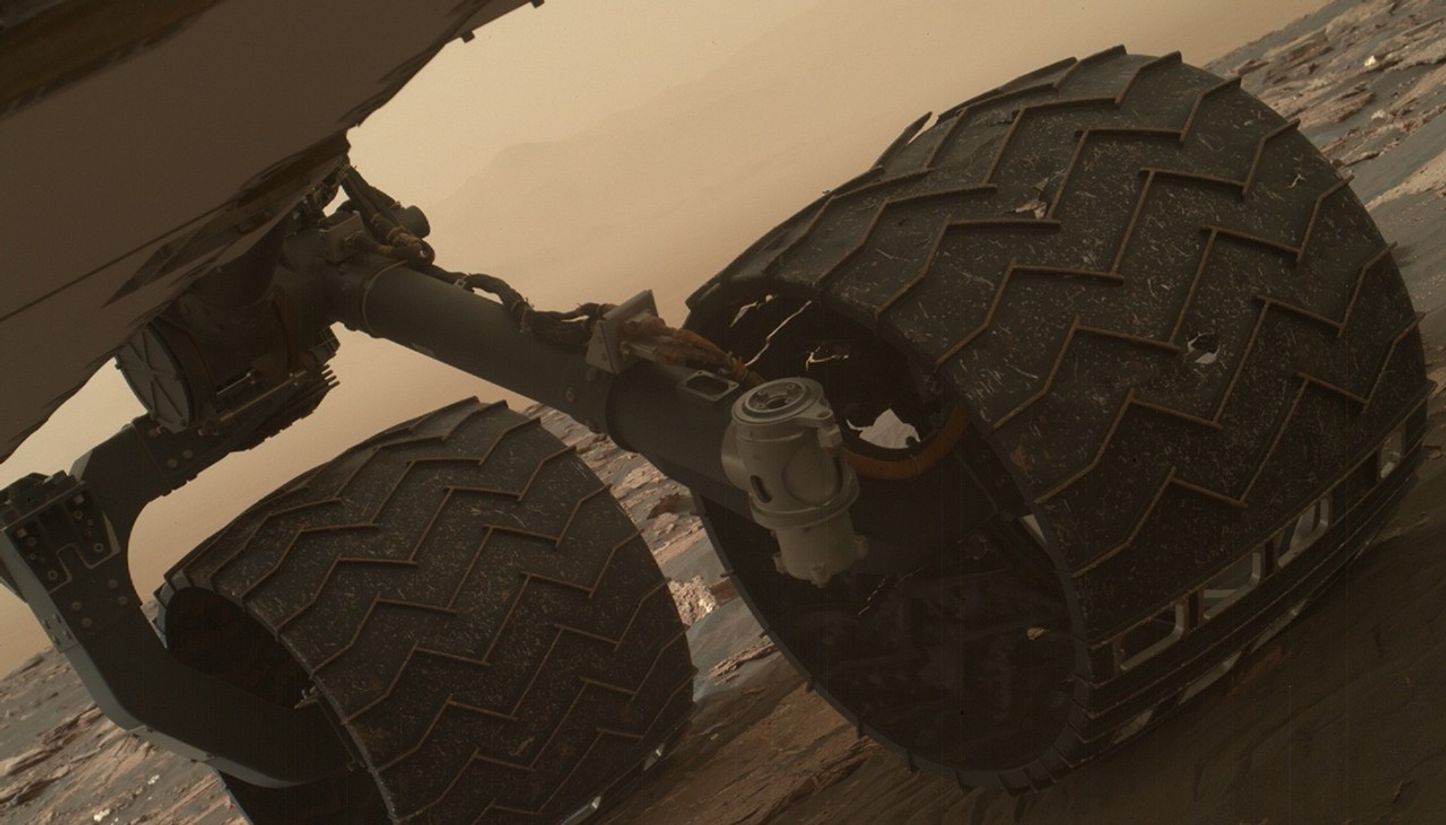
A close photograph of Curiosity's wheels can look like the aftermath of a crash. Thin aluminium is torn open, edges are bent and Martian daylight passes through gaps that were once solid metal. The first useful question is not whether the damage is real. It is. The better question is which parts of the wheel are damaged, because not every visible surface carries the same load.
Images of this wear have circulated online for years and often return without their original date. NASA's featured photograph of a partly detached raised tread was taken in March 2017, not during a sudden new failure in 2026. Curiosity was still conducting science in 2026, including the unusual recovery of a rock that became stuck around its drill. The frightening picture therefore needs mechanical context rather than a countdown to an invented breakdown.
The paper-thin skin is only one part of each wheel
Each of Curiosity's six wheels is roughly 50 centimetres in diameter and 40 centimetres wide. JPL described the metal skin between the raised treads as about half the thickness of a United States dime. A later engineering paper gives a thickness of 0.75 millimetres. That thin skin saved mass, an important constraint for a rover that had to survive launch, landing and movement on another planet.
The skin is not the whole skeleton. Each wheel also has strong rims at its edges, an internal stiffening ring and raised zigzag features called grousers. Those grousers carry much of the rover's weight, provide traction and help the wheel cross uneven ground. A hole through a panel of skin is serious evidence of wear, but it is not the same event as losing the wheel's rim, hub or every load-bearing grouser.
Sharp fixed rocks create the most damaging squeeze
Curiosity began accumulating holes faster than engineers expected in 2013 while crossing terrain containing sharp rocks. A loose rock can sometimes move under a wheel. A pointed rock embedded in the ground behaves more like a punch. When the suspension and other wheels keep pushing, a thin aluminium panel can be forced onto that point with enough pressure to crack or puncture it.
The problem is not simply that Mars is rocky. The rover has six driven wheels linked by a suspension that keeps them in contact with uneven terrain. When one wheel climbs, wheels ahead of it may pull and wheels behind it may push. That interaction can increase the force against a sharp feature. Understanding those forces allowed the team to change driving behaviour rather than merely watch the holes grow.
Curiosity changes six wheel speeds to reduce the squeeze
On flat ground the wheels can turn at similar speeds, but that simple rule becomes less suitable when one wheel climbs over a rock. JPL's traction control software uses real-time information about the suspension to adjust individual wheel speeds. By reducing the unwanted push and pull between wheels, the algorithm lowers the pressure that can drive a pointed rock into the vulnerable skin between grousers.
Software cannot turn damaged aluminium back into an intact sheet, and traction control does not make every route safe. It changes the rate of wear. Rover planners also use orbital and surface imagery to choose less hazardous paths, avoid fields of sharp wind-sculpted rocks and sometimes drive in reverse when testing shows that approach is gentler. The protection is a collection of small operational decisions, not one magical repair.
A camera on the robotic arm becomes the mechanic's inspection lamp
There is no technician beside Curiosity, so the rover photographs its own wheels. The Mars Hand Lens Imager, or MAHLI, sits on the turret at the end of the robotic arm. The mission team positions it beneath the rover to capture planned inspection sets, then engineers measure cracks and compare wheel sections with earlier images. Supplemental cameras can provide additional views between fuller inspections.
That history matters more than one dramatic frame. Engineers track cumulative crack length, broken grousers and the rate at which damage is changing. NASA increased the frequency of wheel imaging in 2022 after another grouser was found damaged. A new gap may look enormous to a viewer, but operational decisions depend on where the crack sits, which structural features remain and whether the trend is accelerating.
NASA planned for a damaged wheel, not an undamaged photograph
Earth testing with rover wheels helps the team connect visible damage to remaining capability. In 2017, JPL reported that testing associated three broken grousers on a wheel with roughly 60 percent of its useful life. That was a planning milestone, not a claim that the wheel would fail on the next drive. The rover had already travelled far enough to reach major science destinations, and its routes and imaging cadence could be adjusted.
By 2022, NASA said ground testing had shown that Curiosity could be driven on its wheel rims if that ever became necessary. Engineers also described a possible controlled removal of loose remnants in an extreme future case. Those options do not make the wheels immortal. They show why a machine designed for an unreachable environment is judged by retained function and managed risk, not by whether every surface still looks new.
The damage became a design lesson carried to later rovers
Curiosity's early wheel wear triggered a long investigation involving terrain, forces, materials, crack measurements and drive methods. The published engineering assessment says the wheels were designed to operate with considerable damage, but the unexpectedly fast rate of cracking still mattered. The mission had to learn which sections were most vulnerable and how driving rules changed the stress placed on them.
That is the deeper reason the torn metal remains fascinating. It is not evidence that NASA forgot to build tyres, and it is not proof that the rover is about to stop. It is a visible record of engineering under a strict mass budget, followed by years of measurement and adaptation. Curiosity survives not because the damage is imaginary, but because the rest of the system can understand and work around it.
Sources and further reading
- NASA Science: dated wheel inspection image and wheel dimensions ↗
- NASA JPL: traction control algorithm and rock-wheel forces ↗
- NASA JPL technical paper: Curiosity wheel construction and damage assessment ↗
- NASA: 2022 wheel inspection cadence and ground-tested rim driving ↗
- NASA JPL: Curiosity's active 2026 drill recovery ↗
- Google Trends: seven-day US interest in Mars rover searches ↗
This article was written for Curiosity Desk. We do not copy other publishers or invent quotes. If a material error is found, we correct it openly.
Read the full standards →One answer should lead to a better question
Bring your curiosity to the group
Curious Minds is our public Facebook community for surprising science, strange history, Australian wildlife and everyday questions. No copied posts, no personal-friend invitations and no link dumping.
- Three self-contained discussion prompts each week
- Sourced answers and honest uncertainty
- Respectful conversation without spam