Two showers are peaking, but the sky will not look twice as busy
Search interest in meteor showers rose sharply in the United States on 27 July as two annual streams approached their late July peaks. The Southern Delta Aquariids and Alpha Capricornids are both active now, and current observing calendars place their strongest activity around 30 and 31 July 2026. That overlap is why the event is being called a double meteor shower.
The phrase can create the wrong picture. Two solid clouds are not colliding above Earth, and every streak will not arrive in a neat burst at midnight. Earth is moving through two broad trails of small debris at the same time. Their activity builds and fades over days, while individual meteors can appear anywhere across the sky. The useful expectation is a patient watch with two possible sources, not a scheduled explosion.
The two showers offer different kinds of luck
The International Meteor Organization lists a zenithal hourly rate of 25 for the Southern Delta Aquariids and five for the Alpha Capricornids at maximum. Those figures describe an ideal observer under exceptionally dark, clear skies with the radiant overhead. They are a scientific comparison standard, not a promise that somebody in a suburban garden will count 30 meteors every hour.
The lower rate does not make the Alpha Capricornids uninteresting. International Meteor Organization guidance notes that this stream is known for bright, slow meteors, and some reach fireball brightness. The Southern Delta Aquariids provide the stronger stream overall, but many of their meteors are faint. In 2026, one rare bright Capricornid may therefore be easier to notice than several more numerous Aquariids hidden by moonlight.
A nearly full Moon is the most important fact in this year's forecast
The Moon is full on 29 July 2026, only about two days before the listed shower maxima. The International Meteor Organization describes the lunar conditions for the Southern Delta Aquariids as poor and puts the Moon at roughly 98 percent illuminated near the peak. Its light brightens the whole sky and reduces the contrast between a faint meteor and the background.
The Moon does not stop meteoroids from entering the atmosphere. It changes what human eyes can detect from the ground. This is why an hourly rate copied from a dark-sky calendar can be technically correct yet misleading in a social post. Bright meteors and fireballs can still break through the glare, but a viewer should expect fewer visible streaks than the ideal rate.
The best hour is local, not one universal clock time
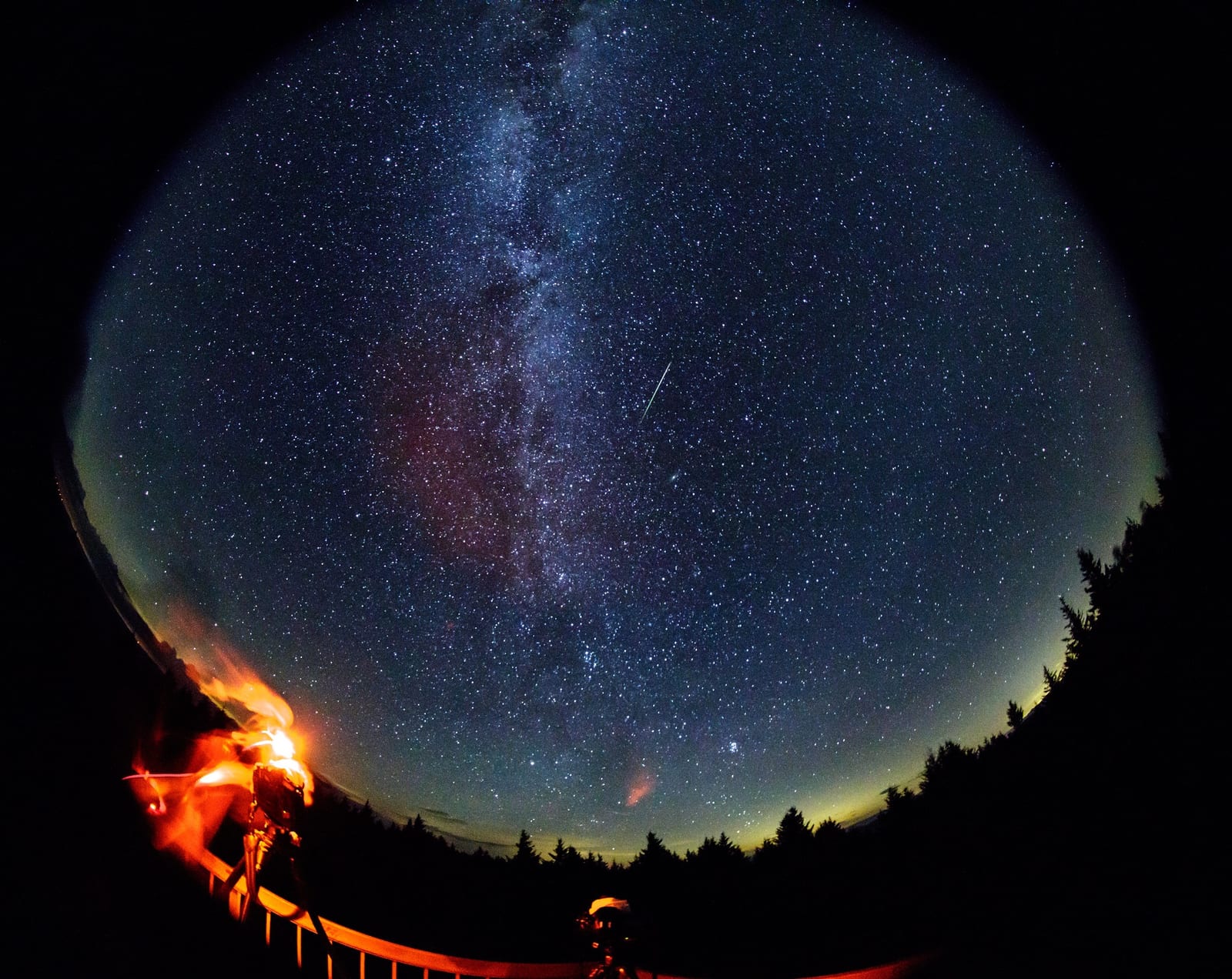
The American Meteor Society places the Alpha Capricornid radiant highest at about 1 am local daylight time and the Southern Delta Aquariid radiant highest at about 3 am. In practical terms, the most useful window is after midnight through the dark hours before dawn. The showers remain active across several nights, so cloud cover on one date does not automatically end the opportunity.
Observers in Australia and other southern locations have the geometric advantage because the Southern Delta Aquariid radiant climbs higher in their sky. Viewers in the United States, Canada and the United Kingdom can still see meteors, but the radiant sits lower toward the southern part of the sky, especially at higher northern latitudes. The result can vary more by latitude, cloud, light pollution and an unobstructed view than by crossing a precise minute on the clock.
Do not stare directly at Aquarius
A shower is named for its radiant, the point from which its meteor paths appear to spread when traced backward. The Southern Delta Aquariid radiant lies in southern Aquarius, while the Alpha Capricornid radiant sits near Capricornus. Those constellations are direction markers created by perspective. The debris is not travelling to Earth from the stars inside them.
NASA recommends looking about 45 degrees away from the Delta Aquariid radiant and roughly halfway between the horizon and the point directly overhead. That gives longer meteor paths room to cross your view. Looking straight at the radiant can make shower meteors appear shorter, and staring at a phone between streaks repeatedly destroys the dark adaptation your eyes are trying to build.
The simplest viewing kit is a chair, warm clothing and patience
Move away from streetlights when it is safe to do so, choose a broad view of the sky and let your eyes adjust for at least 20 to 30 minutes. A reclining chair or blanket is more useful than a telescope because meteors can appear across a large area. Binoculars and telescopes narrow that area so severely that they usually reduce the chance of catching a streak.
Keep the bright Moon behind a building, tree or your shoulder if that can be done without blocking too much sky. Use a dim red light only when necessary and check weather, access rules and personal safety before travelling to a darker site. The event does not justify entering closed land, stopping on an unsafe roadside or looking upward while driving.
A fast streak and a slow fireball may reveal different streams
The 2026 observing calendar gives the Southern Delta Aquariids an entry speed near 41 kilometres per second. The Alpha Capricornids arrive much more slowly, at about 23 kilometres per second. Speed, direction and the path traced back toward a radiant help experienced observers decide which stream produced a meteor.
For a casual viewer, certainty is difficult because several showers and ordinary sporadic meteors are active together. A slow, unusually bright meteor is consistent with the Alpha Capricornids, but brightness alone is not proof. The International Meteor Organization defines a fireball by apparent brightness and asks observers to report details such as time, direction, duration and any fragmentation rather than assigning a shower from one impression.
The flash happens in our atmosphere, not among the stars
A meteoroid is the small piece of natural space material before it produces the visible streak. A meteor is the light phenomenon created when that material meets the atmosphere at high speed. A meteorite is a fragment that survives the journey and reaches the ground. Most shower particles are tiny and disappear high above us.
NASA's Jet Propulsion Laboratory describes meteor streams as dust grains usually released by comets and spread along the parent body's orbit. Earth encounters the trails at predictable parts of its own orbit, which is why the same named showers return each year. The Alpha Capricornids are associated with comet 169P/NEAT. The parentage of the Southern Delta Aquariid stream is more complex, and authoritative NASA pages identify more than one candidate or describe the association as suspected.
Missing this peak may improve your next chance
The Southern Delta Aquariids remain active into August, so some of their meteors overlap with the better known Perseids. The International Meteor Organization lists the Perseid maximum on 13 August 2026 with a much higher ideal rate, while the lunar calendar places a new Moon on 12 August. That combination should provide darker peak conditions than the late July showers receive.
The July event is still worth trying because a meteor watch is not valuable only when a counter reaches a large number. The contrast between a faint high-rate stream and a low-rate stream capable of bright fireballs reveals how misleading a single headline figure can be. In a moonlit year, the meteor you remember may be the one the rate table made least likely.
Sources and further reading
- International Meteor Organization: 2026 Meteor Shower Calendar ↗
- American Meteor Society: activity outlook for 25 to 31 July 2026 ↗
- NASA: 2026 summer meteor shower double feature ↗
- NASA Science: Southern Delta Aquariids viewing guide ↗
- International Meteor Organization: meteor and fireball observing FAQ ↗
- NASA JPL: meteor streams and associated parent bodies ↗
This article was written for Curiosity Desk. We do not copy other publishers or invent quotes. If a material error is found, we correct it openly.
Read the full standards →One answer should lead to a better question
Bring your curiosity to the group
Curious Minds is our public Facebook community for surprising science, strange history, Australian wildlife and everyday questions. No copied posts, no personal-friend invitations and no link dumping.
- Three self-contained discussion prompts each week
- Sourced answers and honest uncertainty
- Respectful conversation without spam