Why lunar dust is a hardware problem
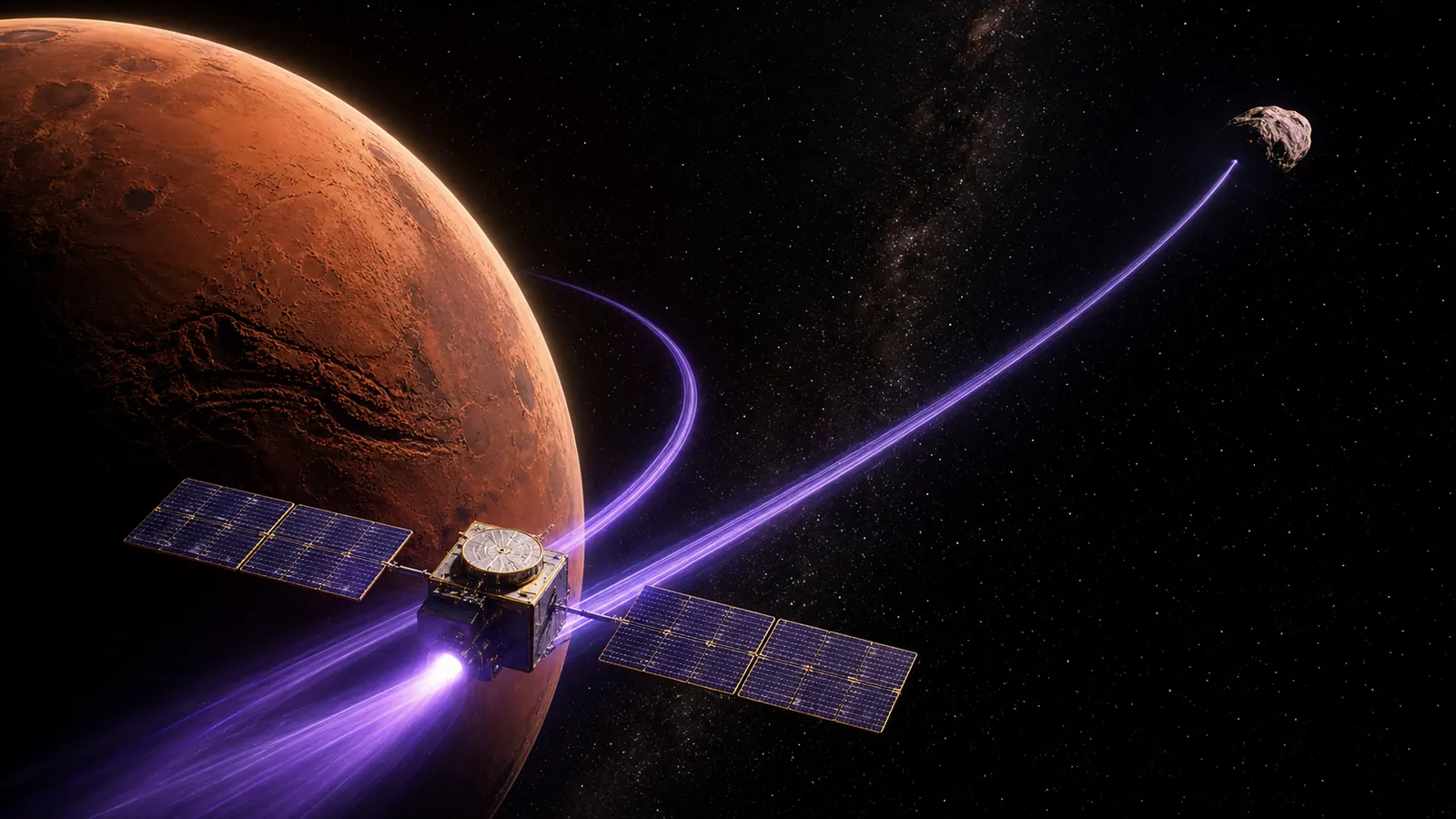
Lunar dust is not just a smaller version of beach sand. NASA describes it as sharp, abrasive and prone to clinging to surfaces. That combination can work its way into joints, seals, mechanisms, spacesuits and instruments, where a grain is both a contaminant and a piece of cutting material. Dust is also part of the human-environment problem: the same material that can coat equipment can be carried into places astronauts must keep clean.
The first engineering question is therefore not simply whether a machine still turns after dust is sprinkled on it. Researchers need to know which particle properties reach which parts, how much dust enters a mechanism, whether a seal keeps working, how a motor or thermal surface responds and whether a mitigation method changes the failure path. A useful test must make those conditions repeatable enough that two hardware designs can be compared.
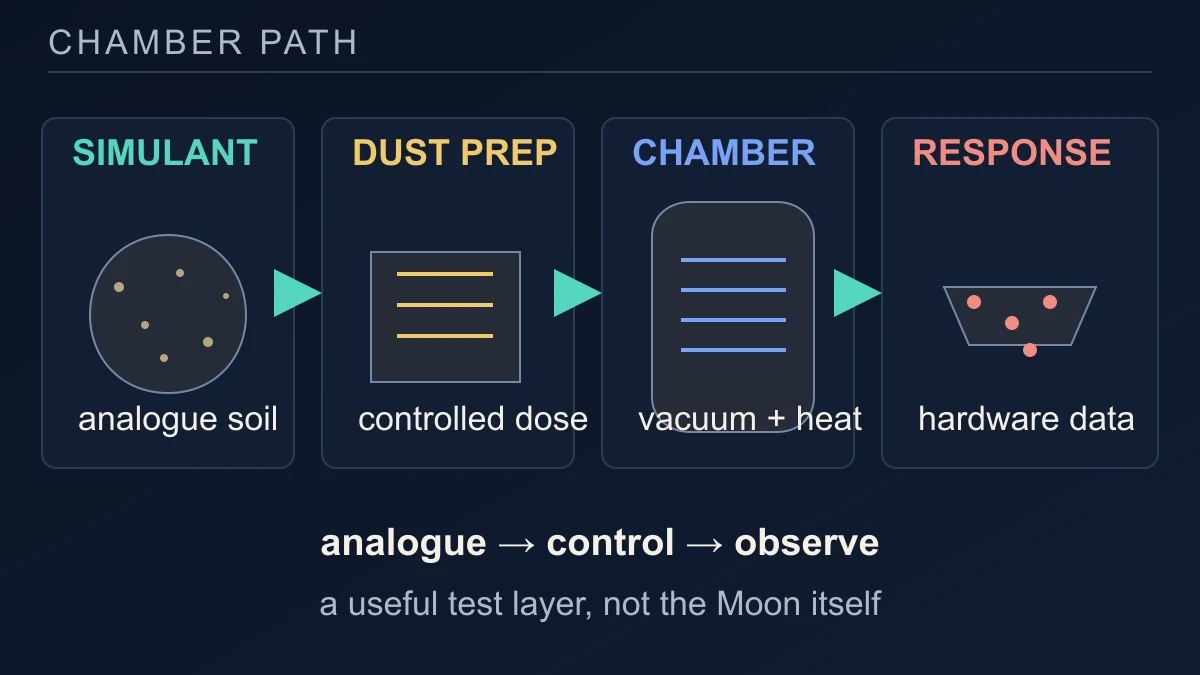
That is why a chamber test begins with a defined analogue and a controlled dose. NASA's lunar-regolith simulant work treats the material as an engineering proxy with documented particle-size distributions, agglutinates and mineralogical and physical characteristics. It is designed to reproduce selected properties of regolith for testing; it is not a jar of untouched lunar soil and does not automatically reproduce every electrical, chemical or mechanical condition on the Moon.
How simulant, vacuum and nitrogen make a useful test environment
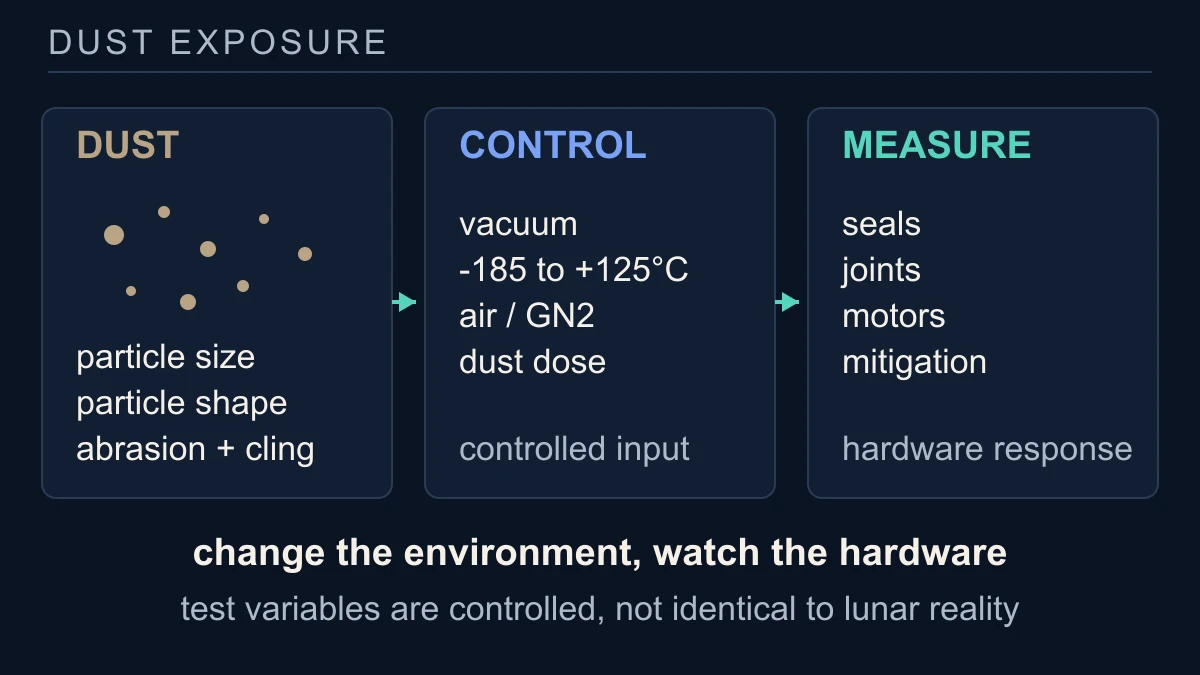
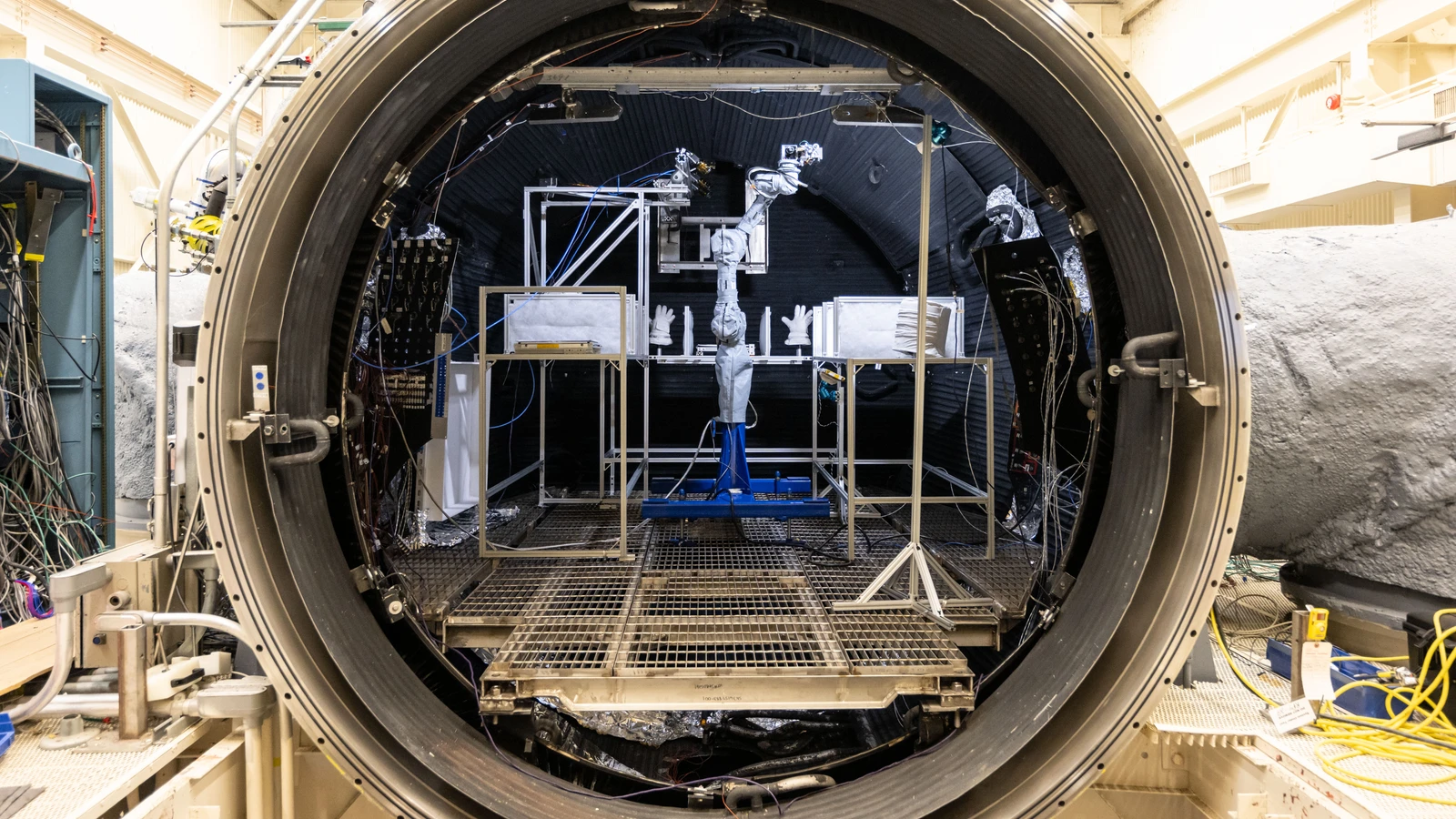
At NASA Johnson, lunar-development testing combines a dust-preparation capability with thermal-vacuum infrastructure. NASA's current facility description says hardware can be tested in vacuum with lunar-regolith simulant, while a closed-loop nitrogen system supports the preparation and repressurisation process. The point is to control the sequence: prepare the analogue, place a measured exposure around the hardware, pull down the pressure, change the temperature and observe what the system does.
The supporting Johnson dust record describes a 15-foot dirty thermal-vacuum chamber with a vacuum range from 1 × 10^-6 torr to 760 torr and a temperature range from -185°C to +125°C. It lists air or gaseous-nitrogen repressurisation, filtration, high-power feed-throughs, a regolith bin and a drill-tube capability, as well as a smaller three-foot chamber for component work. Those specifications describe the facility's available test envelope; they do not mean every test uses every limit at once.
Inside that envelope, a team can change one variable while watching another. It can compare a seal before and after a controlled dust dose, inspect a joint after vacuum and thermal cycling or measure whether a mitigation approach keeps a motor or instrument usable. NASA's simulant-development work adds an important qualification: analogue material is selected and characterised for the question being tested. The resulting measurement is stronger than an anecdote because the input and environment are recorded, but it remains a measurement of the chosen proxy and test recipe.
What a ground test can and cannot establish about lunar operations
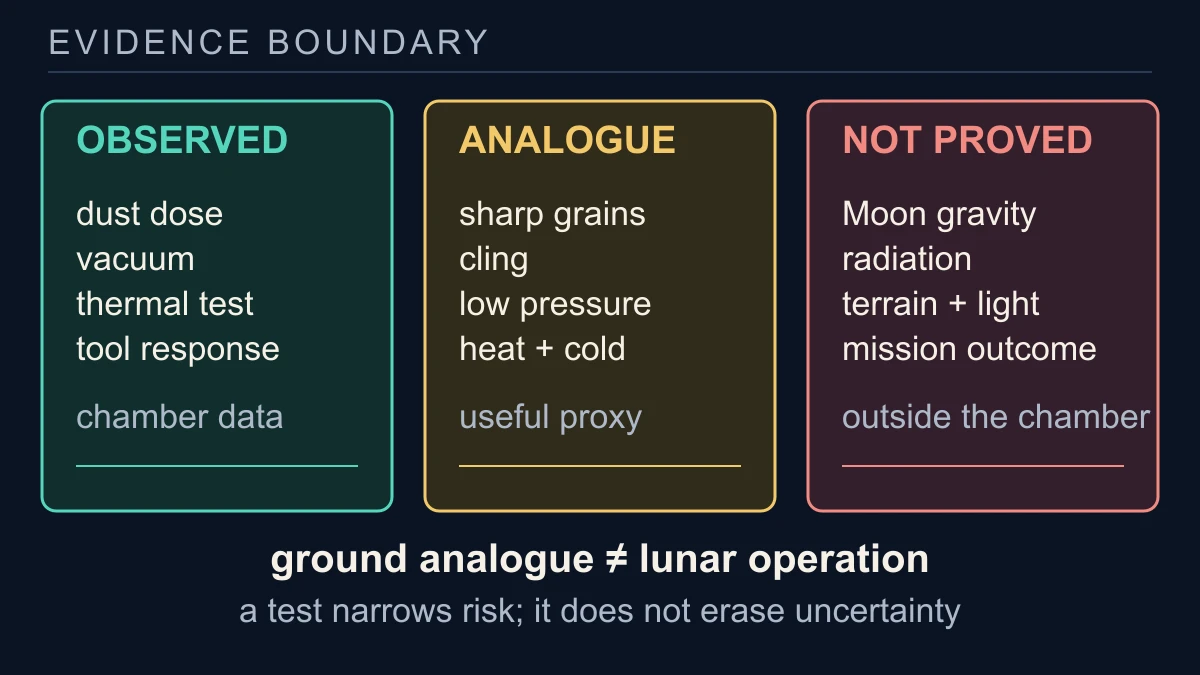
A ground test can establish how a particular hardware configuration responded to a specified dust dose, pressure range, temperature cycle and mitigation method. It can expose a weak seal, a sensitive joint, an overheating component or a useful design change before a mission carries the hardware away from the repair bench. NASA's larger Ames regolith testbeds add another kind of evidence by shaping analogue terrain and lighting for mobility and surface-operation experiments.
But an analogue is not the Moon. A chamber result does not by itself establish performance in lunar gravity, under the Moon's radiation environment or across every combination of terrain, lighting, electrostatic behaviour and operational timing. It does not turn a selected simulant into actual lunar regolith, and it does not prove that an astronaut, rover or instrument will experience the same dust distribution during a real mission. Those claims require additional tests, mission data or evidence designed for the specific missing condition.
The honest conclusion is narrower and more useful: engineers can recreate a controlled slice of the lunar-dust problem well enough to measure hardware response and reduce uncertainty. The chamber turns an abrasive, clinging material into a repeatable experiment; it does not erase the gap between a ground analogue and an operating system on the Moon.
Sources and further reading
This article was written for Curiosity Desk. We do not copy other publishers or invent quotes. If a material error is found, we correct it openly.
Read the full standards →One answer should lead to a better question
Bring your curiosity to the group
Curious Minds is our public Facebook community for surprising science, strange history, Australian wildlife and everyday questions. No copied posts, no personal-friend invitations and no link dumping.
- Three self-contained discussion prompts each week
- Sourced answers and honest uncertainty
- Respectful conversation without spam