How clusters preserve a merger record
Astronomers did not watch the Milky Way swallow LKH. The event happened roughly 12 billion years ago, so any direct scene is gone. The clue is that a galaxy can carry some of its history forward in compact groups of stars called globular clusters. These dense, roughly spherical systems can contain tens of thousands to millions of stars, and clusters that formed in different environments can retain different combinations of age, chemical enrichment and motion.
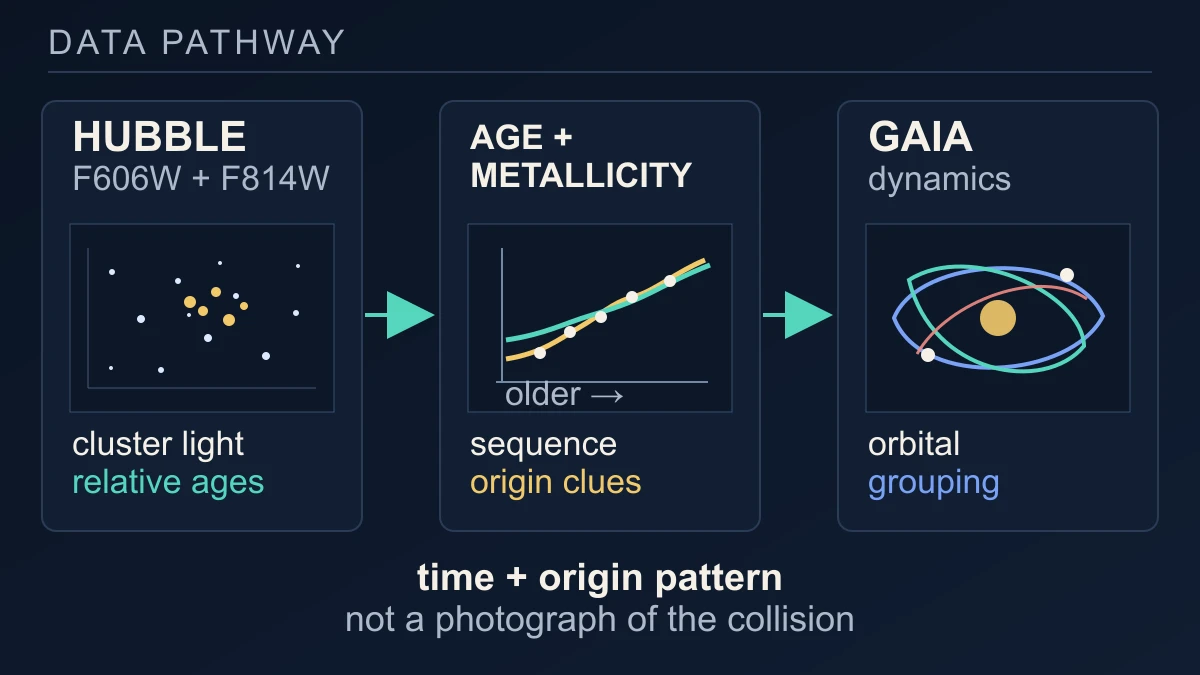
The new study used Hubble Space Telescope observations in the F606W and F814W optical bands to place clusters on a consistent photometric scale. From those data, the researchers estimated relative ages and metallicities: the abundance of elements heavier than hydrogen and helium. The paper stresses that absolute ages depend on the stellar-evolution models used, but relative ordering is the useful archaeological clue. A group that is consistently older or younger, and follows a different age–metallicity sequence, can preserve evidence that it formed in a different building block of the young Galaxy.
Gaia supplied a second kind of clue. The researchers combined the cluster chemistry and chronology with dynamical quantities that describe how clusters move through the Milky Way, including the influence of the Galaxy's rotating bar. The result is not a picture of the old collision. It is a constrained reconstruction: several independent properties of surviving clusters line up in a pattern that is difficult to explain with only the Milky Way's original population and the later Gaia-Sausage-Enceladus merger.
Why three sequences point to three origins
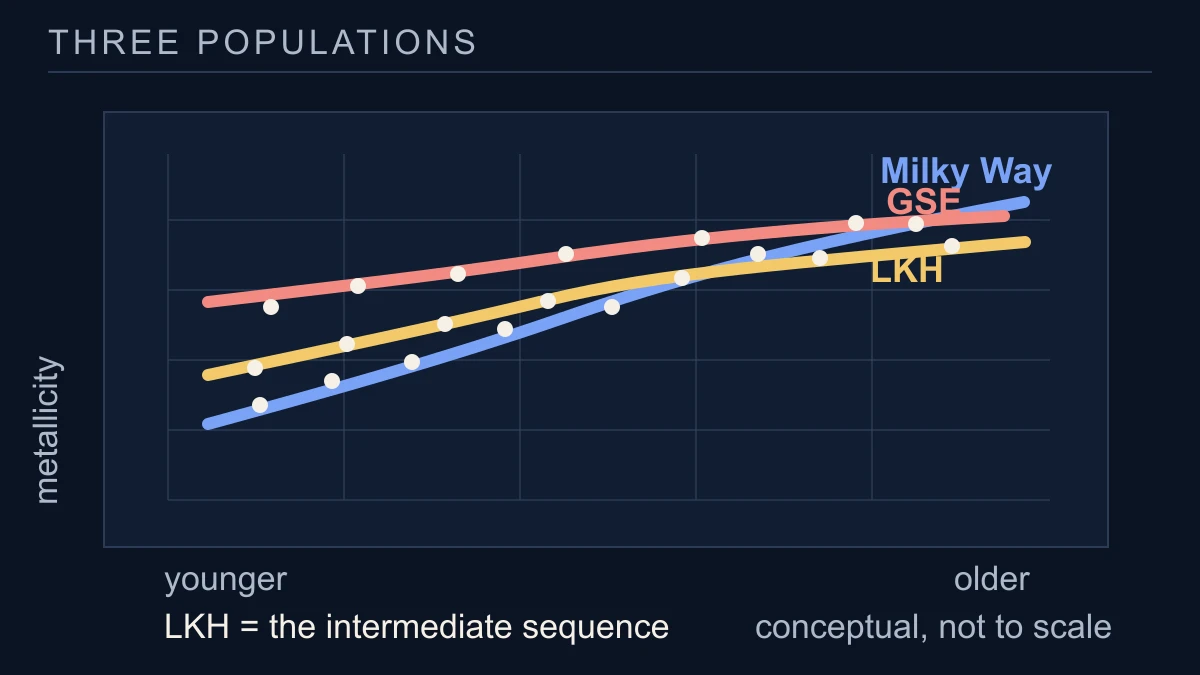
The paper analysed a total of 39 globular clusters with homogeneous age determinations. It tested statistical models containing two, three or four progenitor populations. The three-population model had the strongest evidence. One sequence was associated with clusters born in the Milky Way's main progenitor, one with the Gaia-Sausage-Enceladus merger about 10 billion years ago, and a third intermediate sequence.
That intermediate group is the key result. Twelve of the 15 clusters that earlier work had placed in a low-energy group were assigned to it with high probability, and they are concentrated within about 6 kiloparsecs of the Galactic centre. Their ages sit between the older Milky Way group and the clusters associated with Gaia-Sausage-Enceladus, while their chemical pattern is distinct. The study interprets the group as debris from a separate dwarf galaxy that the young Milky Way absorbed earlier.
The authors call that progenitor Low-energy-Kraken-Heracles, or LKH. Relative to Gaia-Sausage-Enceladus, the event is estimated to have happened about 1.8 billion years earlier. The paper anchors the timing at roughly 12.3 billion years ago and the stellar mass at about 5 × 10^8 times the mass of the Sun, with uncertainties. NASA's public summary rounds the timing to about 11.8 billion years, or roughly 2 billion years after the Big Bang. Those numbers are compatible descriptions at different precision, not two separate collisions.
What the evidence does and does not prove
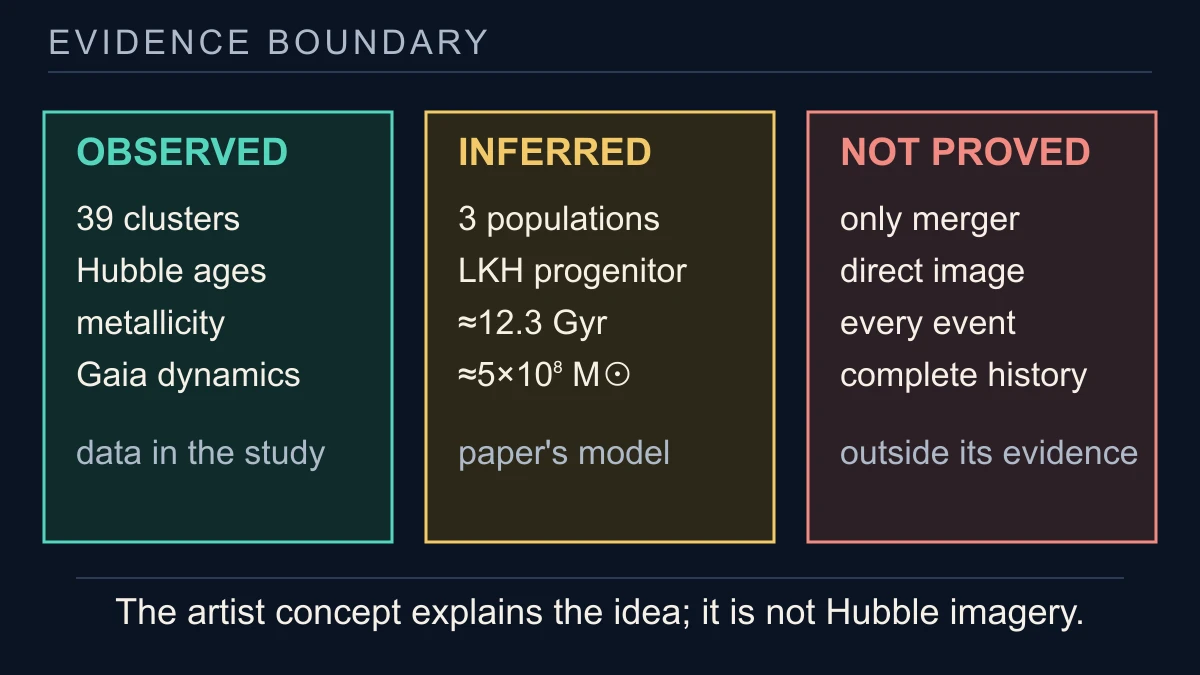
The strongest conclusion is not that Hubble found a hidden photograph. It is that the cluster population contains a third, coherent time-and-origin sequence, and the paper's model finds it most naturally explained by a substantial early accretion event. The result pushes the documented merger history farther back and shows that stars born outside the Milky Way contributed to its earliest structure.
Several boundaries stay attached to that conclusion. The absolute age scale is model-dependent even though the relative ordering is precise. The inferred accretion time is a proxy based on the cluster formation history, and the authors note that star formation can end before an accretion event is fully complete. The study also cannot rule out other, less massive progenitors that left no globular clusters, or progenitors whose clusters were later disrupted. LKH is therefore not proven to be the only merger or the literal first event in the Galaxy's history.
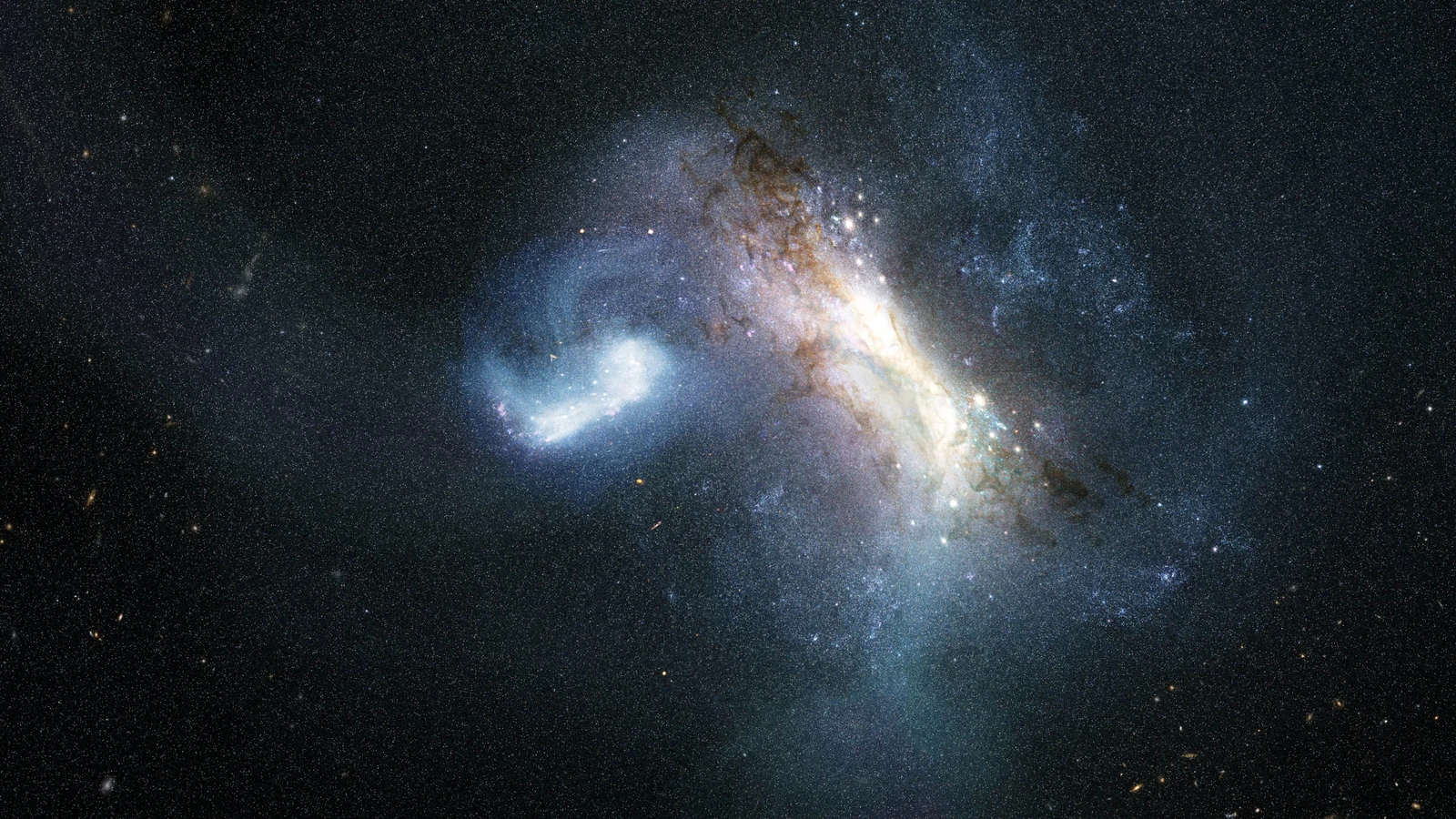
The NASA/ESA image at the top of this article is an artist's concept: it visualises LKH on the left meeting a young Milky Way on the right, but it is not Hubble imagery of the collision. The actual evidence is quieter and more powerful—a set of measured cluster properties, a statistical comparison of possible origins and a careful statement of what remains outside the data.
Sources and further reading
This article was written for Curiosity Desk. We do not copy other publishers or invent quotes. If a material error is found, we correct it openly.
Read the full standards →One answer should lead to a better question
Bring your curiosity to the group
Curious Minds is our public Facebook community for surprising science, strange history, Australian wildlife and everyday questions. No copied posts, no personal-friend invitations and no link dumping.
- Three self-contained discussion prompts each week
- Sourced answers and honest uncertainty
- Respectful conversation without spam