The spacecraft did not visit Mars because it took a wrong turn
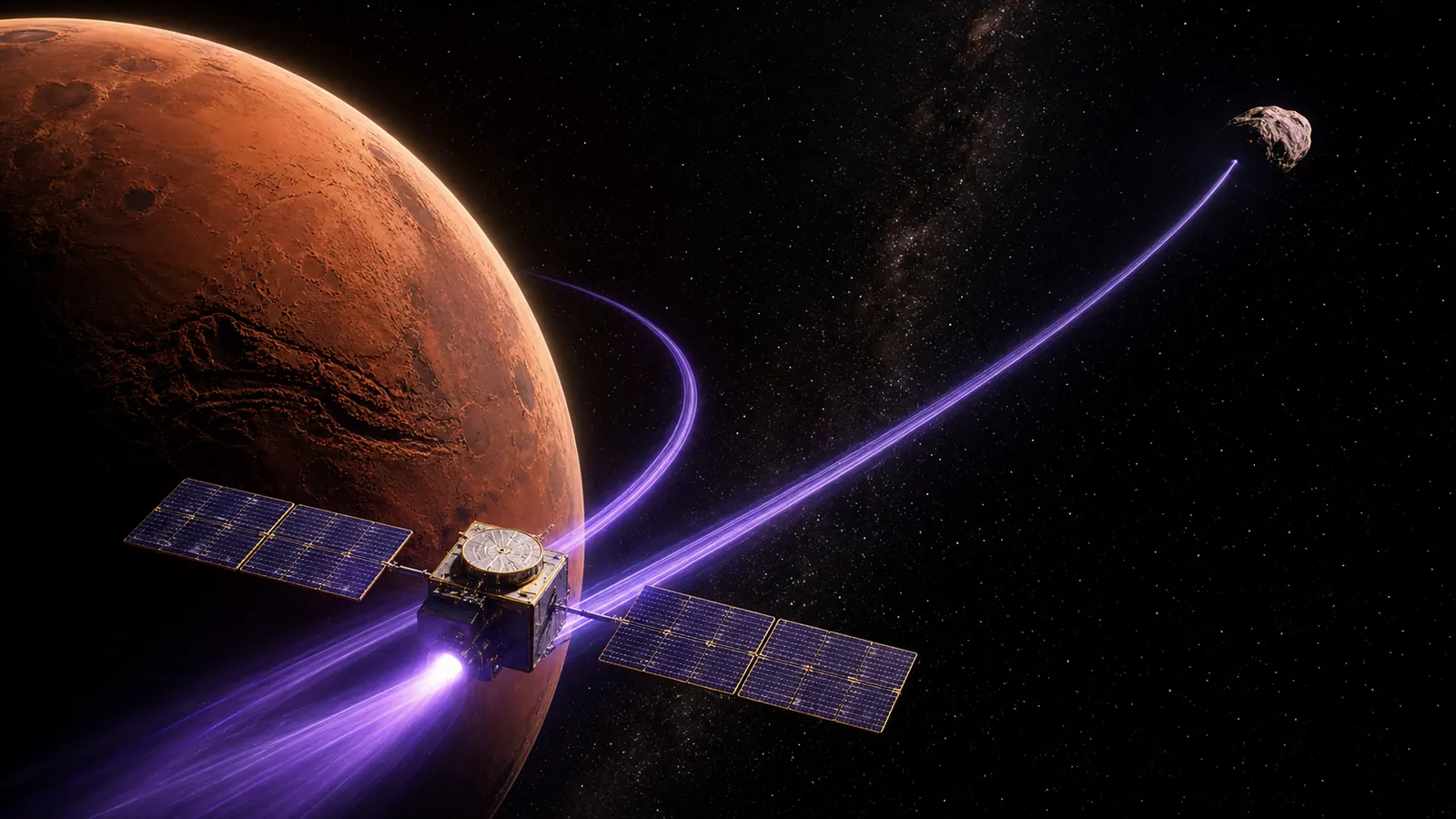
NASA's Psyche spacecraft is travelling toward an asteroid in the main belt, yet on 15 May 2026 it came within 4,609 kilometres of Mars. That detour had been designed years earlier. By approaching the moving planet on a carefully calculated path, Psyche changed its speed and tilted its orbital plane without carrying the propellant required for the same large manoeuvre under rocket power.
A gravity assist is not a free push from a stationary planet. The spacecraft enters and leaves the planet's moving gravitational field along different directions. In a Sun-centred view, a tiny exchange of momentum with Mars can change the craft's energy and trajectory. Mars also changes by an immeasurably small amount. Navigation had to be exact: the useful curve existed between missing the planned geometry and approaching too closely.
Mars became the practice asteroid the team already understood
The encounter offered more than navigation. Psyche's target is a distant, metal-rich world that no spacecraft has explored up close. Mars, by contrast, has extensive measurements from orbiters and rovers. The team used the familiar planet to test the multispectral imager, magnetometer, and gamma-ray and neutron spectrometer under real deep-space operating conditions.
NASA's July analysis says the instruments operated as designed and returned data consistent with existing Mars knowledge while adding views from Psyche's unusual geometry. The imager captured an enhanced-colour mosaic and detected the moons Phobos and Deimos from far away, rehearsing the search for possible small satellites around the asteroid. Calibration against known Mars data helps reveal whether a surprising future signal belongs to the target or the instrument.
The pictures are beautiful, but the invisible measurements are the real rehearsal
A camera can map surface colours and features, but Psyche's scientific question reaches beneath appearance. The magnetometer will look for evidence of remanent magnetisation. The gamma-ray and neutron spectrometer will analyse elemental signatures. Together with gravity and imaging, those measurements can test ideas about how the asteroid formed and how much metal it contains.
The popular description says Psyche might be the exposed core of an early planetary body. That is a hypothesis, not the mission's result. Other formation paths could produce a metal-rich object. Mars could verify that each instrument behaved plausibly; it could not answer the asteroid's origin in advance. The spacecraft must reach its target and combine multiple datasets before the dramatic core story earns or loses support.
Mars is behind it; the most curious world is still ahead
After the flyby, the spacecraft continued toward asteroid Psyche and is scheduled to arrive in August 2029. NASA says it will resume sustained solar-electric propulsion later in 2026. That propulsion supplies gentle, efficient thrust over long periods, while the single Mars encounter delivered a major geometric change at the right point in the journey.
The milestones now form a clean chain: stable cruise, instrument checks, arrival, orbital insertion and months of mapping at different altitudes. Only then can scientists compare density, composition, magnetic history and geology. The flyby did not solve the metal world. It made the solution more trustworthy by testing the tools on a planet we already know—and by borrowing exactly enough motion from Mars to reach a mystery that would otherwise demand much more fuel.
A familiar planet became the calibration target for an unfamiliar world
Mars gave the team something asteroid Psyche cannot: a well-studied target with existing maps and known features. Images, thermal measurements and magnetic observations made during the encounter can be compared with decades of other Mars data. Agreement does not prove every future result will be perfect, but it can expose alignment, timing or calibration problems while engineers still have years to understand them before arrival.
That is why the flyby was more than celestial slingshot theatre. It changed the spacecraft's path and rehearsed the act of turning raw measurements into interpretable science. When Psyche finally fills the instruments' field of view, there will be no detailed ground truth waiting underneath. The confidence earned at Mars will help researchers decide whether a strange pattern belongs to a metal-rich asteroid or to the machinery used to observe it.
Sources and further reading
This article was written for Curiosity Desk. We do not copy other publishers or invent quotes. If a material error is found, we correct it openly.
Read the full standards →One answer should lead to a better question
Bring your curiosity to the group
Curious Minds is our public Facebook community for surprising science, strange history, Australian wildlife and everyday questions. No copied posts, no personal-friend invitations and no link dumping.
- Three self-contained discussion prompts each week
- Sourced answers and honest uncertainty
- Respectful conversation without spam