The pattern starts while the fingertip is still being built
A fingerprint is not scratched onto finished skin. Its primary ridges begin taking shape before birth, at the boundary between the outer skin and the tissue beneath it. Human developmental studies place the first fingertip ridges after roughly the tenth week of gestation, with the broad arch, loop or whorl arrangement defined during the following weeks.
At this stage each fingertip carries a temporary rounded swelling called a volar pad. The pad is changing shape as the finger grows. That curved landscape matters because a ridge pattern must spread across it; a wave travelling over a high, rounded pad meets its neighbours differently from one crossing a flatter pad.
Three signalling pathways create a repeating stripe
The spacing begins inside the developing skin. A 2023 Cell study found that WNT and EDAR signalling promote ridge-forming activity, while BMP signalling opposes it. Activating and inhibiting signals influence one another across short distances, creating a repeating pattern rather than turning the whole fingertip into one continuous thick ridge.
This is described as a Turing reaction-diffusion system, after the mathematical idea that interacting substances can turn an initially even field into spots or stripes. The name does not mean a fetus follows a rigid fingerprint blueprint. It describes a self-organising rule that sets up regularly spaced bands of active and quieter tissue.
A fingerprint grows from several places at once
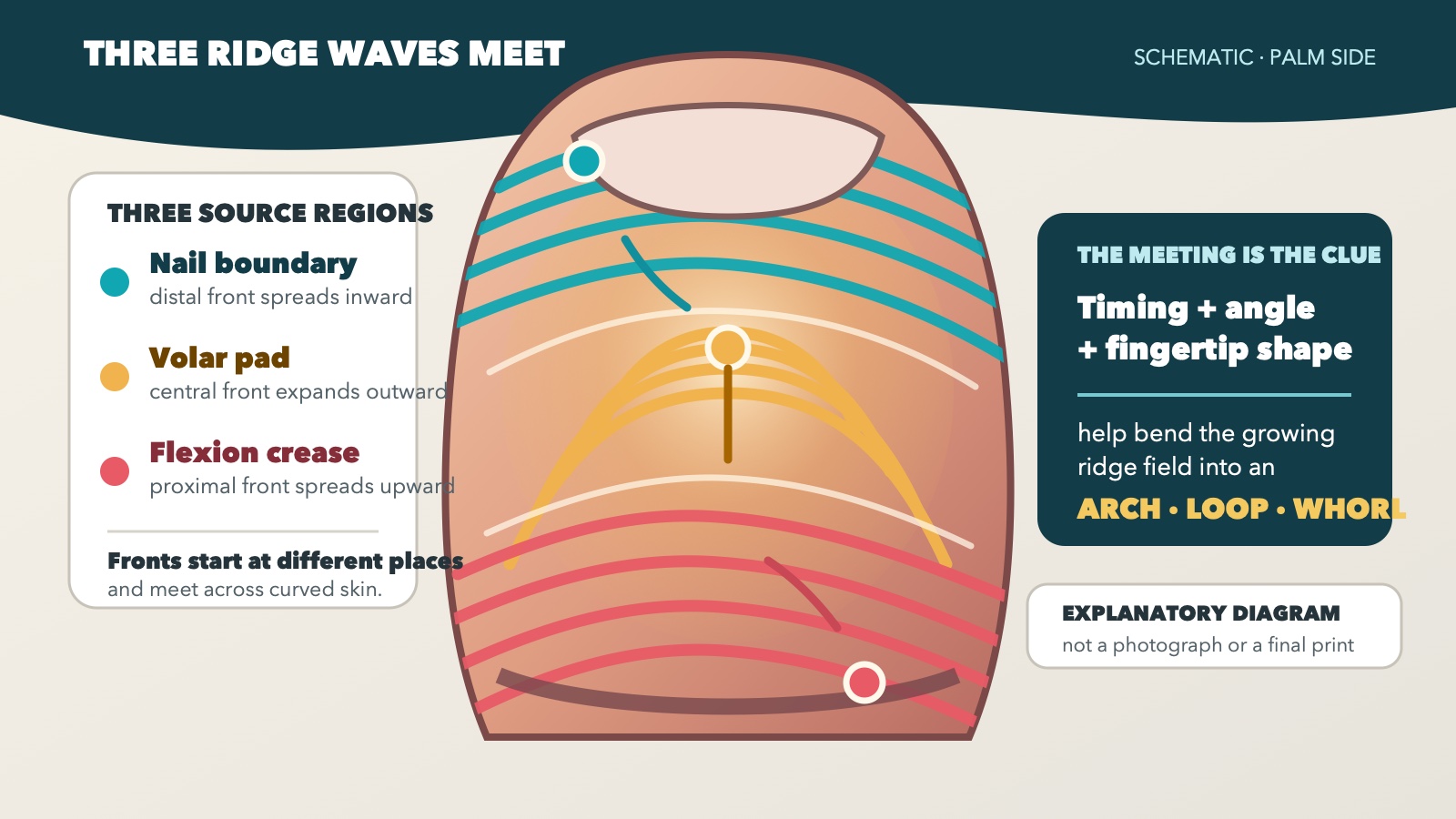
On a fingertip, ridge formation can begin near the centre of the volar pad, along the boundary by the nail and near the flexion crease closest to the tip. The molecular pre-pattern appears first, then bands of concentrated cell growth form downward folds in the epidermis. Those ridge-forming fronts spread like slow waves across the surface.
The fronts do not simply march in parallel from one edge. They begin at slightly different times and angles, encounter curved boundaries and eventually meet. The meeting geometry can bend lines into a loop, close them into a whorl or let them cross the fingertip as an arch. A complicated visible pattern can therefore emerge from one spacing rule acting in several local regions.
Fingerprint ridges borrow the opening act of hair development
The primary study found that early fingerprint ridges share part of the developmental programme used to start hair follicles. Both begin as organised activity in the epithelium. Fingerprint ridges, however, do not recruit the same cluster of cells underneath that would continue building a hair follicle, so the programme stops on a different path.
Localised growth pushes the softer basal layers downward beneath a stiffer upper layer. Continued development turns those internal folds into the raised surface ridges we can see and touch. Sweat-gland openings later line the ridge tops, but the glands do not draw the original arch, loop or whorl.
Genes influence the landscape without specifying every line
Genetics matters. A separate large human study linked fingerprint pattern types to genes involved in limb growth and showed that the proportions of fingers and the shape of the developing digit help influence whether arches, loops or whorls are more likely. Some rare genetic conditions can disrupt ridge formation altogether.
That is different from saying one gene encodes one finished print. Genes help set the signalling system, growth rate and fingertip geometry. Small developmental differences then affect when and where the waves start and how they collide. Even identical twins, who share almost all their DNA, do not acquire identical fine ridge details.
The lasting print is a record of a moving developmental system
Once the primary ridge arrangement is established, later growth enlarges it rather than redrawing it from scratch. Ordinary surface wear does not erase the deeper pattern; new outer skin follows the same underlying architecture. A sufficiently deep injury can produce a scar, which is why permanence should not be overstated as invulnerability.
The remarkable part is not that the womb presses a random texture into the skin. A fingertip builds its own pattern. Molecular activators and inhibitors space the ridges, anatomy supplies several starting boundaries, and growth brings the waves together. Your fingerprint is the durable surface trace of those processes meeting once.
Sources and further reading
This article was written for Curiosity Desk. We do not copy other publishers or invent quotes. If a material error is found, we correct it openly.
Read the full standards →One answer should lead to a better question
Bring your curiosity to the group
Curious Minds is our public Facebook community for surprising science, strange history, Australian wildlife and everyday questions. No copied posts, no personal-friend invitations and no link dumping.
- Three self-contained discussion prompts each week
- Sourced answers and honest uncertainty
- Respectful conversation without spam