The plasma is hot enough to fuse nuclei but thin enough to control
ITER describes a tokamak plasma target around 150 million degrees Celsius, roughly ten times the Sun's core temperature. Temperature measures average particle energy, not the total heat stored in an entire object. Laboratory plasma is far less dense than the Sun, so a tiny volume does not contain the same total thermal energy as an equally sized piece of solid material.
That distinction prevents one misleading picture but does not make wall contact harmless. Fast particles and intense heat flux can damage surfaces. A fusion device must keep the hottest core away from material walls, remove escaping energy in designed regions and shut down or mitigate unstable events before concentrated loads strike vulnerable components.
Charged particles curve when they cross a magnetic field
Fusion fuel becomes plasma when electrons separate from atomic nuclei. Those charged particles feel the Lorentz force as they move through magnetic fields, causing their paths to curve around field lines. A magnet cannot grip neutral hot gas in the ordinary way; it controls the ionised state because electrical charge couples motion to the field.
Particles spiral rapidly around a line while also travelling along it. If field lines simply ran between two ends, many particles would escape. Tokamaks close the main direction into a torus—a doughnut-shaped chamber—so a particle following the field can circulate instead of immediately reaching an end plate.
Two looping fields are combined to stop particles drifting away
Large external coils create a toroidal field around the long way of the doughnut. An electric current driven through the plasma creates a poloidal field around the short way. Combined, the fields trace helical paths. This twist helps average out drifts that would otherwise move charged particles toward one side of the vessel.
Additional coils shape and position the plasma. Feedback systems watch its motion and adjust fields because the ring is not a rigid object. Pressure gradients, currents and turbulence continually test the configuration. The magnetic bottle is therefore a controlled landscape of curved paths, not a static shell that the plasma cannot cross.
The edge is directed toward a component built to take the punishment
Some particles and heat inevitably move across magnetic surfaces. Tokamaks shape edge field lines toward a divertor, a heavily engineered region that removes helium ash and impurities and receives substantial heat. Even there, spreading and cooling the exhaust enough for materials to survive is one of fusion engineering's hardest problems.
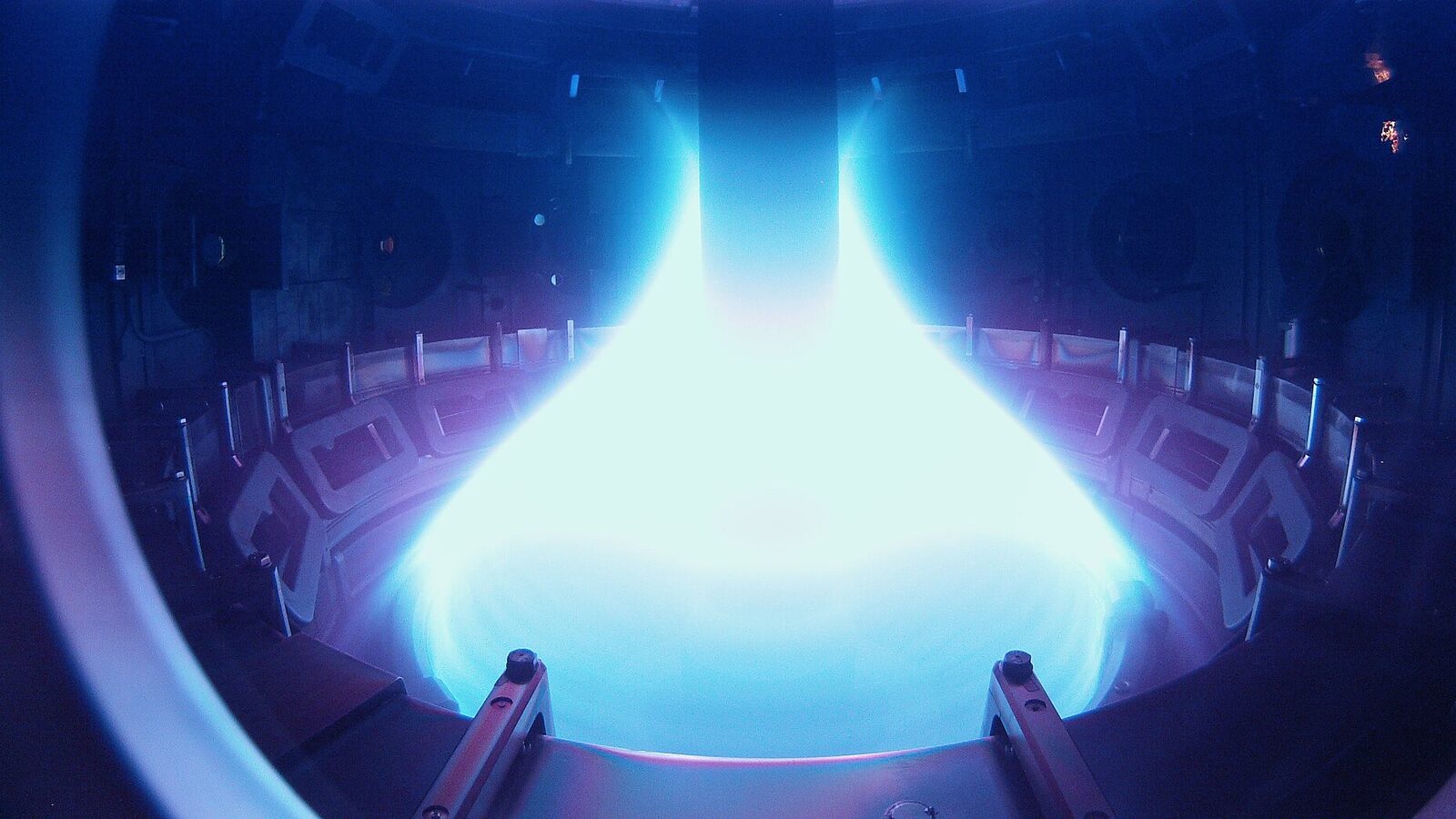
A bright plasma photograph does not show empty space separating every particle from every surface. The hottest core is magnetically isolated while a cooler, turbulent edge interacts with gas, radiation and designed components. Confinement quality is measured through losses, stability and retained energy, not by claiming that nothing ever touches the wall.
A disruption proves the bottle is a balancing act
Plasma instabilities can rearrange magnetic fields or rapidly release stored energy. A major disruption can send heat and electromagnetic forces into the vessel, while runaway electrons may form damaging beams. Researchers use shaping, feedback, impurity injection and predictive control to avoid or soften these events.
ITER is designed to test long-pulse reactor-scale plasma and supporting technologies; it will not generate electricity for the grid. The magnetic principle is already demonstrated across many machines. The frontier lies in sustaining a burning plasma with manageable exhaust, dependable materials and controlled instabilities long enough for a practical power plant to use the heat.
The coils are powerful because the field must be steady and precisely shaped
Large tokamaks use superconducting coils so very high currents can circulate with low electrical resistance after the magnets are cooled. The cryogenic magnet system and the superhot plasma occupy different engineered environments, separated by vacuum structures, shielding and the vessel. Hotter-than-the-Sun plasma does not mean the whole machine shares that temperature.
Magnet protection remains demanding. Rapidly changing fields and forces can load enormous coils, and a superconducting quench converts stored magnetic energy into heat that must be safely managed. A practical fusion plant therefore balances extremes: cryogenic magnets outside, energetic plasma inside and material systems between them that must survive radiation, forces and repeated operation.
Sources and further reading
This article was written for Curiosity Desk. We do not copy other publishers or invent quotes. If a material error is found, we correct it openly.
Read the full standards →One answer should lead to a better question
Bring your curiosity to the group
Curious Minds is our public Facebook community for surprising science, strange history, Australian wildlife and everyday questions. No copied posts, no personal-friend invitations and no link dumping.
- Three self-contained discussion prompts each week
- Sourced answers and honest uncertainty
- Respectful conversation without spam