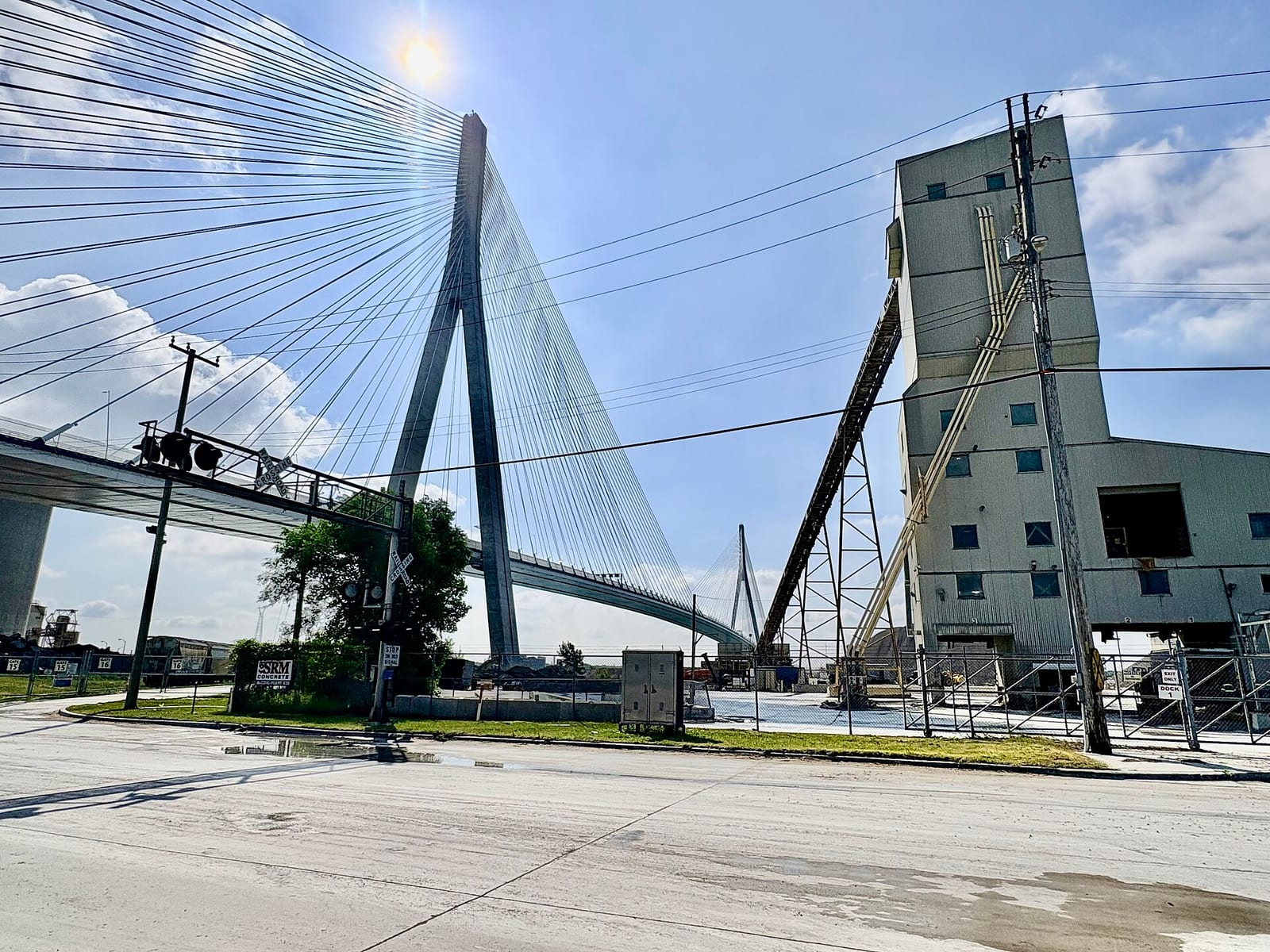
The bridge is only the most visible part of the crossing
The Gordie Howe International Bridge opened to traffic on 27 July 2026 between Windsor, Ontario, and Detroit, Michigan. Its two towers and fan of cables dominate photographs, but a traveller is using a much larger system. The project directly joins Ontario's Highway 401 to Michigan's Interstate 75 and includes highway approaches, tolling, border inspection buildings and separate facilities for passenger and commercial vehicles.
That distinction explains an otherwise puzzling set of numbers. The bridge itself has six traffic lanes. The complete crossing has 16 toll lanes and, according to the bridge authority, 60 Canadian and United States inspection lanes. More lanes at the ends are not excess decoration. A road can carry vehicles continuously, while a border officer may need to check documents, declarations, cargo or a vehicle one at a time.
An 853-metre opening hangs between two banks of cables
The bridge extends roughly 2.5 kilometres from end to end, but its record belongs to the 853-metre main span over the Detroit River. A main span is the distance between the principal supports, not the length of every approach and side span added together. Government of Canada material identifies it as the longest main span of any cable-stayed bridge in North America.
In a cable-stayed bridge, sloping steel stays run directly between the deck and tall towers. The stays transfer the deck's load into those towers, while the towers carry the force down toward their foundations. The repeating fan makes the structure look delicate, yet its purpose is practical: it supports a long river opening without placing a pier in the navigation channel beneath the main span.
The towers solve a river problem, not the border problem
The bridge authority puts the towers at about 220 metres high. Their height gives the stay cables useful angles and makes the crossing a landmark, but the bridge deck cannot decide who or what may enter another country. That job begins in the ports of entry on either shore, where Canadian and United States agencies operate under their own laws and procedures.
Canada describes its new facility as the country's largest and most technologically advanced land border crossing. Its 24 primary inspection lanes can be configured for different mixes of commercial and traveller traffic. It also has dedicated trusted-traveller and trusted-trader lanes, commercial examination docks, enclosed examination bays and imaging and detection equipment for checks that cannot be completed at the first booth.
Extra lanes prevent one slow check from becoming a bridge-wide queue
A six-lane bridge can deliver vehicles faster than six inspection booths could process them when one document problem or cargo examination takes several minutes. The wider inspection plazas divide that flow. Routine travellers can move through primary inspection while selected vehicles leave the main stream for secondary examination. Commercial trucks can use facilities designed for their size and paperwork instead of occupying a passenger lane.
The same principle explains the 16 toll lanes. A toll point is another place where individual transactions can slow a continuous road. Multiple manual, automatic and electronic options let the crossing separate different payment needs before those short delays spread backward. Intelligent video, lane controls, weather monitoring and travel-time detection then help operators respond when demand, an incident or conditions change.
Highway-to-highway matters as much as shoreline-to-shoreline
The Windsor-Detroit corridor carries about 30 per cent of Canada-United States trade moved by truck, according to the Canada Border Services Agency. The new bridge does not replace every existing crossing, but it adds a direct route between two major highway systems. A truck can move from Highway 401 through the Canadian port, across the river, through the United States port and toward I-75 without relying on the same city-street connection as an older crossing.
That network effect is why the project includes the Michigan interchange and road works beyond the dramatic span. A bridge with poor approaches can move a bottleneck from the water to the first intersection. A direct motorway connection gives long-distance passenger and freight traffic another path, while the Ambassador Bridge and Windsor-Detroit Tunnel remain separate alternatives in the region.
Walking across uses the same span but follows a different opening
The bridge includes a toll-free multi-use path for pedestrians and cyclists, but it did not open with vehicle traffic. The bridge authority scheduled the path to welcome users on 5 August 2026 at 8:00 am. That later opening is a useful reminder that one structure can contain several transport systems whose operating preparations and safety procedures finish on different timetables.
The most impressive fact is therefore not a single record. The 853-metre main span makes the river crossing possible without a central pier, six road lanes carry the moving stream, and much larger toll and inspection areas absorb the pauses created by payment and border control. What looks like one bridge from the river is an international processing system spread across two countries.
Sources and further reading
- Government of Canada: 27 July opening and bridge dimensions ↗
- Windsor-Detroit Bridge Authority: opening, lane counts and multi-use path ↗
- Canada Border Services Agency: Canadian port-of-entry facilities ↗
- Windsor-Detroit Bridge Authority: design and traffic technology ↗
- Wikimedia Commons: June 2026 bridge photograph and CC0 licence ↗
This article was written for Curiosity Desk. We do not copy other publishers or invent quotes. If a material error is found, we correct it openly.
Read the full standards →One answer should lead to a better question
Bring your curiosity to the group
Curious Minds is our public Facebook community for surprising science, strange history, Australian wildlife and everyday questions. No copied posts, no personal-friend invitations and no link dumping.
- Three self-contained discussion prompts each week
- Sourced answers and honest uncertainty
- Respectful conversation without spam