The detector is enormous because neutrinos almost never stop
Neutrinos have no electric charge and interact through the weak force, so vast numbers pass through bodies, buildings and Earth without leaving a detectable mark. A useful observatory needs an enormous target volume to catch a small fraction of those rare interactions. IceCube instruments about a cubic kilometre of clear Antarctic ice.
The array contains 5,160 digital optical modules on 86 strings extending deep below the South Pole surface. The ice is both target and transparent detection medium. Burying sensors shields them from surface conditions, but the main advantage is scale: more material gives an incoming neutrino more chances to collide.
IceCube sees the charged debris, not the neutrino itself
When a neutrino rarely interacts with a nucleus in or near the detector, it can produce charged secondary particles such as muons, electrons or particle cascades. Those products carry information about the interaction and move through the ice. Optical modules wait for the faint light those charged particles generate.
A long muon can draw a track across much of the array, while electron- or hadron-rich interactions create more compact cascades. NASA's General Coordinates Network notes that track-like events can offer direction uncertainties below one degree at suitable energies, making them especially useful for asking telescopes to search the same patch of sky.
Faster than light in ice is not faster than light in vacuum
Light travels more slowly through ice than through empty space because it interacts with the material. A highly energetic charged particle can therefore move through ice faster than light propagates through that ice while still remaining below the universal vacuum speed limit. It creates an electromagnetic disturbance analogous to a sonic boom.
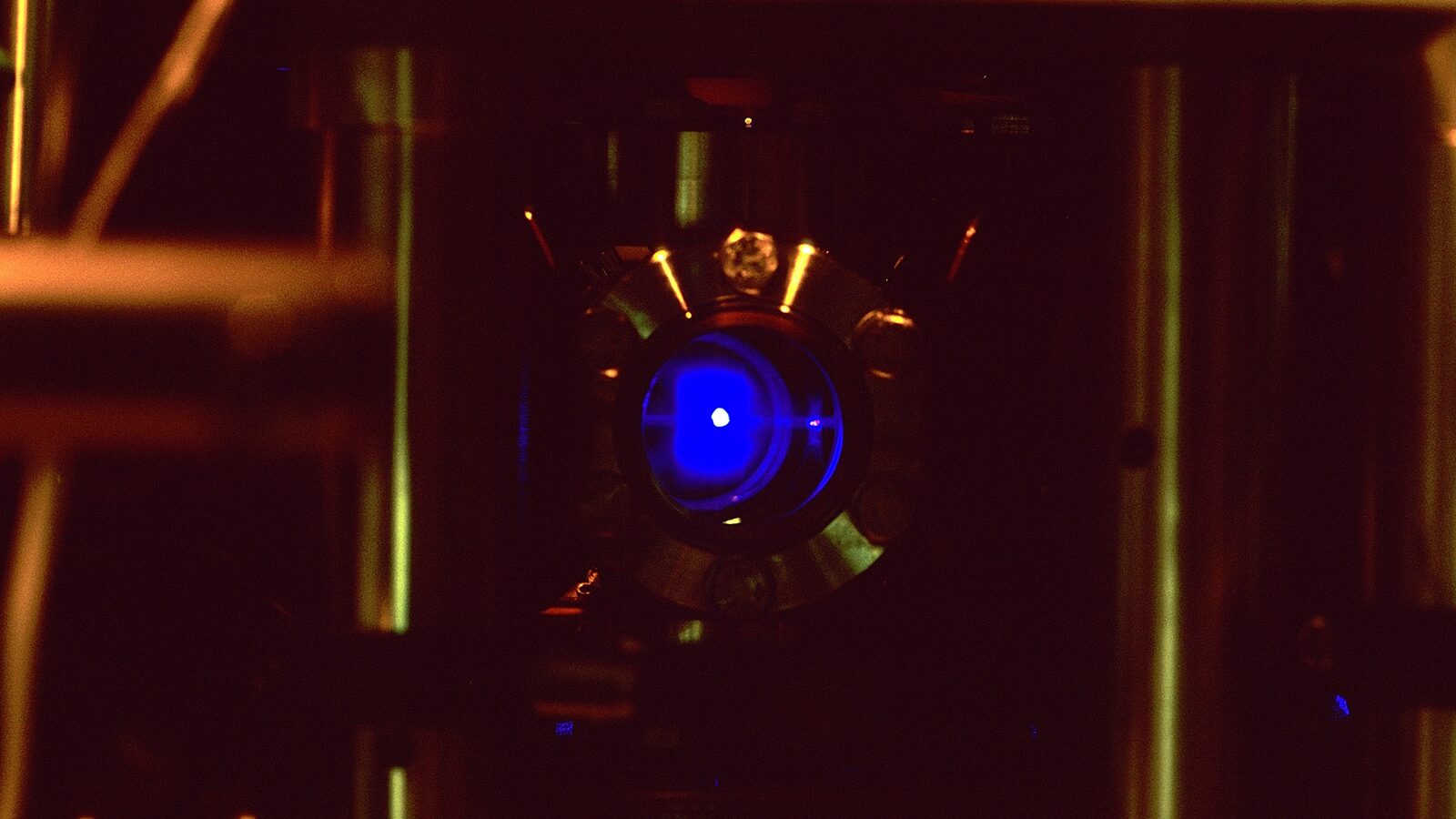
The result is Cherenkov radiation: a cone of blue light whose geometry depends on the particle's path and speed. Berkeley Lab describes IceCube's photomultipliers detecting and amplifying these flashes. The blue light is not emitted by the neutrino and does not mean the charged particle broke relativity.
Nanosecond timing turns scattered flashes into a direction
Each optical module records when light arrives and how much it detects. A particle passing near one string before another creates an ordered pattern across the array. Reconstruction software compares those times and amplitudes with models of light propagation through the ice to infer an event's direction, energy and shape.
The ice is not perfectly uniform. Dust layers, bubbles and optical scattering affect how photons travel, so calibration matters. Berkeley Lab reported timing resolution of a few nanoseconds for the modules. Precise sensors are only half the instrument; an equally careful map of the ice is needed to translate the flashes into a celestial track.
Most triggers are background, so the Earth becomes part of the filter
Cosmic rays striking the atmosphere create abundant muons that can mimic neutrino tracks from above. Researchers use direction, energy and event shape to reject backgrounds. A particle arriving upward through Earth is unlikely to be an ordinary atmospheric muon because rock would absorb it, while a neutrino can cross the planet before interacting near the detector.
Even a well-reconstructed event may have an atmospheric-neutrino origin rather than a distant cosmic source. IceCube assigns probabilities and issues rapid alerts for especially promising high-energy events so other observatories can look for light or gamma rays. The telescope succeeds by turning one rare blue footprint into a coordinated question for the whole sky.
The surface building is only the visible tip of the telescope
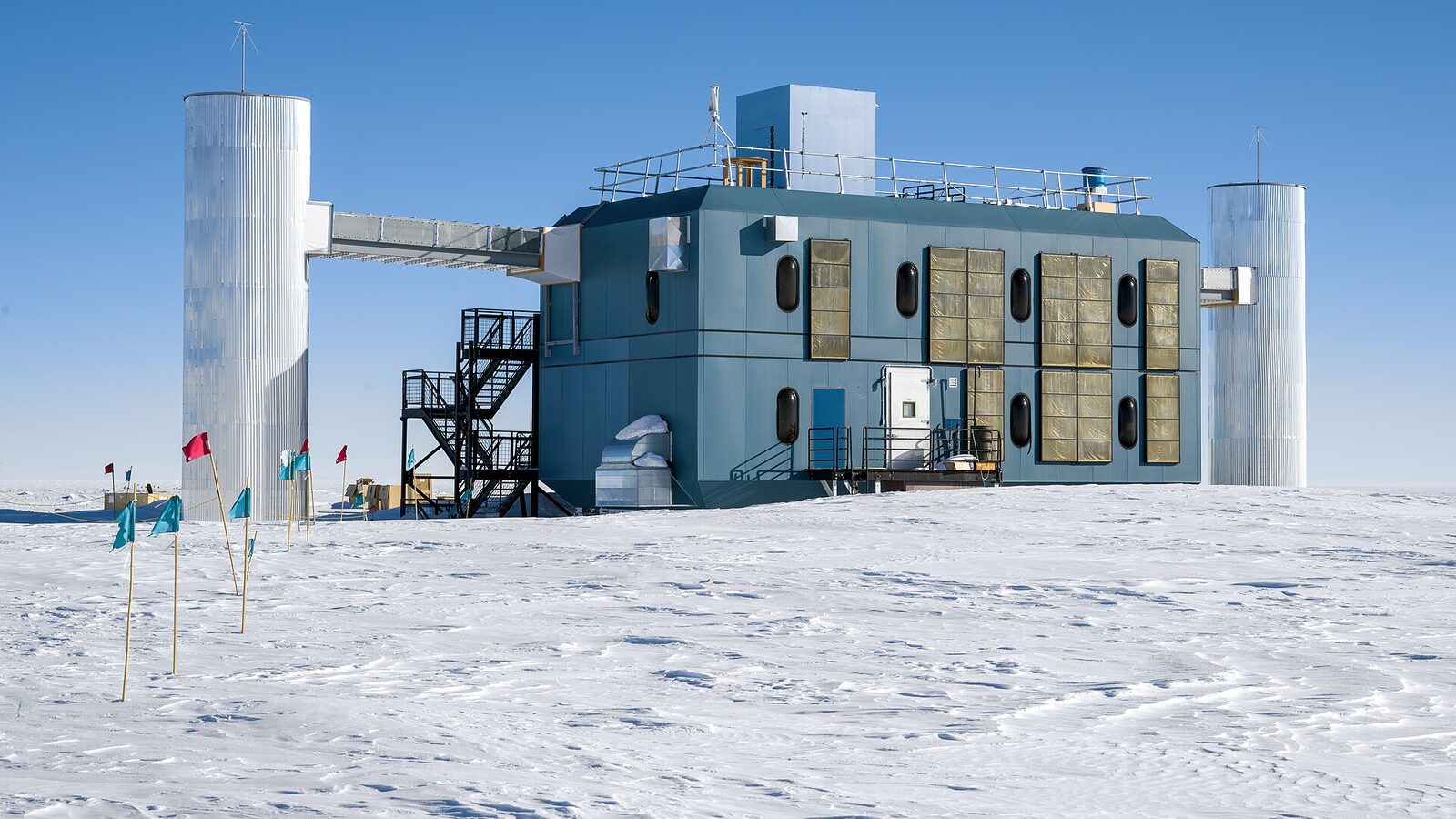
A photograph of IceCube usually shows a compact laboratory on a flat white horizon. The detecting volume is below it, where strings of sealed glass modules occupy ice between roughly 1.5 and 2.5 kilometres deep. Once frozen in place, those sensors cannot be serviced like cameras in an ordinary observatory dome.
That inaccessible design trades repairability for a naturally vast, dark and stable medium. Electronics inside each module digitise signals before sending data upward. Calibration lights and models keep the buried geometry understandable over years. The instrument's most important component is not the building or one sensor; it is the mapped relationship among thousands of sensors and a cubic kilometre of ice.
Sources and further reading
This article was written for Curiosity Desk. We do not copy other publishers or invent quotes. If a material error is found, we correct it openly.
Read the full standards →One answer should lead to a better question
Bring your curiosity to the group
Curious Minds is our public Facebook community for surprising science, strange history, Australian wildlife and everyday questions. No copied posts, no personal-friend invitations and no link dumping.
- Three self-contained discussion prompts each week
- Sourced answers and honest uncertainty
- Respectful conversation without spam