The stage is headed for the Moon, not back toward Earth
NASA says the object is the used upper stage from the Falcon 9 launch that sent Firefly Aerospace’s Blue Ghost 1 lander toward the Moon on 15 January 2025. After deployment, the stage remained in the Earth–Moon system. Solar activity and gravitational forces changed its path until it began an unplanned return toward the lunar surface.
NASA’s Center for Near Earth Object Studies later confirmed a 100% chance of lunar impact near the Einstein and Bell craters on Wednesday 5 August. That statement is about the stage’s tracked trajectory, not a threat forecast. The object is already committed to the Moon; NASA says the event poses no danger to Earth.
Without an atmosphere, the Moon cannot soften the arrival
A falling object on Earth pushes through a deep atmosphere. Drag converts some of its motion into heat, can break it apart and may slow light debris dramatically. The Moon has no substantial atmosphere to provide that braking. The spent stage therefore keeps far more of its impact speed until solid metal meets lunar rock.
Speed matters because an impactor’s motion carries kinetic energy. At contact, that energy does not simply make a stage-shaped dent. It compresses and pulverises the surface, launches a shock through the ground and forces excavated material up and outward. The spray of dust, fragments and sometimes melted rock is called ejecta.
The result should be a small new crater, not damage to the Moon
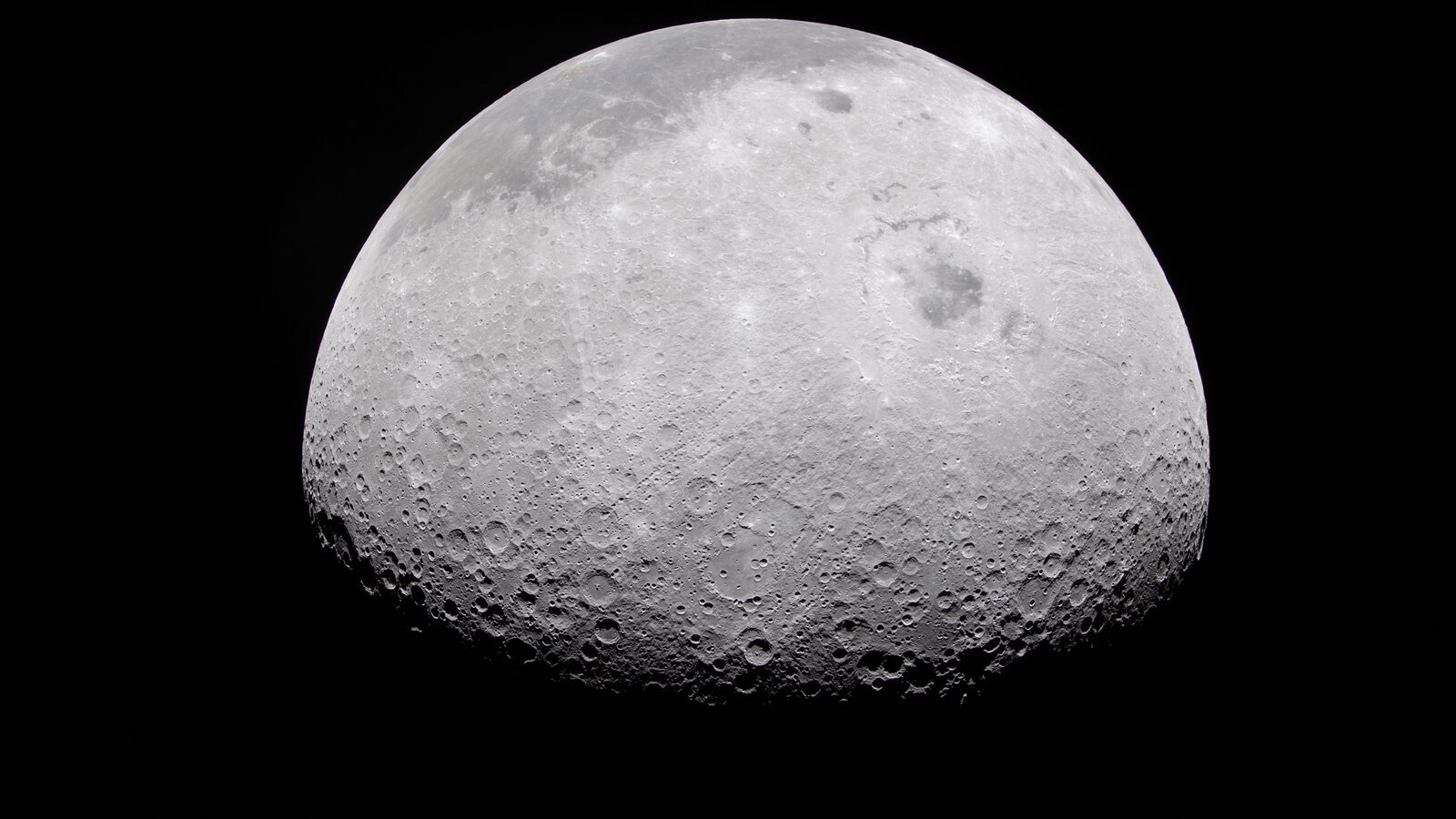
NASA expects the stage to excavate a crater about 60 feet wide and 12 feet deep—roughly 18 metres across and 3.7 metres deep. That is large beside a person or a house, but minute on a world whose diameter is about 3,475 kilometres. The event cannot shift the Moon’s orbit, crack it open or send it toward Earth.
The predicted crater is also ordinary by lunar standards. NASA estimates that a natural meteoroid carrying similar impact energy hits the Moon about once every six days. Human-made impacts are less common, but Apollo upper stages and spacecraft such as LADEE have already produced small craters that the Lunar Reconnaissance Orbiter later identified.
The flash will not become a naked-eye show
NASA says people should not expect to watch the collision by looking at the Moon. The impact will not be visible to the naked eye from Earth. The stage is small, the target is distant and the useful signal may be a brief flash or plume whose visibility depends on geometry, sunlight and observing conditions.
Ground-based telescopes from NASA’s Meteoroid Environments Office will attempt real-time imaging, but weather and lighting may defeat that attempt. A missed flash would not mean the impact failed to occur. Tracking fixes the trajectory, while later before-and-after images can reveal a new crater even when no telescope captures the instant of contact.
Before-and-after pictures can turn the accident into an experiment
NASA’s Lunar Reconnaissance Orbiter and the ShadowCam instrument on South Korea’s lunar orbiter may look for opportunities to image the site. Their chances depend on orbital timing, spacecraft position and illumination, and NASA warns that usable pictures could take several days. The first careful conclusion may therefore arrive after the trend has faded.
A fresh crater preserves several clues. Its diameter and depth test estimates of the stage’s mass, speed and angle. The shape and brightness of its ejecta show how surface material was thrown out. Comparing the real pattern with computer models can improve predictions for natural impacts, spacecraft disposal and the risks that fast debris creates near future equipment.
The important distinction is local disturbance versus planetary danger
A lunar impact is violent at the contact point but harmless at planetary scale. The same statement can be true in two different frames: nearby rock is shattered and thrown outward, while the Moon and Earth continue almost unchanged. Disaster language erases that scale difference and makes a useful, observable mechanics lesson sound like an emergency.
At publication, the trajectory and expected crater are confirmed, but the observed flash, exact crater and ejecta pattern are not. Those results depend on a successful view of the event or later orbital images. What is already clear is the mechanism: an airless world lets a spent rocket keep its speed, the collision converts motion into excavation, and a small scar becomes new data.
Sources and further reading
This article was written for Curiosity Desk. We do not copy other publishers or invent quotes. If a material error is found, we correct it openly.
Read the full standards →One answer should lead to a better question
Bring your curiosity to the group
Curious Minds is our public Facebook community for surprising science, strange history, Australian wildlife and everyday questions. No copied posts, no personal-friend invitations and no link dumping.
- Three self-contained discussion prompts each week
- Sourced answers and honest uncertainty
- Respectful conversation without spam