Gravity is still doing almost all of its usual work
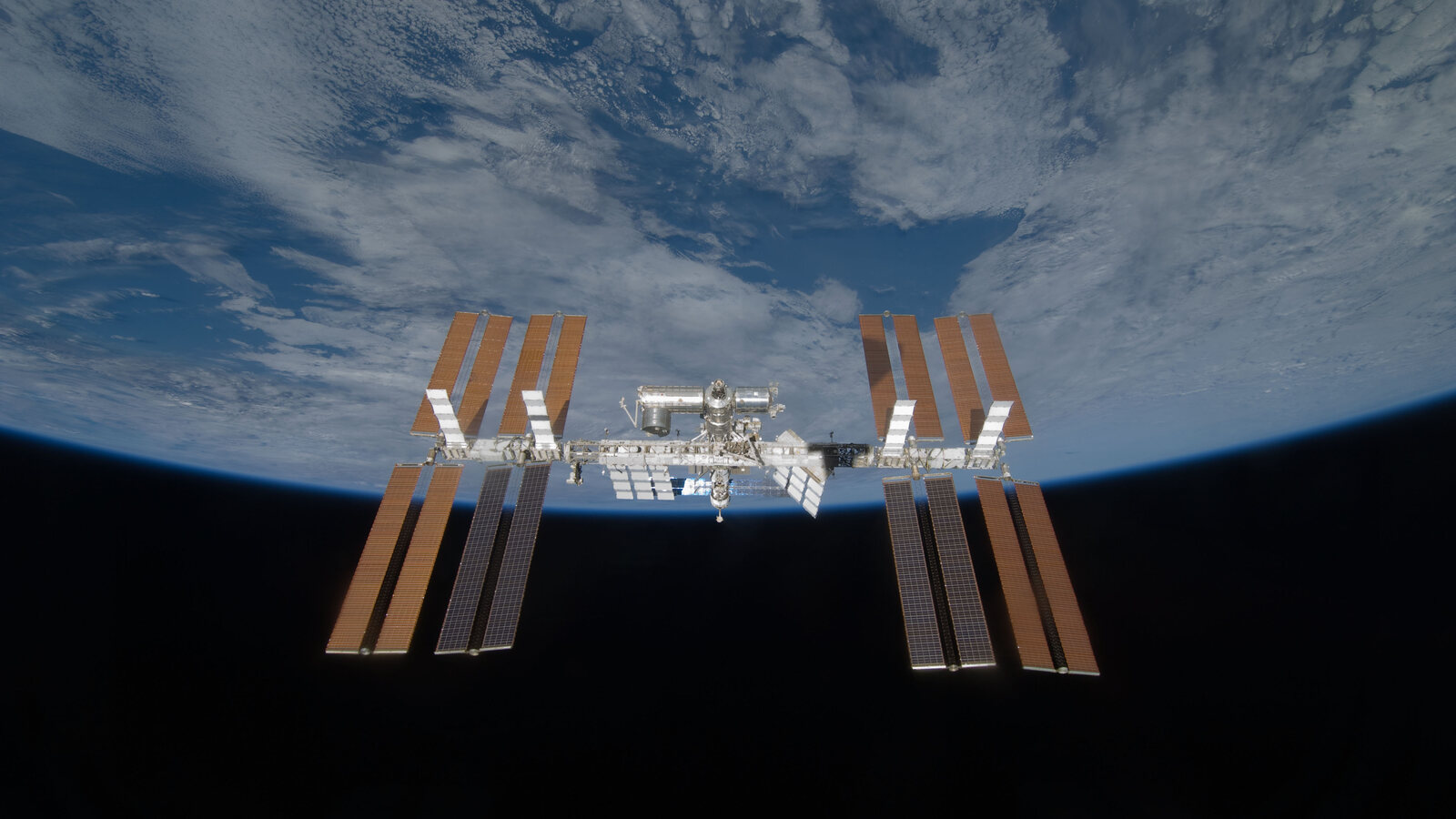
The International Space Station is not floating because it has escaped Earth's gravity. NASA places it roughly 370 to 460 kilometres above the surface. At that height, the pull of gravity is still close to nine-tenths of its strength at the ground. If the station somehow stopped moving sideways, gravity would bring it down.
That fact replaces the common picture of space as a gravity-free zone. Gravity is the force that keeps the station in orbit. The puzzle is not why Earth fails to pull it downward, but why an object being pulled downward can travel around the planet for years without striking the surface.
The station falls while Earth curves away beneath it
The ISS moves sideways at about 28,000 kilometres per hour. Gravity continually bends that motion toward Earth. During the time the station falls, however, its sideways movement carries it over a part of the planet whose surface curves away by a matching amount. It keeps missing the ground and returns around the other side roughly every 90 minutes.
Newton imagined firing a cannonball faster and faster from a high mountain. A slow shot soon hits the ground; a much faster one travels farther before landing. At the right speed, its falling path curves around Earth. The analogy explains the geometry, but a real spacecraft needs no mountain or supporting track: once in orbit, inertia carries it sideways while gravity bends the path.
Astronauts float because the room falls with them
Inside the station, an astronaut, a loose tool and the walls all accelerate together under gravity. The floor does not continually push upward against the astronaut as a floor does on Earth. With almost no supporting force between them, the astronaut and the tool appear to float relative to the cabin.
NASA calls this condition microgravity rather than zero gravity. The word describes the very small leftover accelerations inside the orbiting laboratory, not an absence of Earth's pull. Atmospheric drag, vibrations, station rotations and tiny differences in gravity across the large structure keep the environment from being perfectly weightless.
Low Earth orbit still brushes the top of the atmosphere
Space around the ISS is extremely thin, but it is not a perfect vacuum. Scattered atmospheric particles strike the station and create drag. Each collision removes a little orbital energy, so the station's altitude gradually decreases instead of remaining fixed forever.
Visiting spacecraft and station propulsion systems periodically perform reboost manoeuvres. A carefully timed thrust increases the station's speed and raises its orbit, replacing energy lost to drag. Solar activity matters because it can heat and expand the upper atmosphere, changing how much drag the station encounters at a given height.
Orbiting needs speed; staying in this low orbit needs maintenance
It is tempting to choose between two simple explanations: the ISS stays up because it moves fast, or it stays up because engines hold it there. The complete answer uses both at different times. Continuous sideways speed and gravity create the orbit. Occasional engine burns compensate for the small but persistent drag that would otherwise shrink it.
NASA estimates that, without reboosts, the station's natural orbital lifetime at its current altitude could be roughly one to two years, depending strongly on solar activity. It would not suddenly drop like a stone. Its orbit would decay gradually until thicker air produced much stronger drag and a rapid re-entry became unavoidable.
Falling is not the failure of an orbit; it is the mechanism
A stable-looking orbit is a controlled relationship between speed, curvature and gravity. The station never reaches a place where Earth's pull switches off. It is continually redirected by that pull, while its sideways motion carries it beyond every patch of ground toward which it falls.
Now the floating astronauts and the periodic reboosts fit the same model. Crew and cabin fall together, so they feel weightless. Thin air steals a little speed, so engines restore it. The International Space Station stays above Earth not by refusing to fall, but by falling around an entire planet.
Sources and further reading
This article was written for Curiosity Desk. We do not copy other publishers or invent quotes. If a material error is found, we correct it openly.
Read the full standards →One answer should lead to a better question
Bring your curiosity to the group
Curious Minds is our public Facebook community for surprising science, strange history, Australian wildlife and everyday questions. No copied posts, no personal-friend invitations and no link dumping.
- Three self-contained discussion prompts each week
- Sourced answers and honest uncertainty
- Respectful conversation without spam