A popcorn kernel is a pressure vessel disguised as a seed
Popcorn contains a small reserve of water inside starchy tissue, all wrapped in a hard outer hull called the pericarp. Ordinary maize can split or dry without producing the same white flake. Popcorn varieties combine a suitably strong, relatively impermeable hull with starch and enough internal moisture to build pressure during heating.
As temperature rises past the boiling point of water, some internal water becomes vapour. The hull delays its escape, so pressure climbs and the starch softens into a hot, deformable mass. The US National Agricultural Library describes the decisive moment simply: pressure defeats the hard outer layer and the expanding starch bursts outward.
The shell fails near a repeatable temperature
High-speed experiments published in the Journal of the Royal Society Interface heated kernels while measuring the event. The researchers reported a critical popping temperature near 180 degrees Celsius across the grains they tested. ABC's account of the study describes internal pressure around ten times sea-level atmospheric pressure before failure.
Those values are experimental results, not a recipe that guarantees every kernel will pop at one exact second. Hull strength, moisture and heating rate vary. The key transition is consistent: steam pressure rises while starch becomes ready to expand, then a crack gives the compressed interior a route into much lower-pressure air.
The jump begins with a temporary leg of hot starch
The kernel does not leap merely because gas blasts downward. High-speed footage showed a starch structure emerging through the first fracture and pressing against the hot surface. As that temporary leg is compressed and released, it pushes the kernel away from the pan, more like a small vault than an uncontrolled rocket.
The motion combines fracture, heat and elasticity. The shell opens, starch extrudes, the growing structure loads against the surface and the kernel rotates into the air. The same expansion continues until the dense interior becomes the light, irregular foam we recognise. From fracture to flake, the study observed a transformation lasting less than a tenth of a second.
The pop is delayed because the first crack is not the sound source
Researchers compared high-speed video with microphone recordings. The audible pop did not align exactly with the first shell fracture or with the kernel striking the pan. It followed several milliseconds later. That timing allowed the investigators to reject the simplest explanations and connect the sound to rapid vapour release and pressure oscillation.
A champagne cork and a volcanic vent are much larger systems, but each demonstrates how a sudden pressure change can excite surrounding air. In popcorn, released water vapour helps create the acoustic pulse. The shell break opens the event; the decompressing vapour supplies the characteristic report heard across the kitchen.
An unpopped kernel usually failed one requirement of the machine
A hull with a crack can leak vapour before pressure becomes high enough. A kernel that has lost too much moisture may not generate enough steam, while uneven heating can burn the outside or leave the centre below the transition. Too much internal water can also disturb the way starch expands. Popability depends on the whole pressure vessel, not size alone.
The finished flake is therefore evidence of a tightly ordered failure. Water stores energy as pressure, the hull holds until starch is soft, a fracture releases the interior, a temporary leg launches the kernel and vapour creates the sound. Popcorn looks chaotic in the pan, but each successful piece follows a remarkably compact mechanical sequence.
The white flake is a frozen record of flowing starch
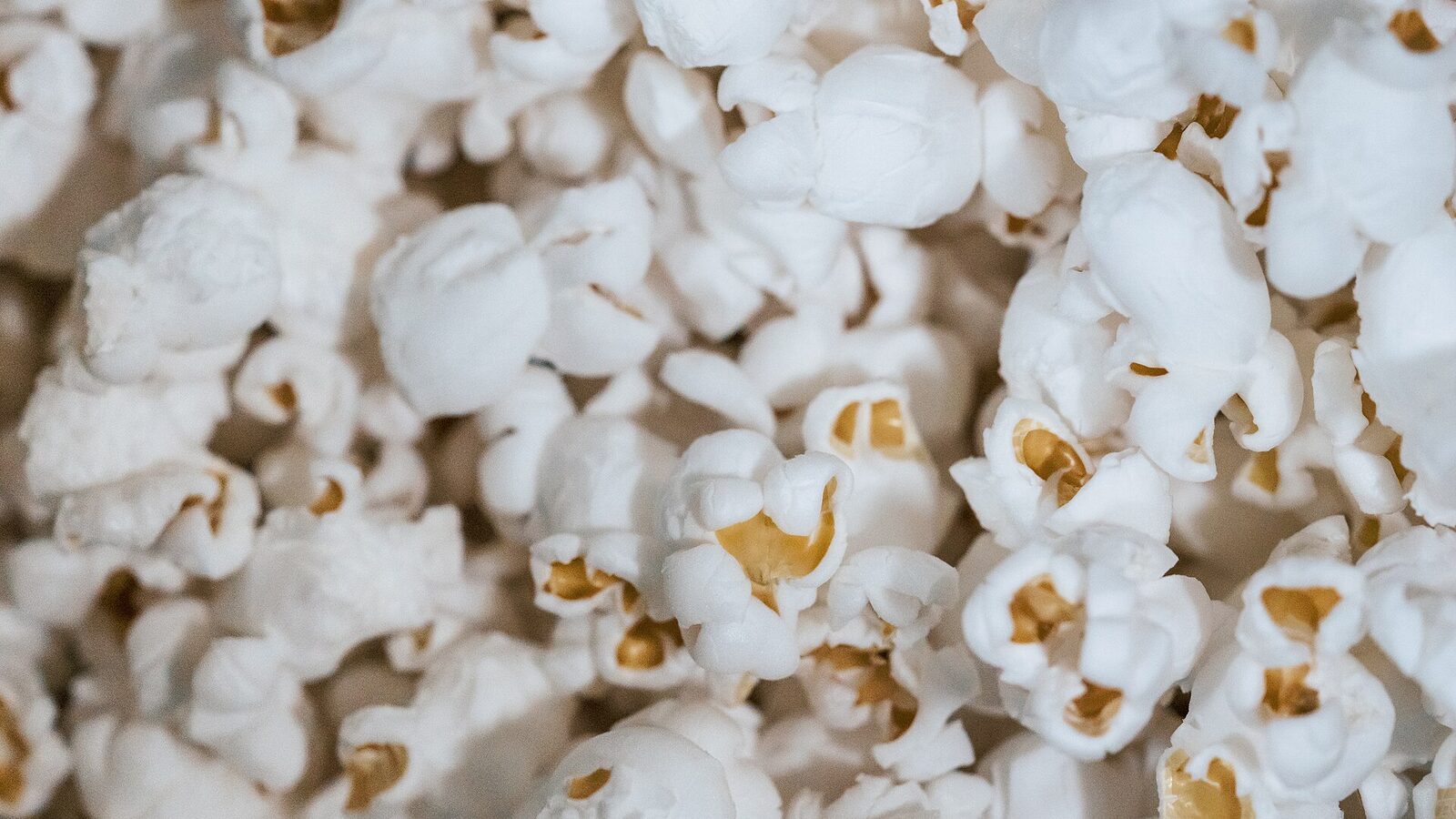
Inside the intact kernel, starch granules are packed into a dense structure. During the pop, heat and water soften that material and the pressure drop lets it expand rapidly. The mass stretches around bubbles of vapour, cools and sets into a porous foam. Its large white body contains far more empty space than the seed did.
Different flake shapes reflect how the hull opened and how the hot starch flowed. The familiar butterfly form spreads irregular wings, while some varieties produce a rounder mushroom shape valued for coatings. Both begin with the same inversion: compact seed tissue crosses a pressure boundary and solidifies after briefly behaving like an expanding fluid.
Sources and further reading
This article was written for Curiosity Desk. We do not copy other publishers or invent quotes. If a material error is found, we correct it openly.
Read the full standards →One answer should lead to a better question
Bring your curiosity to the group
Curious Minds is our public Facebook community for surprising science, strange history, Australian wildlife and everyday questions. No copied posts, no personal-friend invitations and no link dumping.
- Three self-contained discussion prompts each week
- Sourced answers and honest uncertainty
- Respectful conversation without spam