Quantum information is fragile in more than one direction
A classical bit can flip between zero and one, and ordinary computers protect data with copies and parity checks. A qubit can suffer bit-like flips, phase errors and combinations, while small interactions with its environment can destroy the relationships a computation needs. Gates and measurements add their own imperfections.
The obvious backup plan is forbidden. The no-cloning theorem says there is no operation that makes a perfect copy of an arbitrary unknown quantum state. Measuring the state to learn what to copy generally changes it. Quantum error correction must therefore create redundancy without producing independent duplicates of the hidden information.
One logical qubit is distributed through correlations
An error-correcting code maps one logical qubit into an entangled state of several physical qubits. No single physical qubit contains a readable master copy. The information lives in correlations across the group, so a local error can alter part of the pattern without immediately erasing the encoded logical state.
This resembles spreading a message across constraints rather than photocopying the page. The analogy stops where quantum behaviour begins: the components can be in superposition and entangled, and the code must preserve relative phase. The goal is to make likely physical errors leave detectable changes in carefully chosen collective properties.
Syndrome measurements ask what broke, not what the answer is
Extra qubits and operations measure parity-like checks called stabilisers. Their outcomes form an error syndrome. A syndrome can indicate that the pattern has changed in a way consistent with an error at a location, while revealing nothing about whether the logical qubit represents zero, one or a superposition of both.
A classical decoder interprets the syndrome and chooses a correction, or keeps track of how later results should be interpreted. The process repeats because noise continues. Fault tolerance also demands that a faulty checking operation does not spread more damage than the code can handle. Protecting the data requires a fast conversation between quantum hardware and classical inference.
Below threshold means adding protection finally helps more than it hurts
Larger codes require more physical qubits and operations, which create additional opportunities for error. Error correction scales usefully only when component error rates sit below a code-dependent threshold. In that regime, increasing code distance can suppress the logical error rate because the added redundancy outpaces the extra noise.
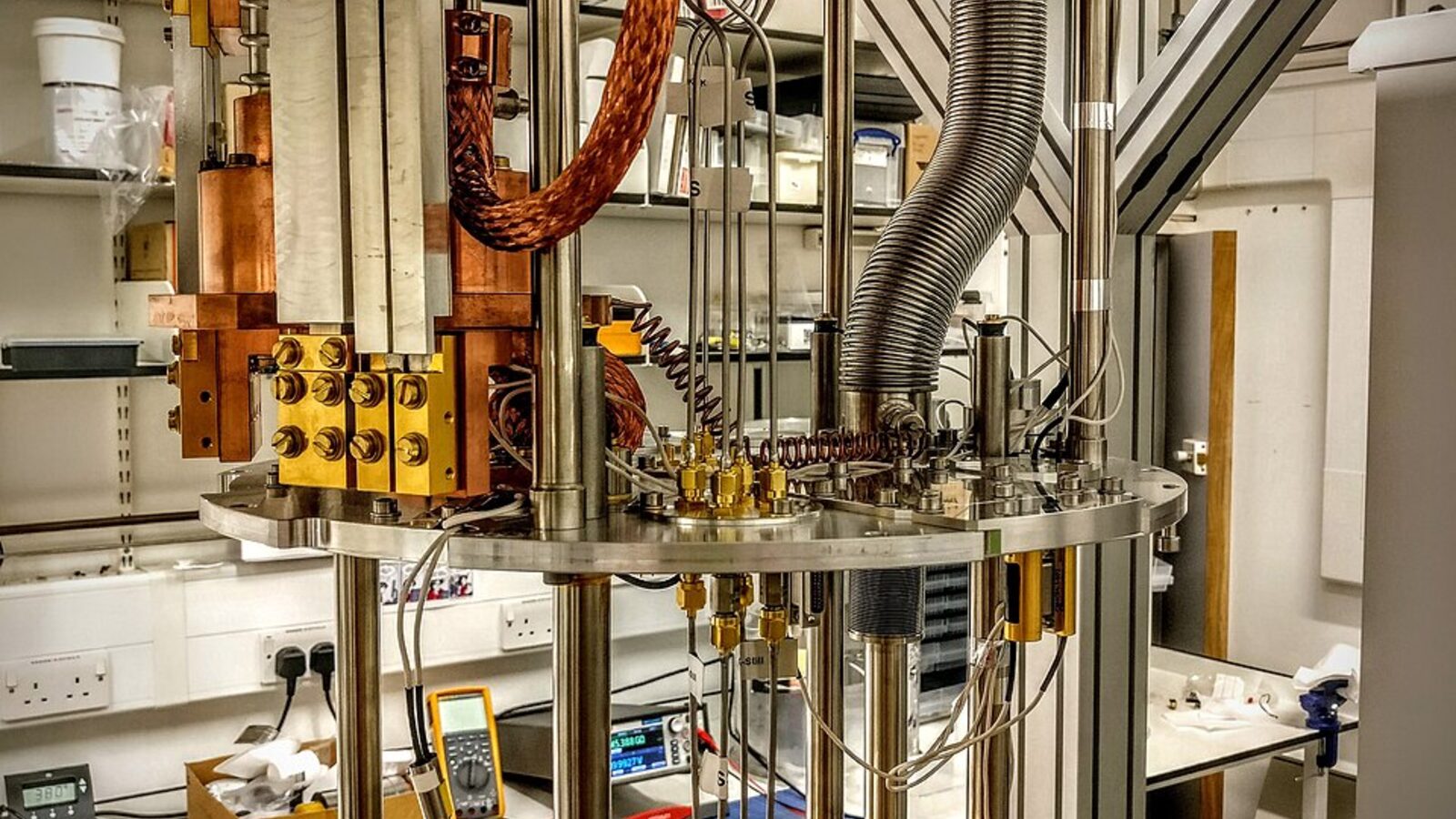
A 2024 Nature paper from Google Quantum AI reported below-threshold surface-code memories on superconducting processors. Its larger distance-seven memory used 101 physical qubits and reduced logical error relative to the smaller code, with real-time decoding demonstrated at distance five. That is a milestone for memory, not a complete general-purpose fault-tolerant computer.
Rare correlated failures are the next enemy of the neat theory
Mathematical threshold arguments often begin with simplified noise. Real devices can suffer leakage, drift, radiation events, control crosstalk and correlated errors affecting several qubits together. The Nature experiment reported rare correlated events that limited performance over long runs. More qubits do not automatically cure errors that arrive in organised groups.
A useful quantum computer will need reliable logical gates, state preparation, measurement, long runtimes and enormous overhead reductions in addition to protected memory. The central trick nevertheless works: do not copy the secret state. Encode it in shared correlations, repeatedly read only the footprints of damage and repair those footprints before they become a logical mistake.
A logical qubit is a protected behaviour, not one hidden component
It is tempting to imagine that one physical qubit remains the real data while neighbours act as guards. In a code, the logical basis states are collective patterns across the full block. Losing or disturbing one member can be recoverable precisely because no component was appointed as the irreplaceable original.
That collective view explains both the power and the overhead. Logical operations must manipulate encoded relationships without exposing them, and checks must continue throughout a computation. A machine advertised with many physical qubits may therefore provide far fewer useful logical qubits. Counting protected behaviour is more meaningful than counting hardware alone.
Sources and further reading
This article was written for Curiosity Desk. We do not copy other publishers or invent quotes. If a material error is found, we correct it openly.
Read the full standards →One answer should lead to a better question
Bring your curiosity to the group
Curious Minds is our public Facebook community for surprising science, strange history, Australian wildlife and everyday questions. No copied posts, no personal-friend invitations and no link dumping.
- Three self-contained discussion prompts each week
- Sourced answers and honest uncertainty
- Respectful conversation without spam