The strange parcel that changes when someone opens it
Today's internet moves ordinary bits. A router can read, copy, regenerate and forward them without changing the information. A future quantum network would sometimes carry a far more delicate parcel: a quantum state encoded in a particle such as a photon, or shared between distant devices through entanglement. Measuring an unknown state generally disturbs it, and the no-cloning principle prevents making a perfect backup of that unknown state before sending it on.
Those restrictions sound like weaknesses, yet they create unusual possibilities. An attempt to intercept certain quantum key-distribution signals can leave evidence in their statistics. Entanglement shared across a network could connect quantum sensors, processors or clocks in ways that an ordinary exchange of copied bits cannot reproduce. The point is not to load a webpage before the button is pressed. It is to make new kinds of coordination possible.
Why the ordinary internet's easiest trick does not work
Light fades in fibre. Classical networks solve that problem with amplifiers and repeaters that detect a weakened signal, recreate its bits and send a fresh strong copy. A repeater cannot take an arbitrary quantum state and manufacture an identical replacement without destroying the feature it is meant to preserve. This is one reason laboratory links are much easier than a reliable continental network.
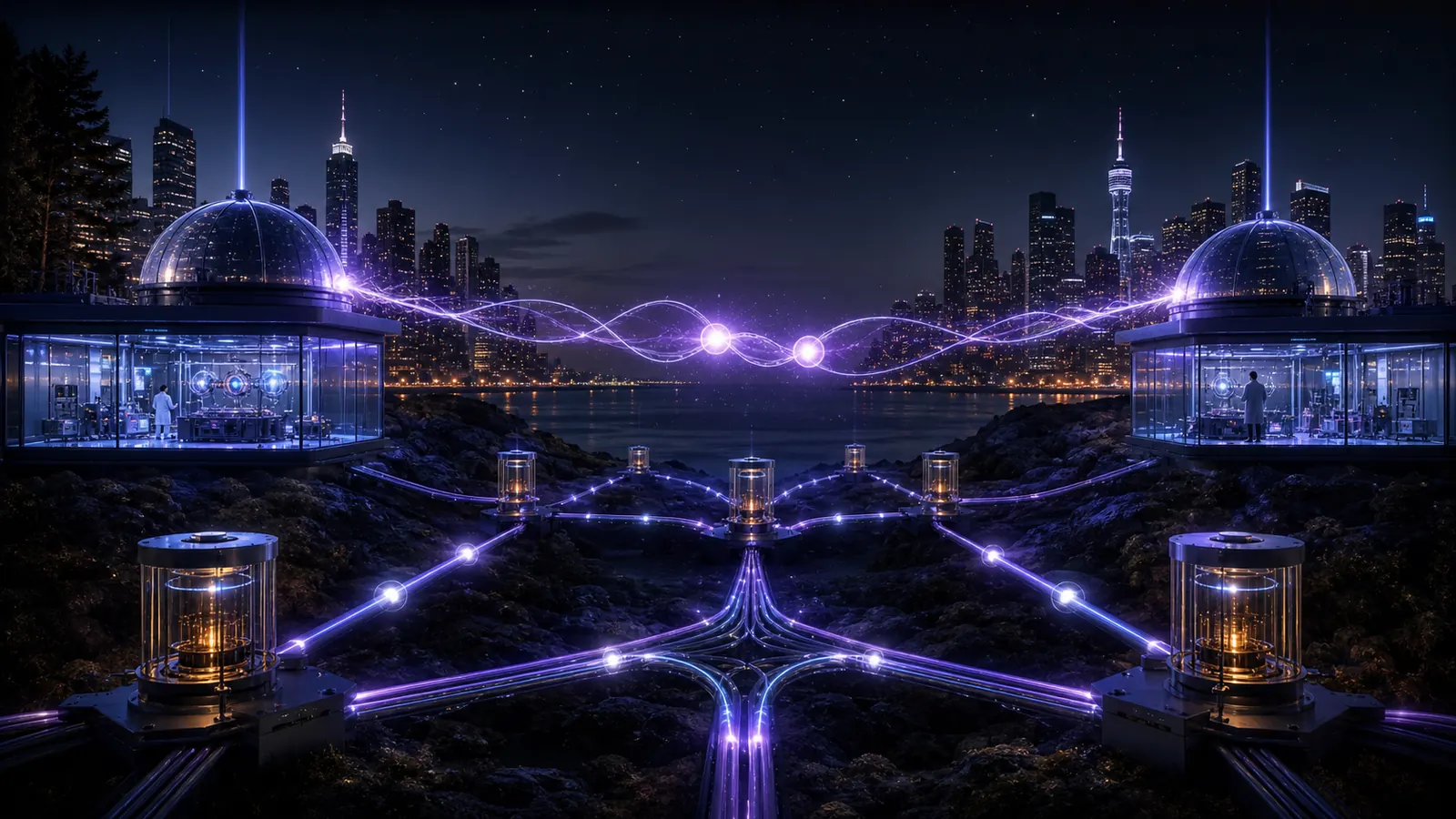
Quantum repeater proposals work around the problem by creating entanglement across shorter segments, storing fragile states in quantum memories and connecting the segments through carefully controlled measurements. Each step introduces loss, noise and timing problems. Useful networks will also need switching, routing, compatible devices and error correction. The US Department of Energy's blueprint treats those components as research priorities, not finished infrastructure waiting to be switched on.
Entanglement feels instantaneous, but it cannot carry a secret message alone
Measurements of entangled particles can show correlations that classical intuition struggles to explain. That does not give one operator a dial that writes a controllable message onto the distant result. To compare outcomes or complete protocols such as quantum teleportation, the parties still need ordinary classical communication. That communication remains limited by the speed of light.
This is the clean test for breathless claims. If a proposal says entanglement alone sends usable words, money or warnings instantly across space, it has skipped the classical channel required to interpret the result. NIST experiments have examined how quickly quantum information propagates and still describe a finite limit. Quantum networks may improve security and distributed computation without becoming a loophole in relativity.
What would prove the frontier is becoming infrastructure
A few connected laboratories do not yet equal a public quantum internet. The important milestones are repeaters that extend distance without ruining fidelity, memories that hold states long enough to coordinate links, interfaces that connect different quantum hardware, and error rates low enough for an application to outperform a classical alternative. Networks also need authentication and ordinary cybersecurity; quantum physics cannot stop someone stealing a password from an unlocked laptop.
If those gates are crossed, the earliest networks will probably join research facilities, data centres, sensors and specialised government or industrial systems. Most everyday traffic can continue travelling as classical bits because email and video do not benefit from keeping every bit quantum. The remarkable future is therefore a second layer working beside the internet we know: small at first, technically demanding, and able to distribute something ordinary networks were never designed to carry.
Entanglement creates a connection without creating a faster message
Entangled particles can produce correlations that ordinary shared instructions cannot explain, even when the measurements are far apart. But each local result is unpredictable. To compare results or complete protocols such as teleporting a quantum state, the users still need an ordinary classical message, and that message cannot outrun light. The network's strange resource is coordinated quantum information, not a loophole for instant conversation across space.
This boundary matters because 'quantum teleportation' sounds like matter or readable data vanishing from one place and appearing elsewhere. What is transferred is a quantum state, using entanglement plus classical communication; the original state is not freely copied. Those constraints are not disappointments. They are exactly what could make certain links valuable: an attempted interception disturbs the delicate state, while unknown quantum information cannot simply be duplicated and stored unnoticed.
Sources and further reading
This article was written for Curiosity Desk. We do not copy other publishers or invent quotes. If a material error is found, we correct it openly.
Read the full standards →One answer should lead to a better question
Bring your curiosity to the group
Curious Minds is our public Facebook community for surprising science, strange history, Australian wildlife and everyday questions. No copied posts, no personal-friend invitations and no link dumping.
- Three self-contained discussion prompts each week
- Sourced answers and honest uncertainty
- Respectful conversation without spam