Stress builds while a fault is locked
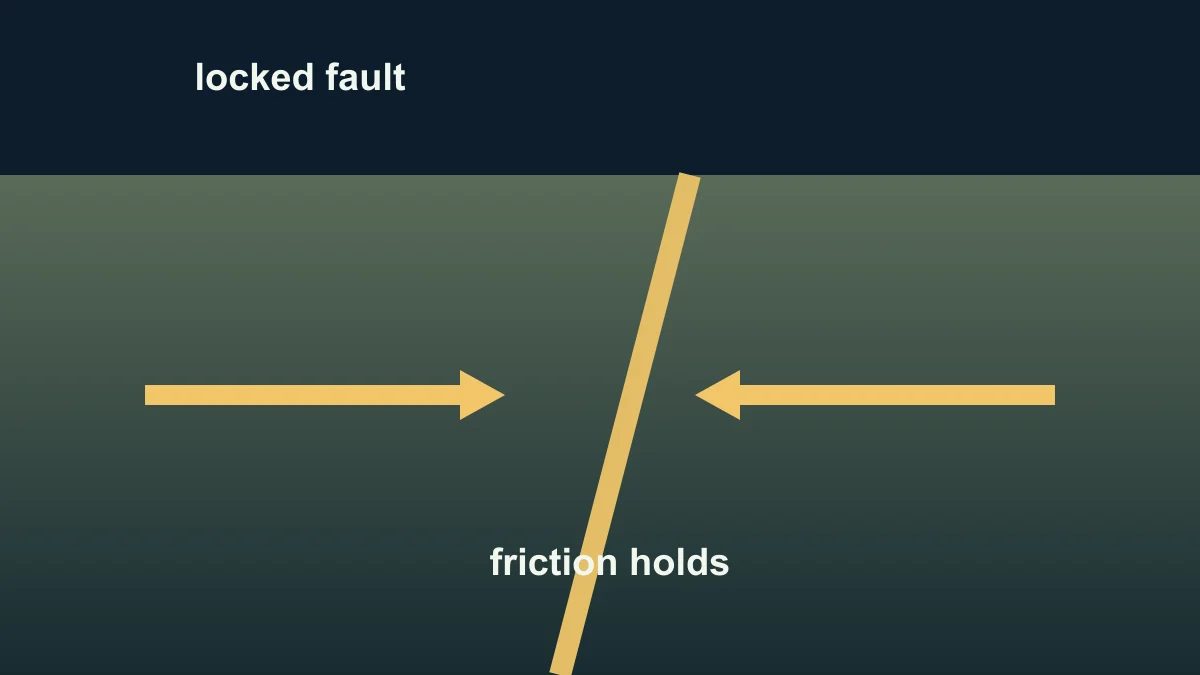
An earthquake begins with movement on a fault: a fracture or zone of fractures where blocks of rock can move relative to one another. The rocks are often being pushed, pulled or sheared by the slow motion of the wider crust. For a time, rough surfaces on the fault can grip one another. Stress then builds in the surrounding rock even though the two sides do not visibly move past each other.
That locked period is important because an earthquake is not simply the ground deciding to wobble. USGS describes the usual trigger as stress becoming stronger than the friction holding a fault in place. Once that threshold is crossed, the rock can shift abruptly. The diagram is a simplified cross-section, not a picture of a particular fault or a way to identify where the next earthquake will occur.
Faults differ in size, shape and setting, so the same simple picture cannot explain every earthquake. Some are associated with plate boundaries, but movement can also occur within a tectonic plate. The common point is the mechanical one: a fault can store strain while it is stuck, then release part of that strain when slip begins.
A sudden slip releases seismic waves
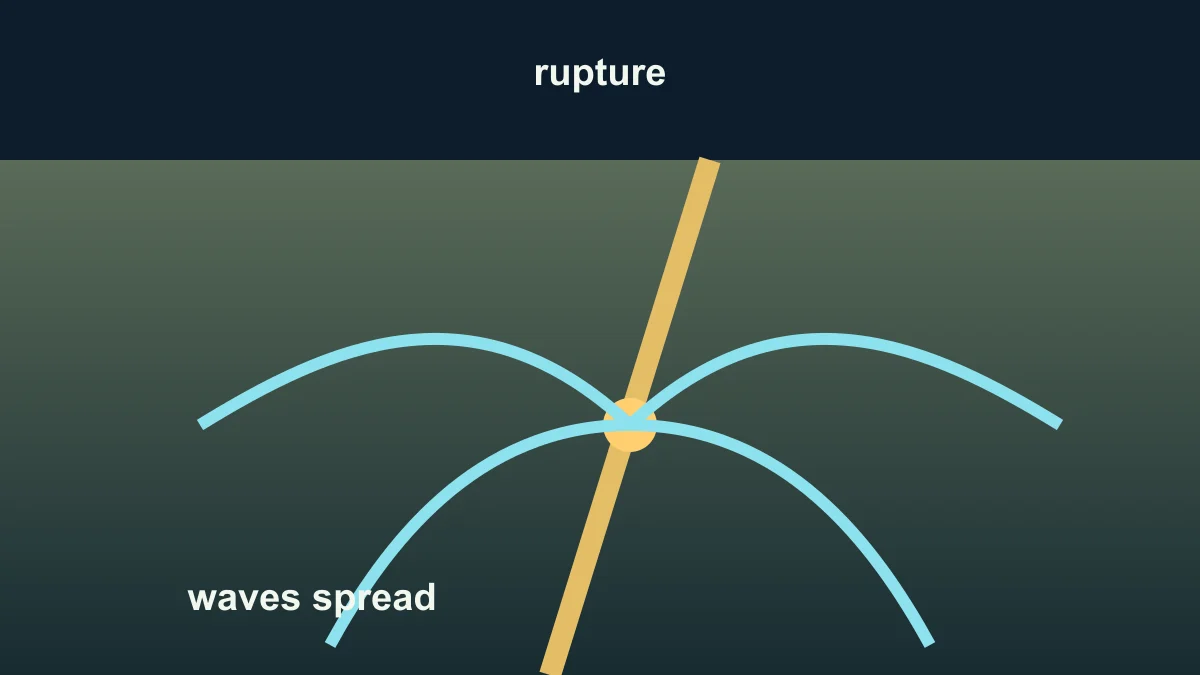
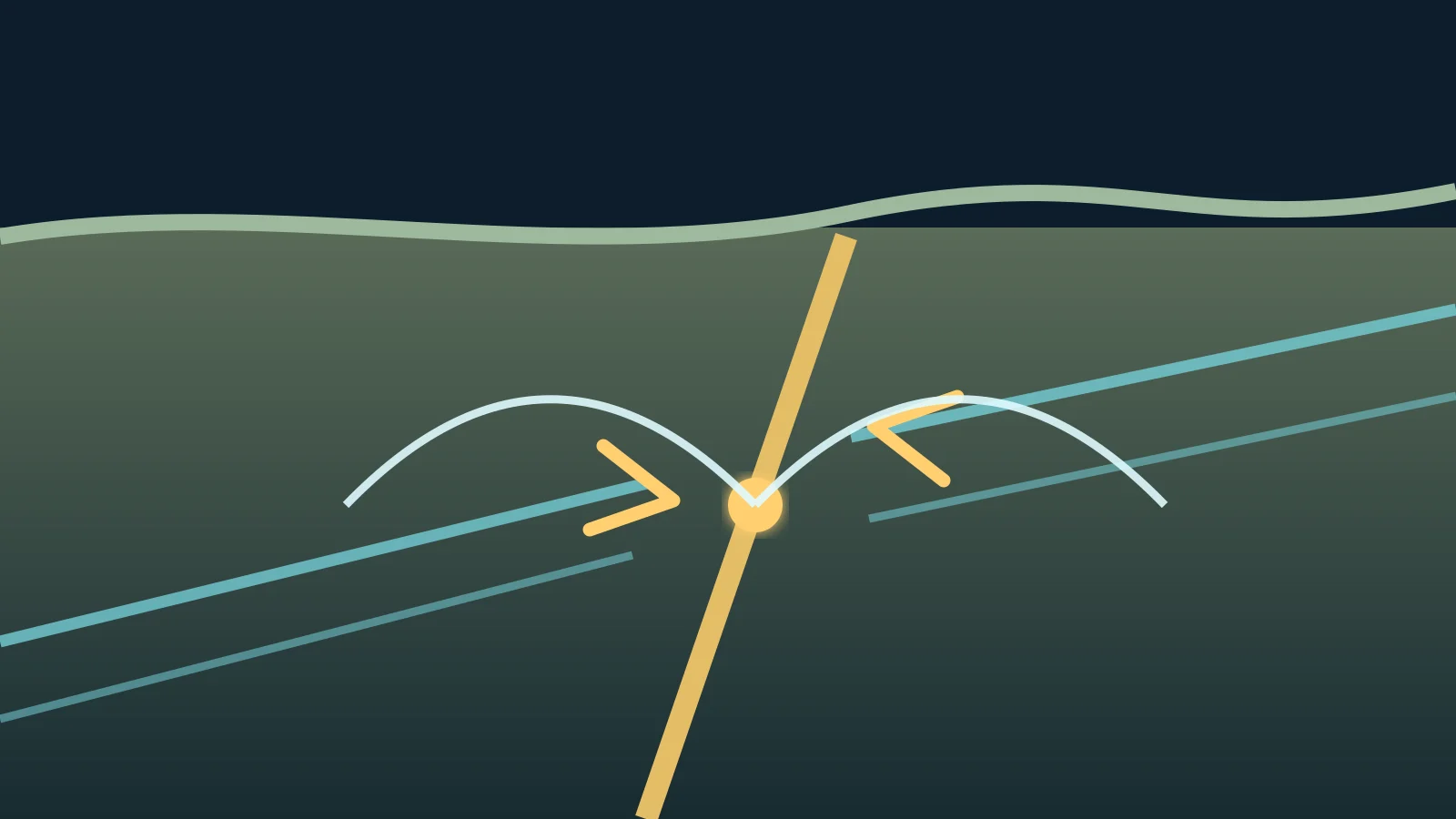
When the fault slips, stored strain energy is released. Some energy goes into moving and breaking rock along the fault. Some travels outward as seismic waves: vibrations that pass through the Earth and along its surface. Those waves are what make the ground move at a distance from the part of the fault that ruptured.
The rupture does not make every point shake in the same way or at the same time. Different kinds of seismic waves travel differently through rock, and their paths can be altered by the materials they cross. This is why an earthquake can be felt far from its origin without implying that a simple drawing traces a real wave path, gives a warning time or predicts an effect for a particular neighbourhood.
Scientists record these motions with instruments called seismometers. The records allow researchers to locate and measure an event, but they do not turn the basic fault-slip explanation into a reliable short-term prediction. The useful distinction is between understanding why ruptures can occur and claiming knowledge of the exact time or place of a future one.
Magnitude and local shaking are not the same thing
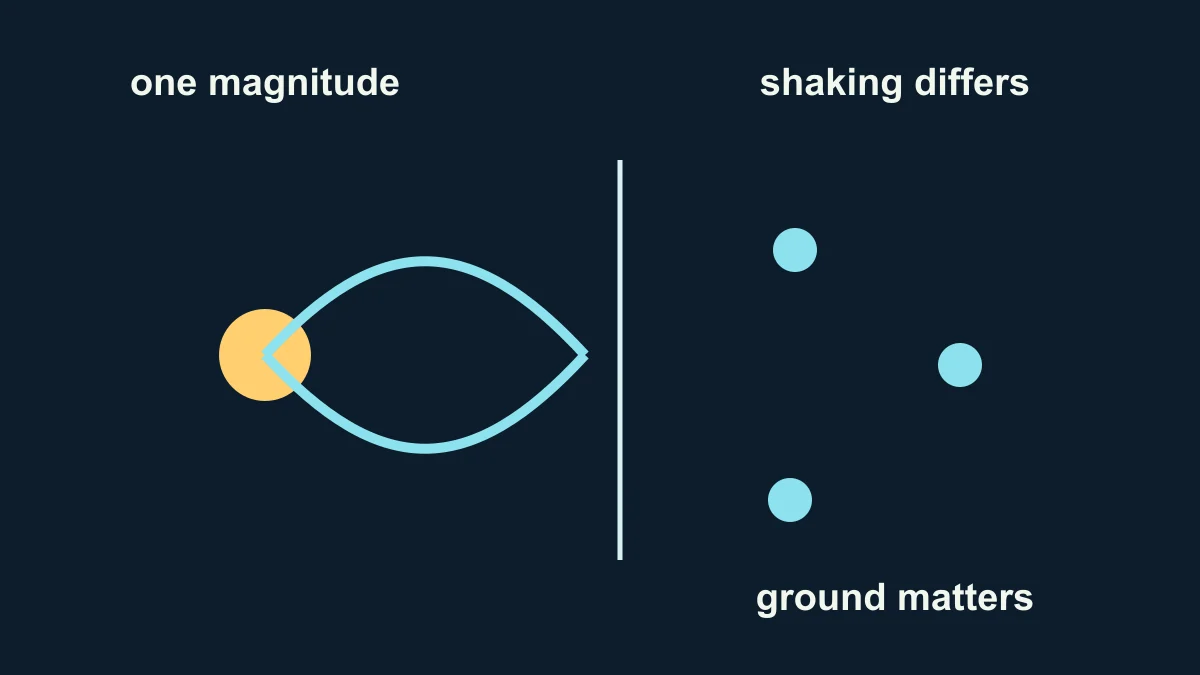
Magnitude is one measure of an earthquake's size at its source, calculated from recorded seismic waves. It is not a universal description of what every person experiences. USGS distinguishes magnitude from intensity or local shaking because the latter can differ from place to place in the same event.
Distance from the fault, the depth and direction of the rupture, and the local ground can all affect shaking. Soft sediments can respond differently from solid rock, for example. That boundary matters: this article explains the physical mechanism, not whether a building is safe, what a community should do, or when and where an earthquake will occur. For any current local hazard information, readers should use the relevant official authority.
The difference also explains why an event can have one reported magnitude while reports from communities are not identical. A magnitude describes the event using instrument records and a defined calculation. Local shaking describes effects at a place. Both are useful, but they answer different questions, and neither substitutes for current advice from emergency managers or geological agencies during an active event.
This is why a number by itself is incomplete context. It can describe the size of the source event without showing the pattern of shaking on a map, the condition of a particular structure, or the needs of people nearby. Keeping those questions separate makes the mechanism clearer and avoids turning a general science explainer into advice that should come from current official local information.
Sources and further reading
This article was written for Curiosity Desk. We do not copy other publishers or invent quotes. If a material error is found, we correct it openly.
Read the full standards →One answer should lead to a better question
Bring your curiosity to the group
Curious Minds is our public Facebook community for surprising science, strange history, Australian wildlife and everyday questions. No copied posts, no personal-friend invitations and no link dumping.
- Three self-contained discussion prompts each week
- Sourced answers and honest uncertainty
- Respectful conversation without spam