Inside the study
The dramatic moments were a tiny part of the footage
- Sharks fitted with cameras
- 13 juveniles
- Sharks with usable footage
- 11
- Usable video
- 68.5 hours
- Speed bursts
- 20
- Share of footage
- 0.12%
- Recorded prey captures
- 0
- Time along the seafloor
- 50.1%
- Study coast
- New South Wales
These figures come from the peer-reviewed paper published on 8 July 2026. They describe the recorded sample, not every minute of a white shark's life.
A camera on a shark answers a different question
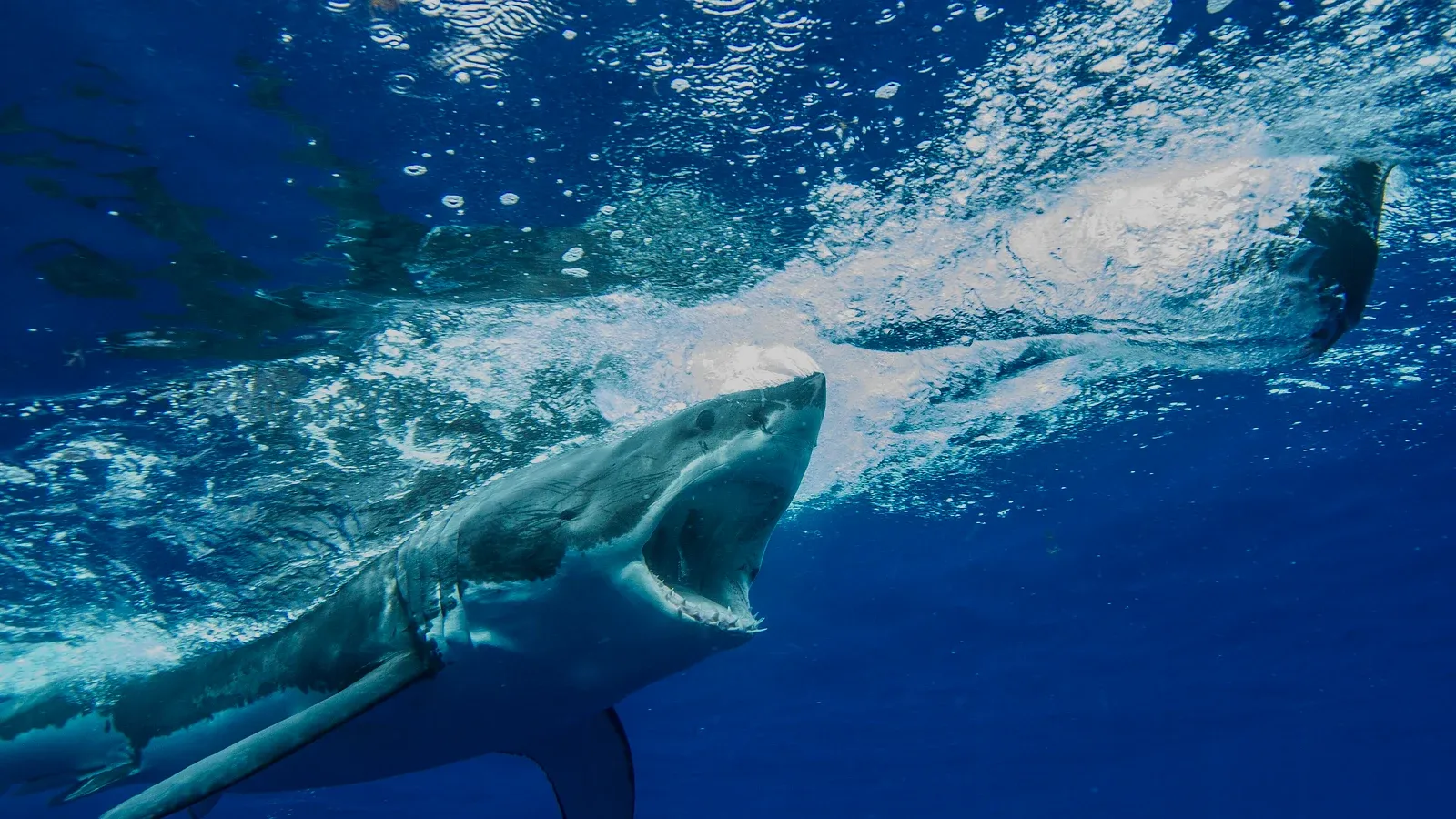
Most people meet a white shark through its most dramatic seconds: a breach, a fast turn or a mouth opening near the surface. A study published in Frontiers in Marine Science on 8 July 2026 replaced that highlight reel with hours of ordinary life. Researchers fitted camera and movement packages to 13 juvenile white sharks caught between Evans Head and Port Macquarie on the New South Wales coast.
The result was not a continuous record of attack attempts. It was a shark's moving view of sand, open water, reef edges, other animals and long periods of steady swimming. That difference matters. A tracking dot can show where an animal went, but a camera can reveal what was in front of it and whether a sudden acceleration looked like travel, investigation or a pursuit.
The researchers waited before counting the footage
The packages combined a camera with depth and three-axis acceleration sensors. Twelve were programmed to begin recording during daylight at least 24 hours after release. The delay was designed to keep capture and handling from dominating the behaviour being measured. One package instead used an acceleration trigger in an attempt to catch short foraging events.
Not every deployment produced a full usable record. The researchers analysed 68.5 hours from 11 sharks for encounters and bursts. Some of the detailed time-budget comparisons used a smaller subset because footage was too short, interrupted or poor in quality. The sharks measured 1.74 to 2.83 metres long, which places the study firmly in the juvenile life stage rather than the large adults familiar from many wildlife films.
Only 20 speed bursts appeared in 68.5 hours
The team identified 20 burst events across six of the 11 sharks. Together those events lasted 298 seconds, or just under five minutes. They represented 0.12 percent of the entire usable observation period. Each burst lasted between five and 54 seconds, and none ended in a successful prey capture visible in the recorded material.
That is not proof that young white sharks almost never feed. A camera covers a limited window, the sample was small and a successful hunt could occur before or after a deployment. The result is still useful because it replaces an assumption with an observed rate: within this footage, high-speed behaviour was uncommon and successful predation was not documented.
Most fast movements began close to the seabed
Sixteen of the 20 bursts started while a shark was travelling along the seafloor. Ten continued horizontally along the bottom, seven involved an ascent and three involved a descent. That pattern is different from the vertical ambush image often associated with adult white sharks hunting seals near the surface.
The authors suggest that juvenile hunting strategies can differ from those of larger sharks or animals at seal colonies. Bottom-dwelling rays, small sharks, octopuses and fish create a different set of opportunities. A fast horizontal movement over sand may be a better response there than a high-speed launch from deep water.
Potential prey was often noticed and then ignored
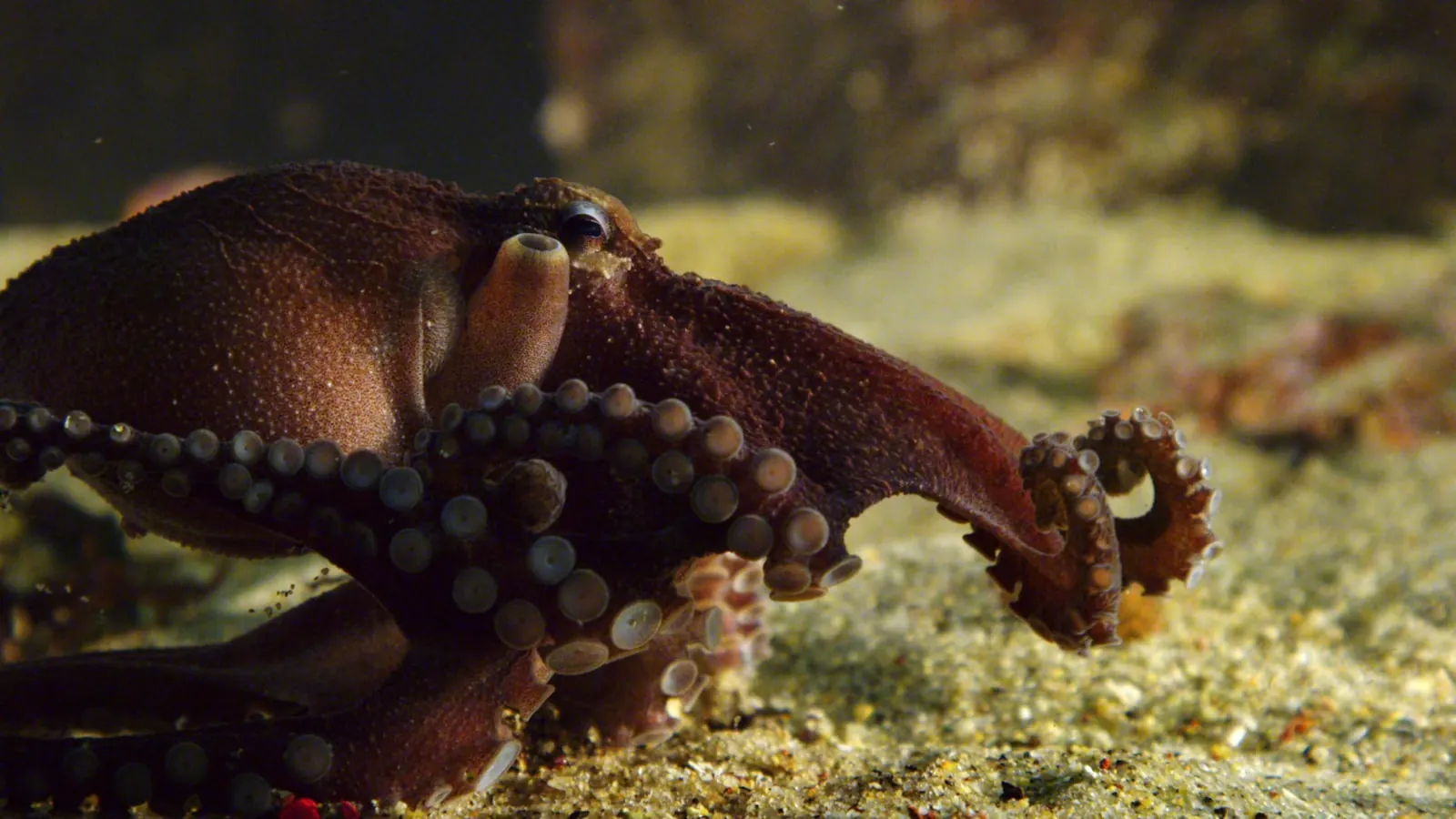
Across ten sharks, the researchers recorded 85 encounters with animals that could be potential prey. The list included rays, a stingaree, fish, a hammerhead shark, another white shark, a dolphin, an octopus and an oarfish. Only three encounters with a potential prey item were linked to a burst in the study's comparison.
A shark circled the oarfish three times without trying to eat it. Two sharks made long ascents to inspect large animals such as a marlin, hammerhead and another white shark, then returned to the seabed. These observations do not reveal what the sharks were thinking, but they show that detection does not automatically produce an attack.
Sand filled more of the record than reef or kelp
Among the continuous footage used to compare position and habitat, the sharks spent 50.1 percent of their time swimming along the seafloor and 34.5 percent at the surface. When the seabed was visible, sand was the dominant habitat type for 89 percent of that classified time. Reef accounted for nine percent and kelp just over two percent.
The researchers warn against reading those numbers as a simple preference. Much of the study region is already sandy, so the footage may partly reflect what habitat was available. When more complex reef appeared, sharks tended to move around its edge rather than straight across it. Confirming a true selection would require detailed habitat maps matched to precise shark positions.
Some small fish stayed beside a shark for hours
The cameras also captured a quieter relationship. Single guiding fish were recorded with seven sharks for a combined 17 hours. Groups of baitfish appeared around eight sharks for 13.5 hours, and some stayed with one individual for as long as 4.6 hours. On four occasions, baitfish scraped against the shark's head, possibly to remove parasites.
The paper treats the relationship cautiously. Small fish may gain protection, food scraps or access to material on a shark's skin, while the shark may be largely unaffected. The footage cannot prove a single benefit in every encounter. It does show that a juvenile white shark can function as moving habitat for other animals, not merely as a hunter passing through the scene.
The footage does not calculate the danger to swimmers
This study investigated shark behaviour and habitat use. It did not measure the probability of a bite, compare beaches with and without people or test how sharks respond to swimmers. The absence of a successful prey capture in 68.5 hours should not be converted into a claim that white sharks pose no risk.
Other research helps define that separate question. A 2023 drone study across 26 Southern California beaches found daily human and juvenile-shark co-occurrence on 97 percent of surveyed days at known aggregation beaches. The result applied to those aggregation locations, not every beach, and the authors still described unprovoked bites as rare rather than impossible.
Young white sharks do not live like miniature adults
Juveniles use different habitats and pursue different food from large adults. Research in Southern California has linked nursery areas with warm shallow water, bottom-dwelling prey and protection from larger predators. Another tracking study found that juveniles at one aggregation site selected water from 16 to 22 degrees Celsius and depths shallower than two metres.
The new Australian footage adds behaviour to that movement picture. It shows young sharks spending substantial time close to a sandy bottom, making rare bursts and frequently passing potential prey without pursuit. None of those findings makes an individual encounter predictable. Together they explain why the life of a juvenile cannot be reconstructed from footage of an adult breaching beneath a seal.
The most useful result is the uneventful majority
Wildlife cameras are often promoted with the moment that looks most cinematic. In this study, the scientific value came from annotating every second, including the long stretches when no chase occurred. Those ordinary minutes made it possible to calculate that bursts occupied 0.12 percent of the footage and to compare surface travel, bottom travel and habitat.
The overlooked detail is therefore not a more spectacular attack. It is the enormous amount of time in which a feared predator was simply moving, inspecting and sharing space with other animals. The footage does not turn white sharks into harmless characters, but it does replace a one-scene stereotype with a measured view from the shark's own back.
Sources and further reading
- Frontiers in Marine Science: A white shark's view, insights into the behaviour of a marine predator ↗
- PLOS One: Overlapping habitat use of juvenile white sharks and people along Southern California beaches ↗
- Frontiers in Marine Science: Micro-scale thermal habitat and juvenile white shark movements ↗
- California State University Long Beach Shark Lab: Juvenile white shark behaviour and biology ↗
This article was written for Curiosity Desk. We do not copy other publishers or invent quotes. If a material error is found, we correct it openly.
Read the full standards →One answer should lead to a better question
Bring your curiosity to the group
Curious Minds is our public Facebook community for surprising science, strange history, Australian wildlife and everyday questions. No copied posts, no personal-friend invitations and no link dumping.
- Three self-contained discussion prompts each week
- Sourced answers and honest uncertainty
- Respectful conversation without spam