The baseline aircraft needs more mission fuel
Sydney to London approaches 10,000 nautical miles and may take up to 22 hours. Airbus created the ULR derivative because the baseline A350-1000 does not provide the same published range for that mission.
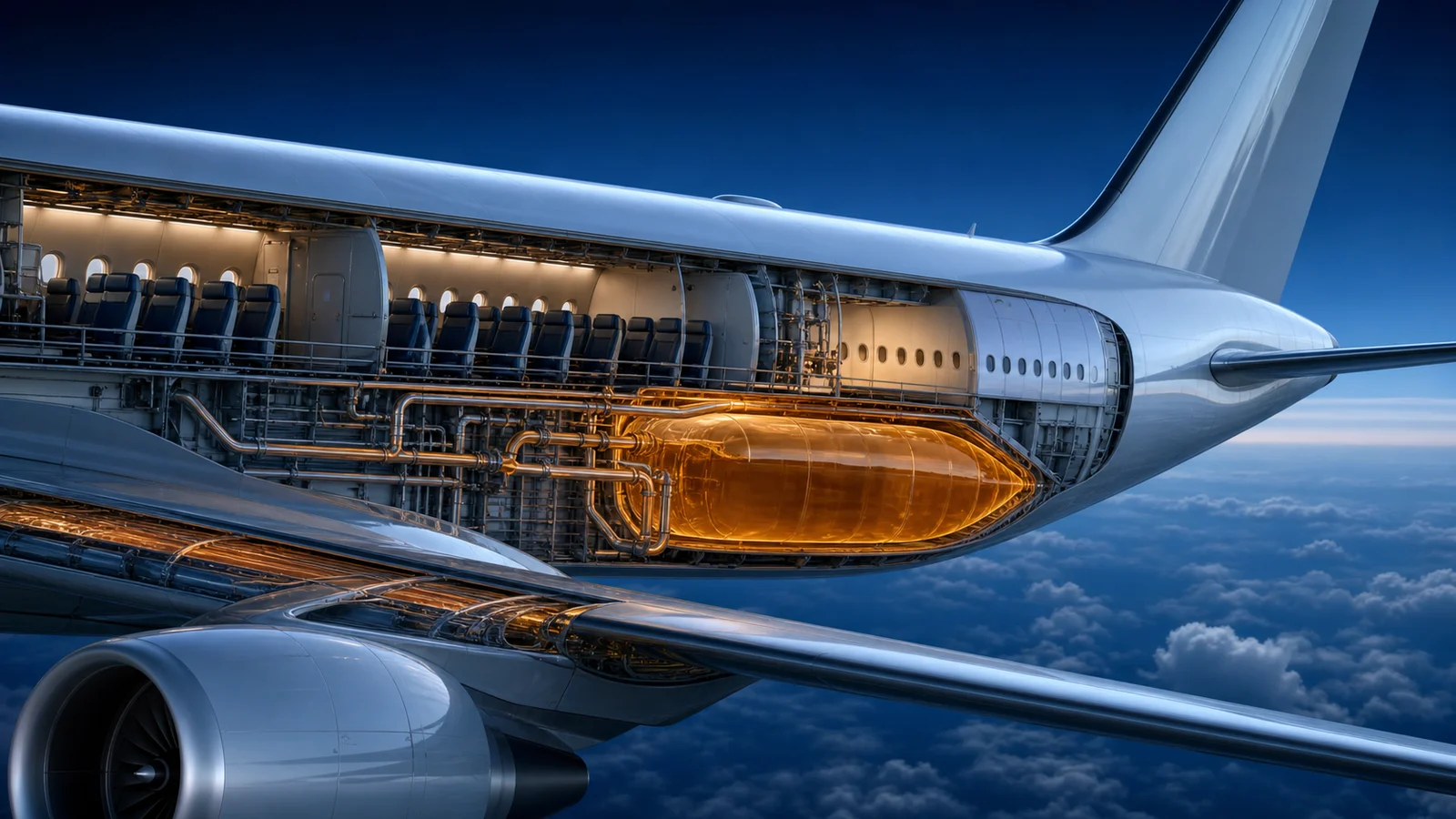
The rear centre tank raises fuel capacity by 20,000 litres. Airbus says this extends range by around 1,000 nautical miles and retains fuel provision for diversions at the destination end.
Rear is a location, not an extra cabin tank
The tank is integrated into the aircraft structure rather than placed among passenger seats. Its position and connections make it part of the certified fuel architecture.
That architecture must deliver fuel predictably while the aircraft climbs, cruises, descends and changes attitude. It also has to manage how fuel location affects weight distribution during the mission.
Transfers matter as much as storage
The Fuel Quantity Management System sequences and controls fuel transfers among tanks. Pumps, gauges and pressure systems must agree so the crew and aircraft systems know the usable fuel state.
Airbus is instrumenting fuel flow, temperature and oxygen concentration in the tank during testing. Those measurements show why a tank cannot be treated as a simple larger container.
The modification triggers certification
Airbus identifies the rear centre tank and related fuel system as major changes requiring EASA certification of the ULR variant. Testing covers performance in different flight phases and altitudes.
Certification evidence supports approved limitations and procedures. It does not remove the need for airline dispatchers and crews to calculate fuel for each route, weather pattern and possible diversion.
What the tank does and does not prove
It enables the planned range when combined with increased take-off weight, efficient engines, aircraft design and the selected cabin. It does not by itself guarantee that any city pair can be flown with any payload.
The accurate answer is therefore mechanical and operational: 20,000 litres expands available energy, while structure, transfer management, weight and certification make that energy usable over an ultra-long flight.
The 20,000 litres are an addition, not the whole supply
The headline number describes the extra rear centre tank, not the aircraft's total fuel capacity. The A350-1000 already carries fuel in its standard tank system. The ULR modification adds enough capacity for Airbus to publish roughly 1,000 additional nautical miles of range.
That distinction prevents two common mistakes: treating 20,000 litres as all the fuel aboard, or assuming 20,000 litres always produces exactly the same distance. Winds, routing, payload, temperature and required reserves all change the mission calculation.
Fuel must arrive where it is needed in the right order
A long-range aircraft does not simply draw every tank down at once. The modified Fuel Quantity Management System controls transfers so that usable fuel reaches the engines while the aircraft remains inside approved balance and system limits.
That is why Airbus is testing the full chain rather than only the tank shell. The campaign observes pumps, gauges, pressure and transfer behaviour through climb, cruise and descent, at different altitudes and fuel states.
Diversion fuel remains part of the design
Airbus says the extra range is calculated while retaining provision for a diversion near the destination. The route cannot be planned on the assumption that every litre will be consumed just as the aircraft reaches London.
Actual dispatch fuel will be set for the flight that day. The rear tank expands the aircraft's options, but regulated reserves, weather alternatives and payload planning still decide how those options are used.
Sources and further reading
This article was written for Curiosity Desk. We do not copy other publishers or invent quotes. If a material error is found, we correct it openly.
Read the full standards →One answer should lead to a better question
Bring your curiosity to the group
Curious Minds is our public Facebook community for surprising science, strange history, Australian wildlife and everyday questions. No copied posts, no personal-friend invitations and no link dumping.
- Three self-contained discussion prompts each week
- Sourced answers and honest uncertainty
- Respectful conversation without spam