A filter is a measurement, not a prettier version of one image
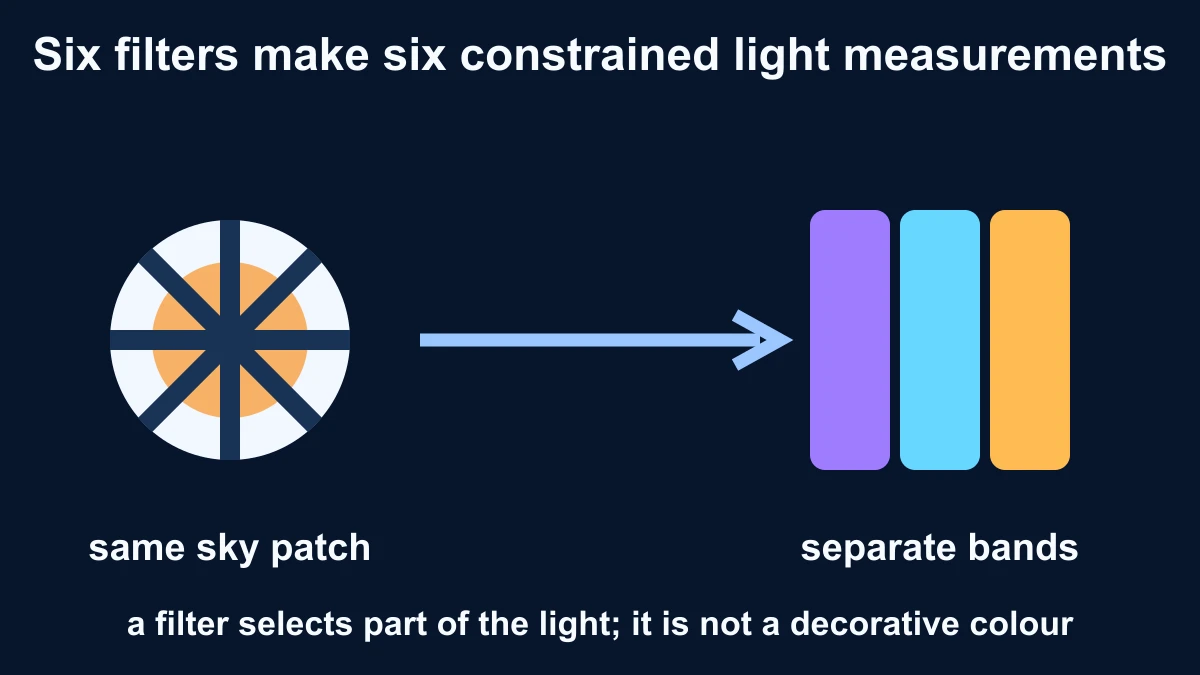
Rubin Observatory surveys the southern sky repeatedly because one image says where something was at one moment, while a sequence of carefully chosen measurements can show whether it changed. Its Legacy Survey of Space and Time, or LSST, began in late June 2026. The main survey is designed to work for ten years, using six filters named u, g, r, i, z and y. A filter lets through a selected range of visible or near-infrared light. It is not a coat of paint applied after a photograph is made.
That distinction matters because an object's brightness can differ between filters. A cool star, a dust cloud and a distant galaxy need not have the same pattern of brightness across the bands. A single measurement cannot settle what an object is, but several constrained measurements create a more informative starting record. The coloured images people see in public releases may be assembled for human viewing; the scientific value begins with the separate measurements and their calibration.
The survey does not promise that every field is measured in all six filters every night. Rubin's current official description says the Wide Fast Deep component covers about 18,000 square degrees and obtains a roughly 30-second exposure in some filter about every three days. Weather, scheduling and the intended cadence all matter. The useful claim is not continuous surveillance. It is a planned sequence of comparable measurements across a very large area.
Revisiting a field turns a snapshot into a record of change
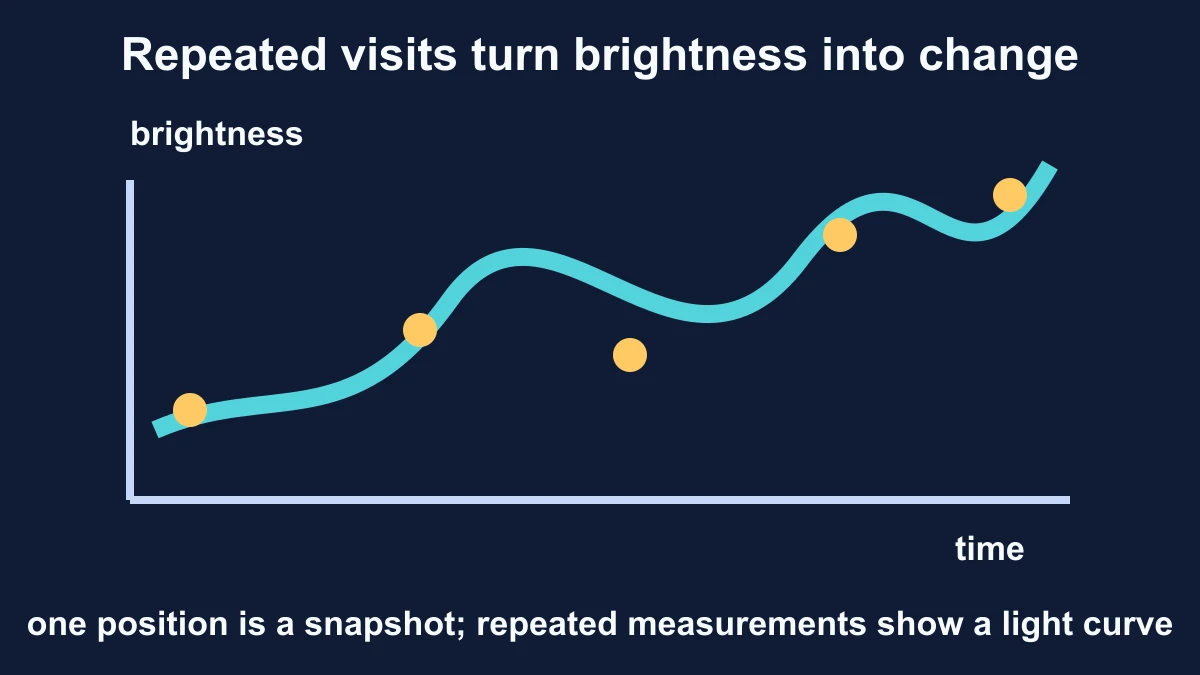
A return visit lets astronomers compare a new measurement with an earlier one. If the brightness rises and falls, the sequence can become a light curve: a graph of measured brightness against time. If a point shifts against distant stars, repeated positions can help describe motion. The official survey-strategy material explicitly connects revisit intervals and observation geometries with detecting moving Solar System objects and characterising variable sources.
This is why cadence—the timing of observations—is not a background technical setting. It determines which changes can be sampled well enough to recognise. A short-lived flash can be missed if the field is not revisited at a useful time. A slowly changing star needs observations spread over longer intervals. Rubin's survey has to balance those needs with sky brightness, weather, filter changes and the many science goals of one observatory.
Repeated images also make a more honest public story possible. A striking object in one frame may be an artefact, a calibration problem or an ordinary object measured under different conditions. Comparison across visits is evidence, but it is not an automatic explanation. The pattern tells researchers that something deserves analysis; it does not by itself identify the physical cause.
An alert marks a change worth checking, not a confirmed discovery
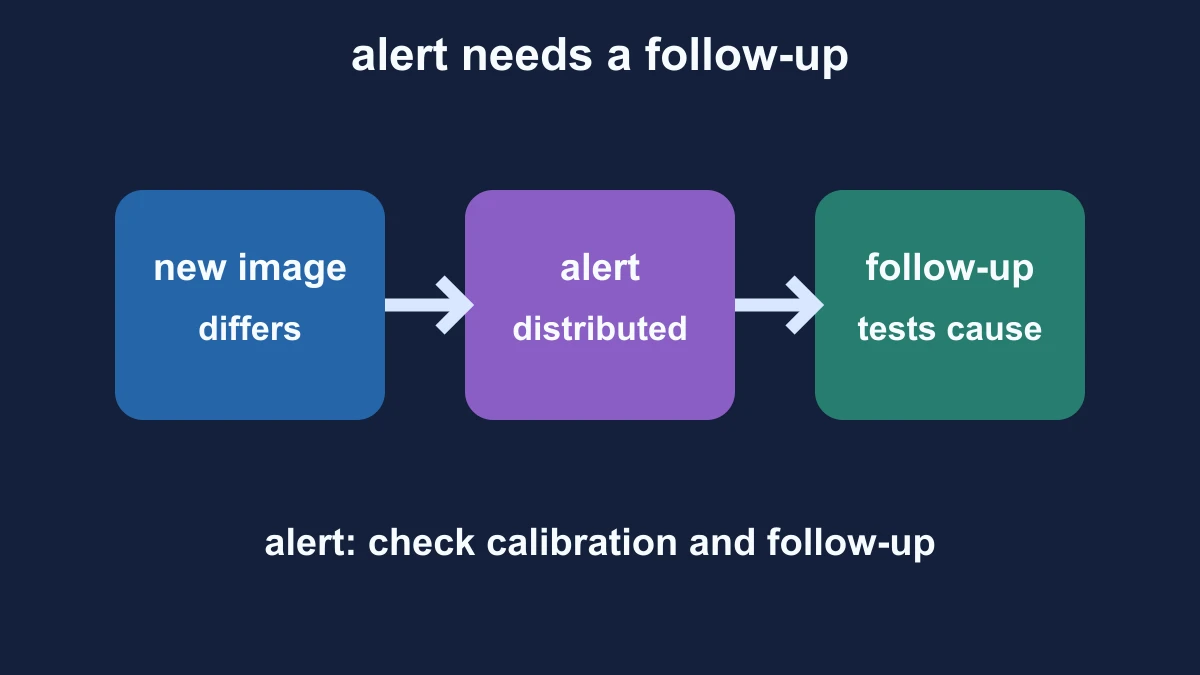
Rubin's prompt data products can issue an alert soon after an exposure when a source has changed significantly compared with a reference image. That is deliberately fast: it allows astronomers and automated alert brokers to notice possible supernovae, variable stars, moving objects or other changes while additional observations may still be useful. The alert is a structured notice about a measured difference, not a press release declaring what caused it.
The official data-product description separates that fast stage from later products. Difference imaging, calibration, source catalogues and moving-object processing add context on different timescales; yearly releases reprocess the accumulated data more uniformly. Follow-up by other instruments can also test a candidate. A later measurement may strengthen the case, classify it differently or show that the original alert was not an astrophysical event at all.
That boundary is the reason a repeated-colour survey is more than a huge camera. Rubin is building an evolving measurement record that lets scientists ask sharper questions about motion and variability. It will produce many opportunities for discovery, but an alert alone is not proof of one. The next reliable update should name the data, the method and the independent checks that turn a changing pixel into a supported conclusion.
Sources and further reading
This article was written for Curiosity Desk. We do not copy other publishers or invent quotes. If a material error is found, we correct it openly.
Read the full standards →One answer should lead to a better question
Bring your curiosity to the group
Curious Minds is our public Facebook community for surprising science, strange history, Australian wildlife and everyday questions. No copied posts, no personal-friend invitations and no link dumping.
- Three self-contained discussion prompts each week
- Sourced answers and honest uncertainty
- Respectful conversation without spam