The magnetar turns a quantum prediction into a test
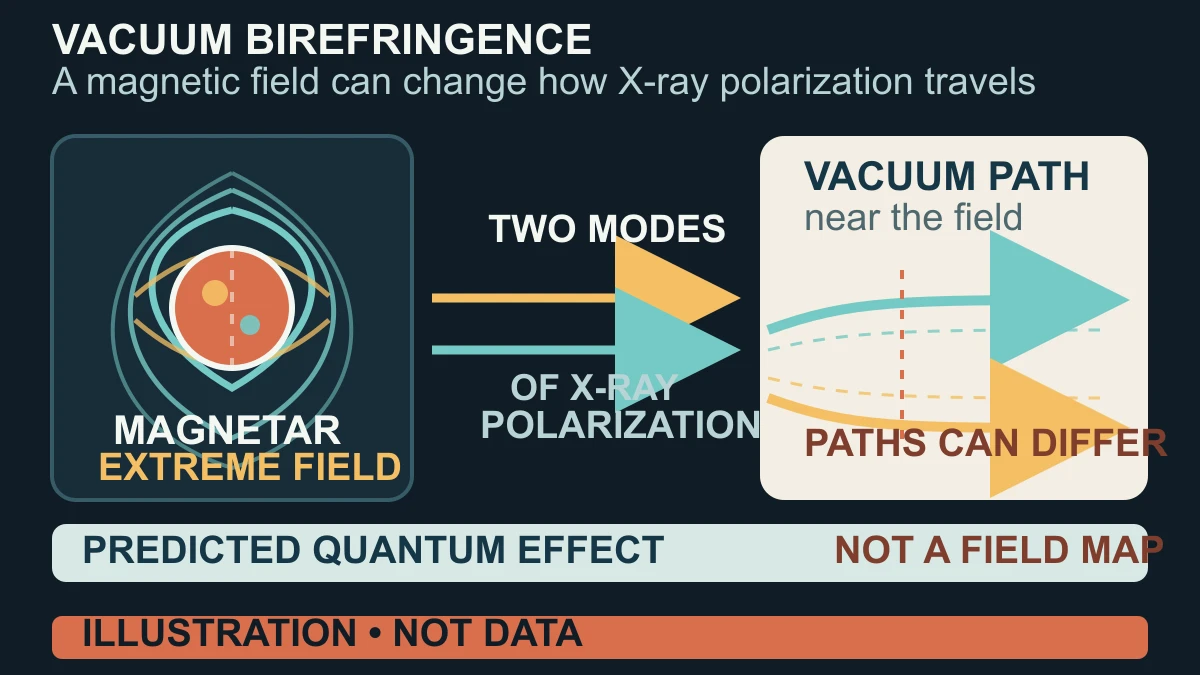
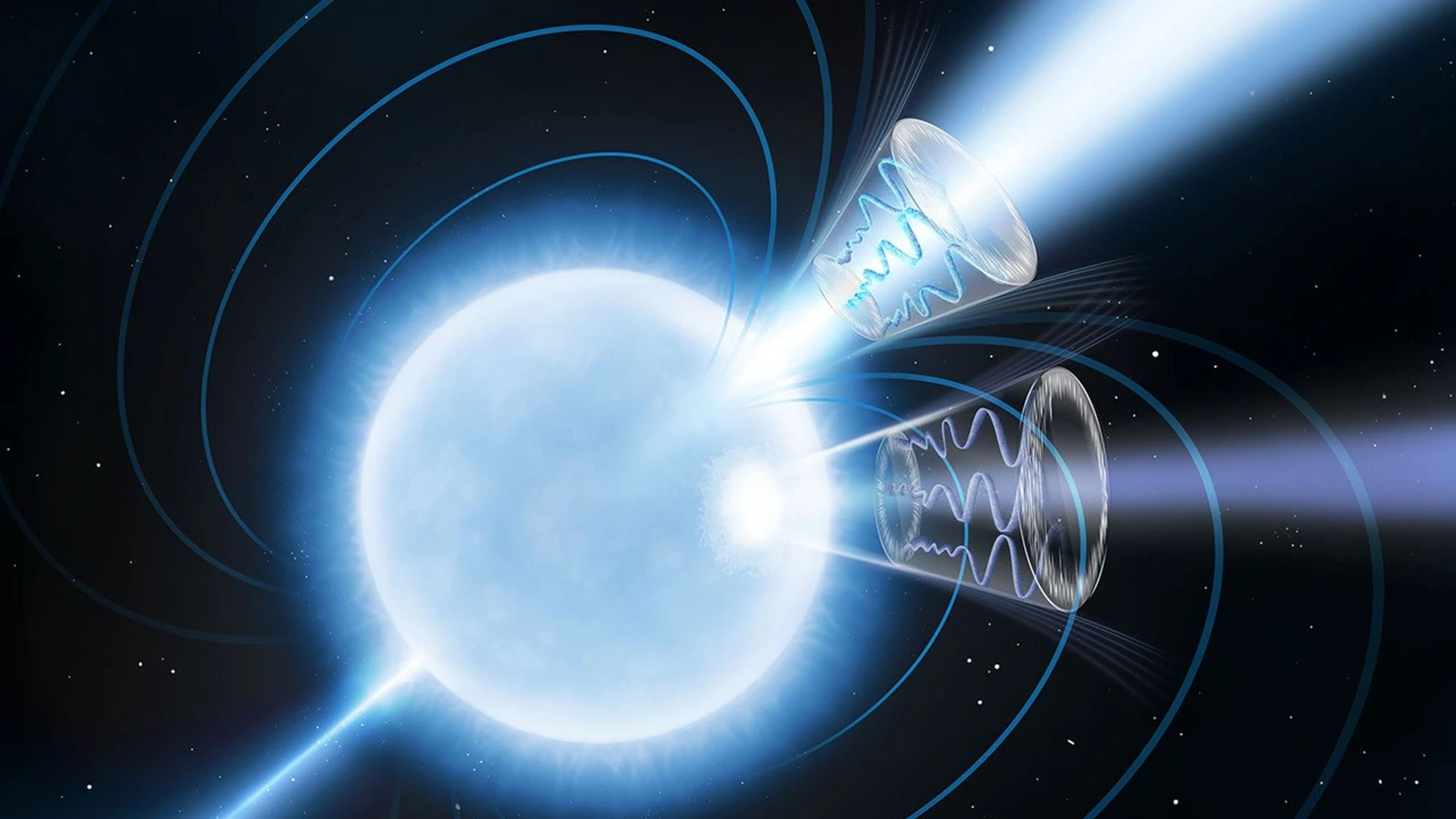
Empty space is not being photographed or scooped up. In quantum electrodynamics, an ultra-strong magnetic field can give the vacuum polarization-dependent refractive indices: light in different polarization states can propagate differently. A magnetar is a neutron star whose surface field exceeds 10^14 gauss, making it a natural laboratory for an effect that is far too small to reproduce with ordinary magnets.
The Nature team studied radio-emitting magnetar 1E 1547.0−5408. The paper reports phase- and energy-resolved X-ray polarization from NASA's Imaging X-ray Polarimetry Explorer, coordinated with NICER and Parkes/Murriyang radio observations. Its result is a high, structured signal: up to 65% phase-averaged at 2 keV, nearly 80% at some phases in the 2–3 keV band and above about 40% across the radio-beam crossing. Those are measured properties; calling them vacuum birefringence is the interpretation.
The useful word is birefringence: the vacuum behaves, for this extreme environment, as though it has different optical responses for different polarization states. That does not mean the star has turned empty space into glass, nor that every photon follows a visibly split path. It means the predicted quantum interaction can leave a statistical pattern in the light that survives the journey to a telescope.
IXPE reads polarization from the track of an electron
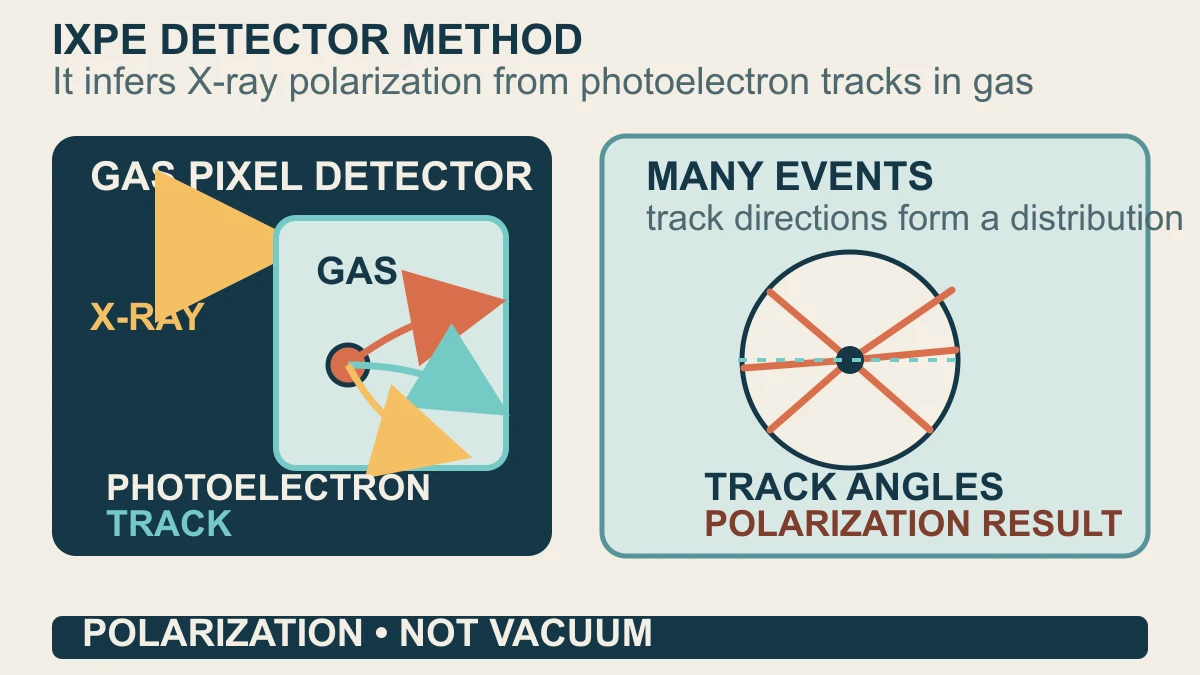
IXPE does not directly measure a change in the vacuum's density or take a picture of a magnetic field. Its three telescopes focus X-rays into Gas Pixel Detectors. When an X-ray interacts in the detector gas, the photoelectron it ejects is preferentially emitted in a direction related to the incoming X-ray's polarization. The detector records the photoelectron track, and a large collection of initial track directions yields the degree of polarization and the position angle.
That is why the result is a measurement of light rather than a direct photograph of the thing being tested. Polarization describes a preferred orientation in the electromagnetic wave. IXPE estimates how strong that preference is and which direction it points, then researchers compare the values across X-ray energy and the magnetar's roughly two-second rotation. The pattern can test competing models even though the quantum vacuum itself is invisible.
NICER supplied complementary X-ray timing and spectral information, while Murriyang, CSIRO's 64-metre Parkes radio telescope, supplied radio polarization from the same rotating source. The campaign's power came from coordination: the X-ray and radio polarization angles could be compared as the magnetar turned. A clean relationship with the large-scale magnetic geometry makes the interpretation more constrained, but it does not remove the need to test the geometry and the models.
A strong signal is not the same as a complete proof
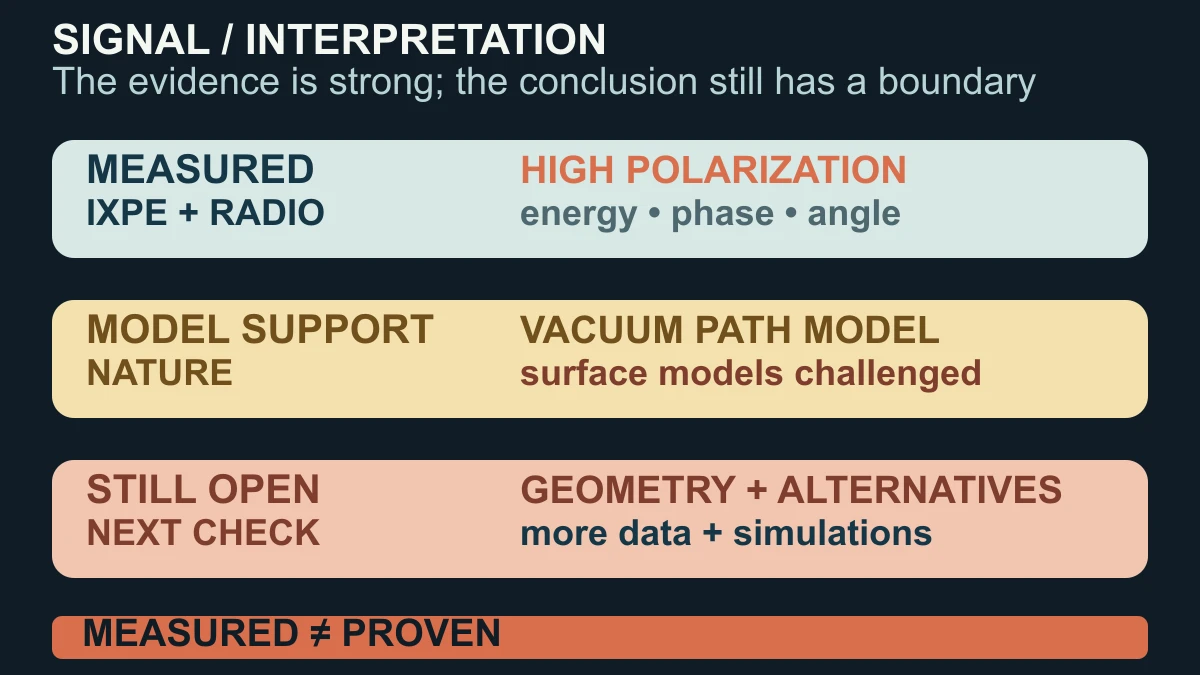
The evidence chain has several layers. The team measured high X-ray polarization, saw it vary with energy and rotational phase, and found that the X-ray and radio polarization angles were consistent with the rotating-vector model. The published paper says propagation governed by vacuum birefringence can naturally explain those signals, while standard surface-emission models that send light to infinity without refractive propagation are challenged. That is why the result is a marked advance, not a routine detection.
The boundary matters because a model that explains a pattern is not the same thing as a detector flag labelled vacuum birefringence. An independent analysis of the same 2025 IXPE data reports a strong phase- and energy-integrated polarization measurement but keeps the smoking-gun conclusion cautious: detailed geometry and additional modeling still matter, and a definitive conclusion does not follow from the polarization value alone. The disagreement is a useful part of the evidence, not a reason to hide the result.
So what did IXPE actually measure? It measured the orientation and degree of polarization in X-rays from 1E 1547.0−5408. Those photons carry a pattern that is unusually compatible with a quantum-electrodynamics prediction about propagation near a magnetar. NASA, CSIRO and the researchers point to more observations and improved simulations as the next check. The honest payoff is therefore precise: empty space may have revealed its quantum optical behavior, but the observation is evidence for a theory rather than a complete proof of every prediction.
Sources and further reading
- Nature — Vacuum birefringence and the polarized X-ray emission from a radio magnetar ↗
- arXiv — Vacuum birefringence in the polarized X-ray emission of a radio magnetar ↗
- arXiv — The long quest for vacuum birefringence in magnetars ↗
- NASA Science — NASA's IXPE May Have Proven 90-Year-Old Theory ↗
- NASA/IXPE — Official magnetar artist concept asset ↗
- NASA — Imaging X-ray Polarimetry Explorer (IXPE) ↗
- NASA IXPE — Polarization Detection ↗
- CSIRO — Rare ultra-magnetic star the key to solving a quantum cold case ↗
- CSIRO — Murriyang, our Parkes radio telescope ↗
- HEASARC — IXPE mission and data archive ↗
- NASA — Guidelines for using NASA Images and Media ↗
This article was written for Curiosity Desk. We do not copy other publishers or invent quotes. If a material error is found, we correct it openly.
Read the full standards →One answer should lead to a better question
Bring your curiosity to the group
Curious Minds is our public Facebook community for surprising science, strange history, Australian wildlife and everyday questions. No copied posts, no personal-friend invitations and no link dumping.
- Three self-contained discussion prompts each week
- Sourced answers and honest uncertainty
- Respectful conversation without spam