A radio wave reaches separated antennas at different moments
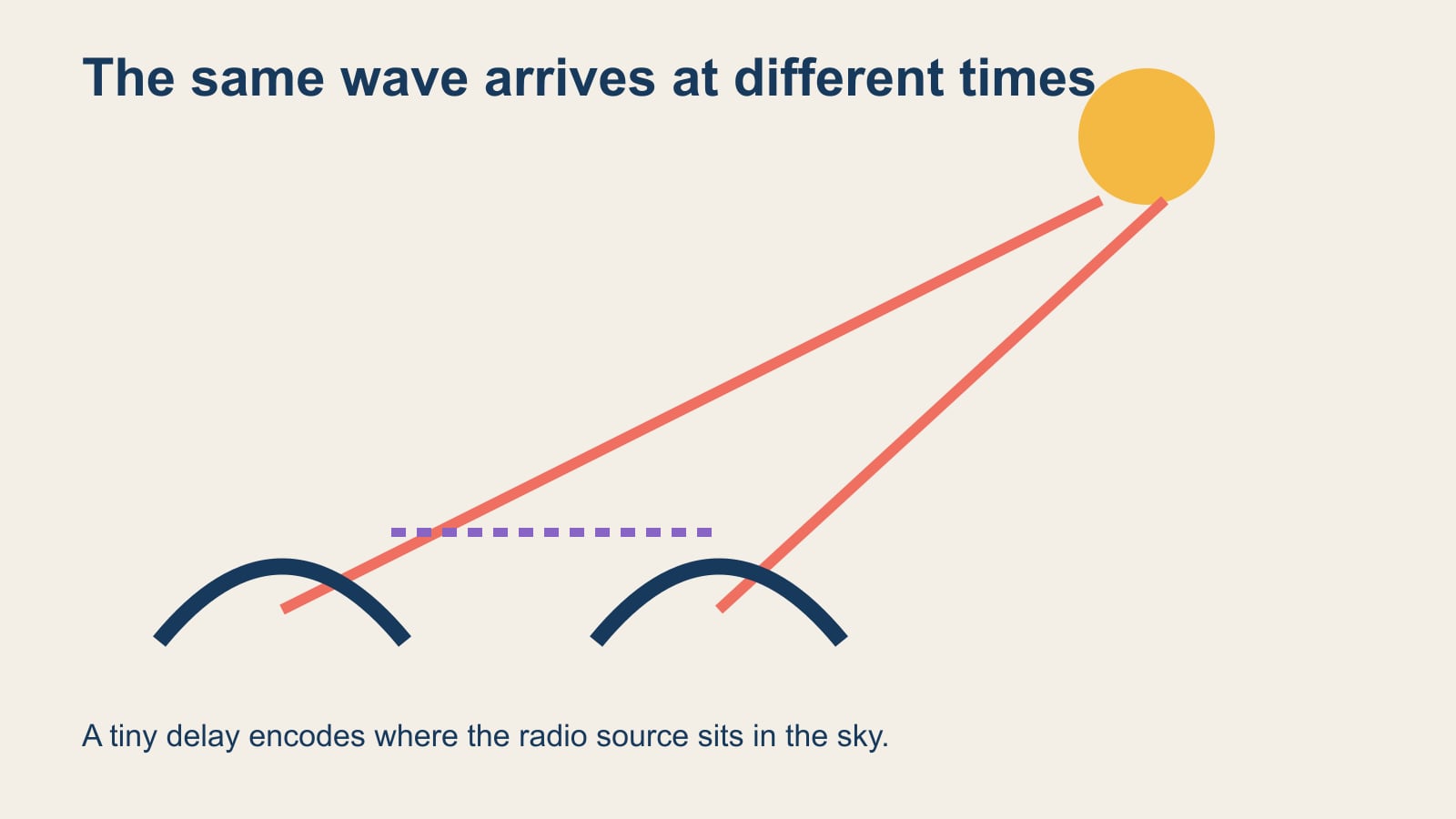
Imagine a nearly flat radio wave crossing an array. Unless its source is directly above a perfectly level pair of antennas, the wavefront reaches one receiver before the other. The delay may be tiny, but modern clocks and electronics preserve enough timing and phase information to measure that difference across a shared frequency band.
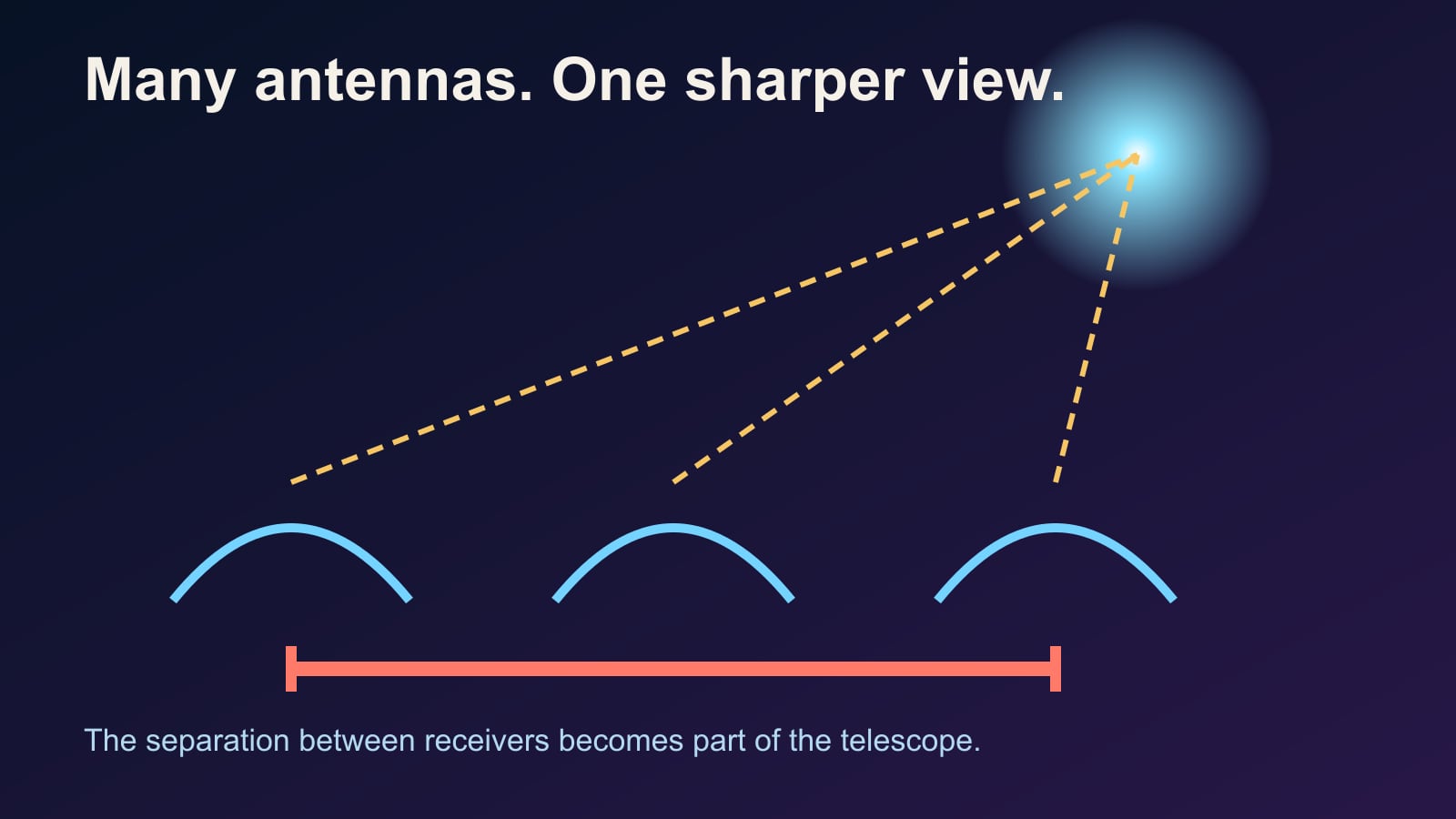
The delay changes predictably with the source's direction and the vector between the two antennas. That connecting vector is called a baseline. Each baseline is therefore a spatial measuring tool: it records how strongly the arriving wave agrees with itself across one particular separation and orientation on the ground.
Frequency matters as well as distance. Astronomers often describe a baseline in wavelengths because the same physical separation samples different angular scales at different observing frequencies. Keeping the receivers synchronised and attaching reliable time and frequency information is therefore part of the measurement, not administrative work performed after it.
A correlator turns antenna pairs into spatial measurements
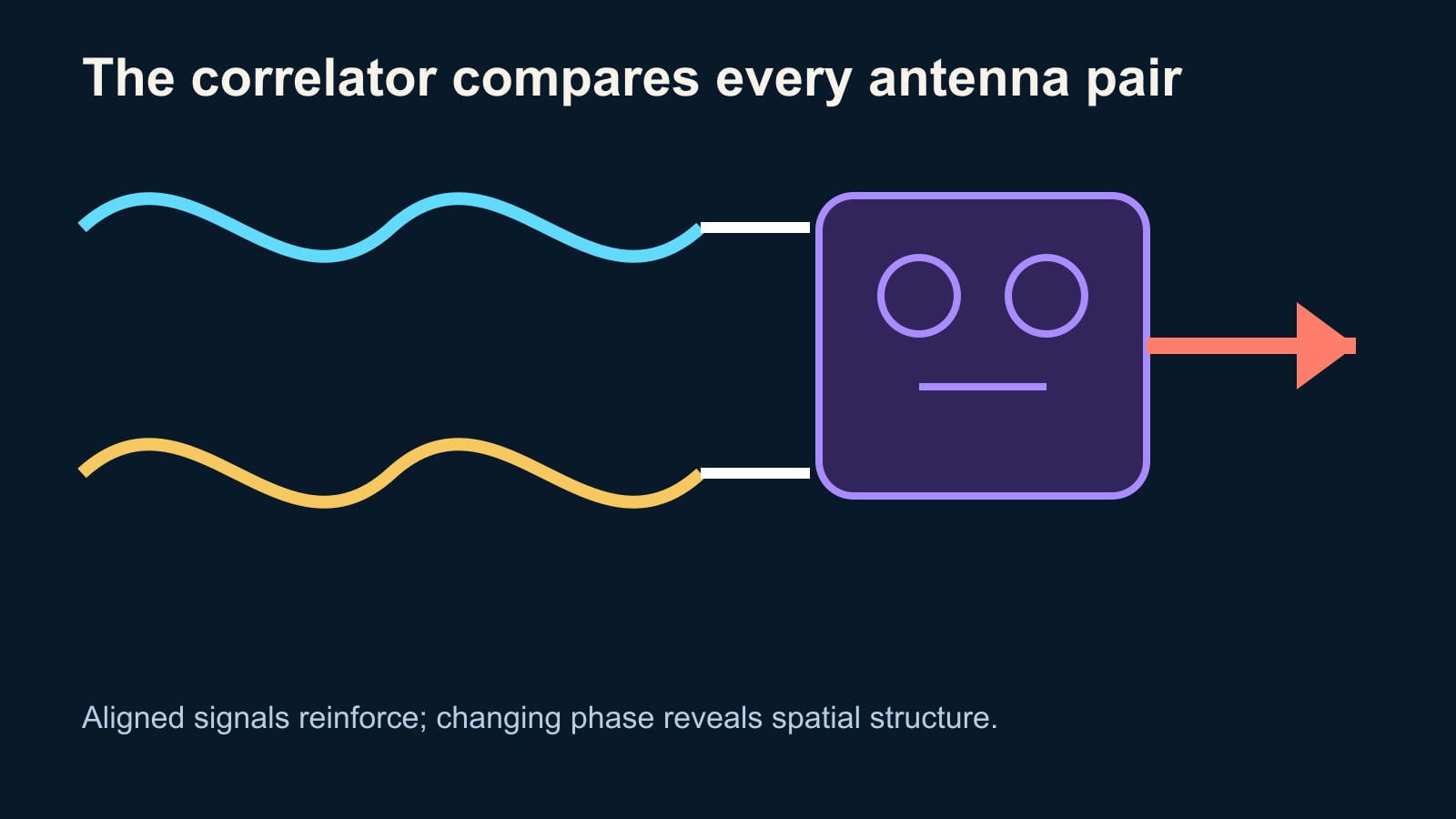
An array does not simply add all receiver voltages into one louder signal. Its correlator compares streams from antenna pairs after accounting for geometric delay. When matching features line up, their correlation retains information about the radio source's brightness structure at the spatial scale sampled by that baseline.
With many antennas, the number of distinct pairs grows quickly. Each pair contributes a complex measurement containing amplitude and phase. Calibration is essential because clocks, electronics, the atmosphere and radio-frequency interference can alter those values. The output is not yet a photograph; it is a carefully corrected set of samples from which an image can be reconstructed.
Comparing pairs is what preserves direction-sensitive structure. Adding every voltage too early could strengthen a chosen direction, as a phased array does, but it would discard much of the information needed for flexible imaging. A correlator keeps the pairwise relationships so later processing can test how well different sky models explain the observations.
Many baselines synthesize an aperture that was never built
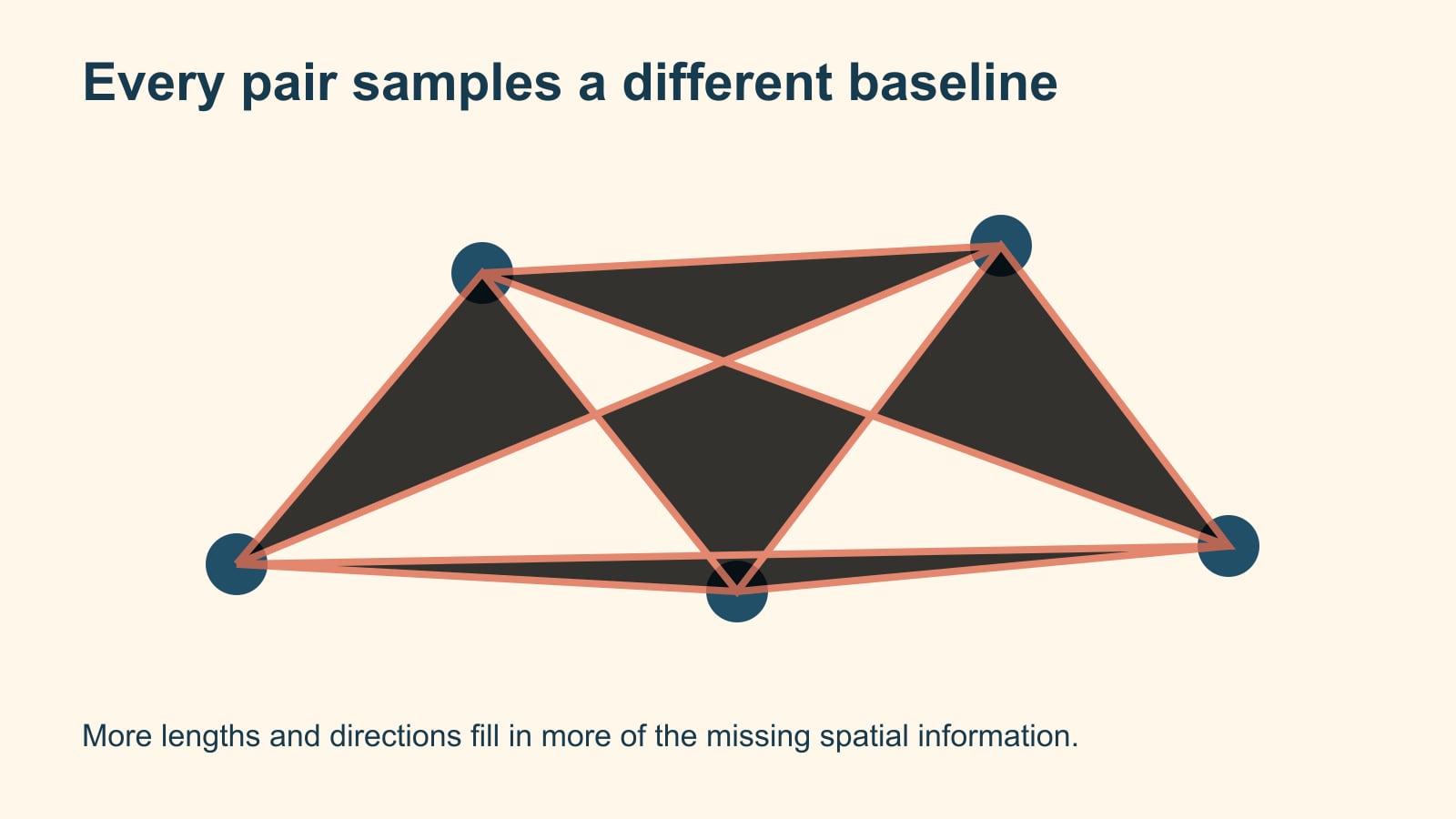
Short baselines respond well to broad structures in the sky, while long baselines can distinguish finer angular detail. Different orientations sample different directions of that structure. As Earth rotates, the projected baselines change relative to the source, adding more measurements without physically moving every antenna around a full two-dimensional aperture.
Imaging software combines these samples through Fourier relationships between sky brightness and the measured correlations. Because the sampling is incomplete, reconstruction includes weighting and deconvolution rather than a single camera-like exposure. The phrase aperture synthesis captures the result: the array builds evidence for the view a much wider filled telescope could have sampled.
This is why array layout changes the resulting image. A compact arrangement supplies many short baselines and is sensitive to broader structures. Spreading stations farther apart adds long baselines and finer detail, but it cannot by itself replace every missing intermediate scale. Designers balance layouts because a scientifically useful view needs coverage, not merely the longest possible line.
One giant eye is a useful metaphor with strict limits
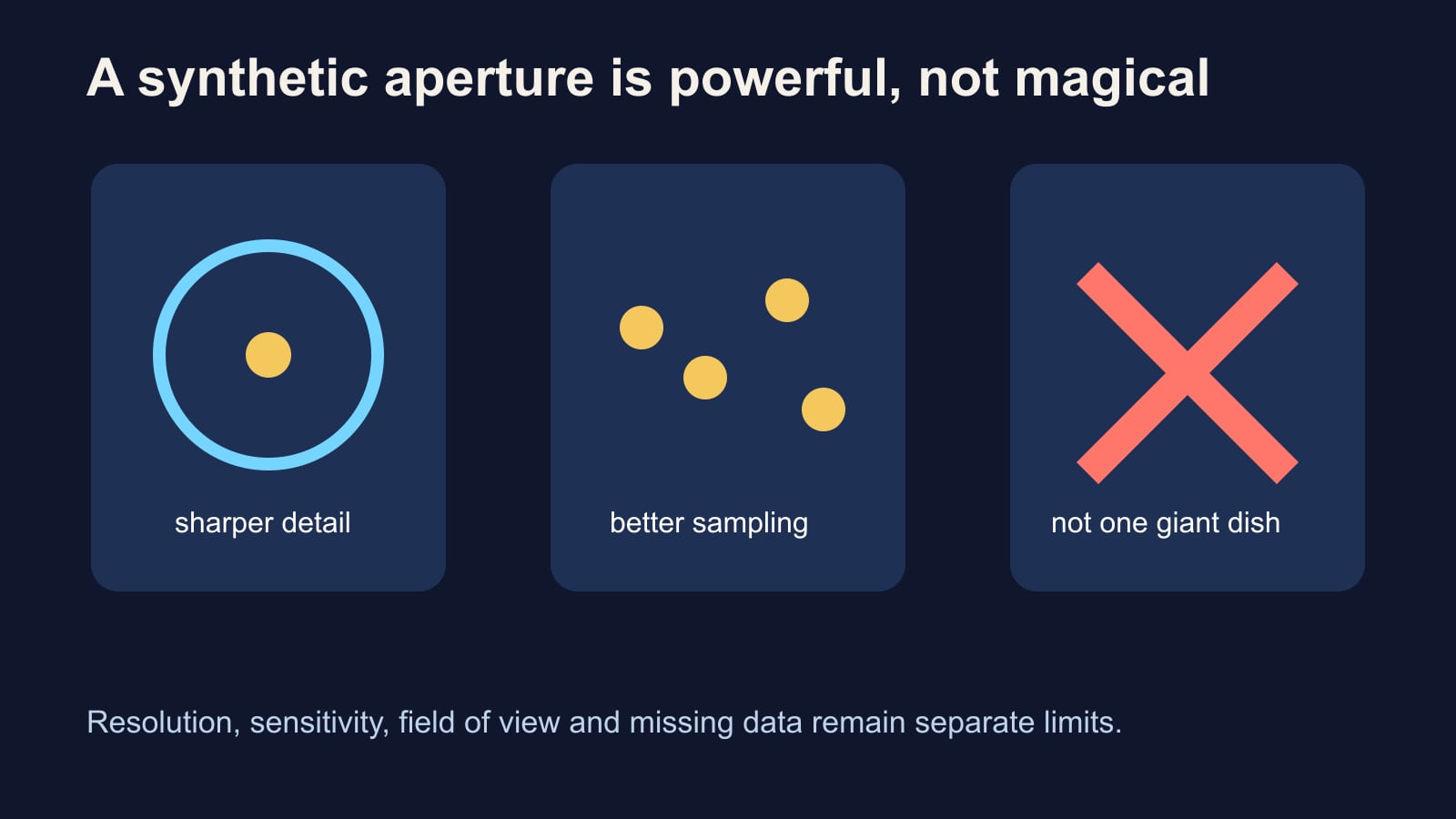
The largest separation helps set the finest angular resolution, but it does not provide the collecting area of a solid dish that wide. Sensitivity depends on the actual antennas, receivers, bandwidth, observing time and noise. The shortest spacings also matter because an array can miss broad, smooth emission that its available baselines do not sample well.
Field of view is another separate property, shaped by the individual stations and observing setup. An array such as the Square Kilometre Array is therefore not one literal dish and not an instant all-sky camera. Its power comes from coordinating many real receivers, preserving phase and timing, and converting a web of baselines into a scientifically testable radio image.
Even the final image is an evidence product with declared choices. Weighting can favour sensitivity or resolution; calibration assumptions and deconvolution affect what structures are recoverable. Astronomers validate features across settings and observations rather than treating every coloured pixel as a direct snapshot. The giant-eye metaphor earns its keep only when those limits remain visible.
Sources and further reading
This article was written for Curiosity Desk. We do not copy other publishers or invent quotes. If a material error is found, we correct it openly.
Read the full standards →One answer should lead to a better question
Bring your curiosity to the group
Curious Minds is our public Facebook community for surprising science, strange history, Australian wildlife and everyday questions. No copied posts, no personal-friend invitations and no link dumping.
- Three self-contained discussion prompts each week
- Sourced answers and honest uncertainty
- Respectful conversation without spam