The heliosphere is a moving shield, not a fixed wall
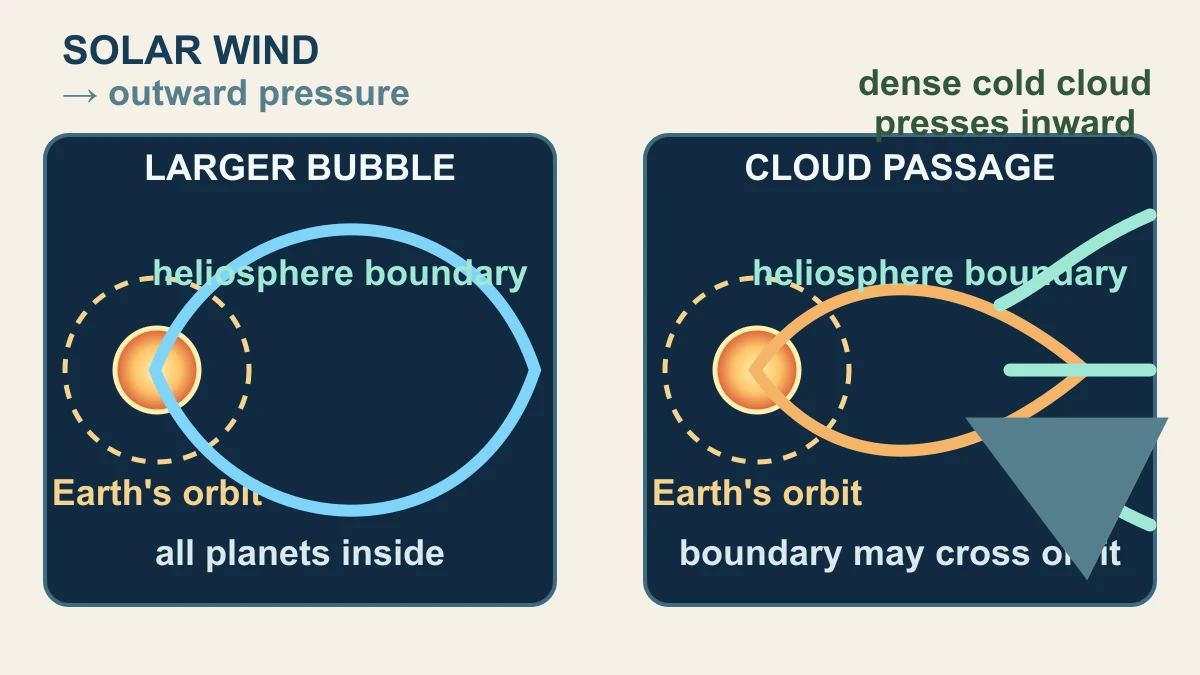
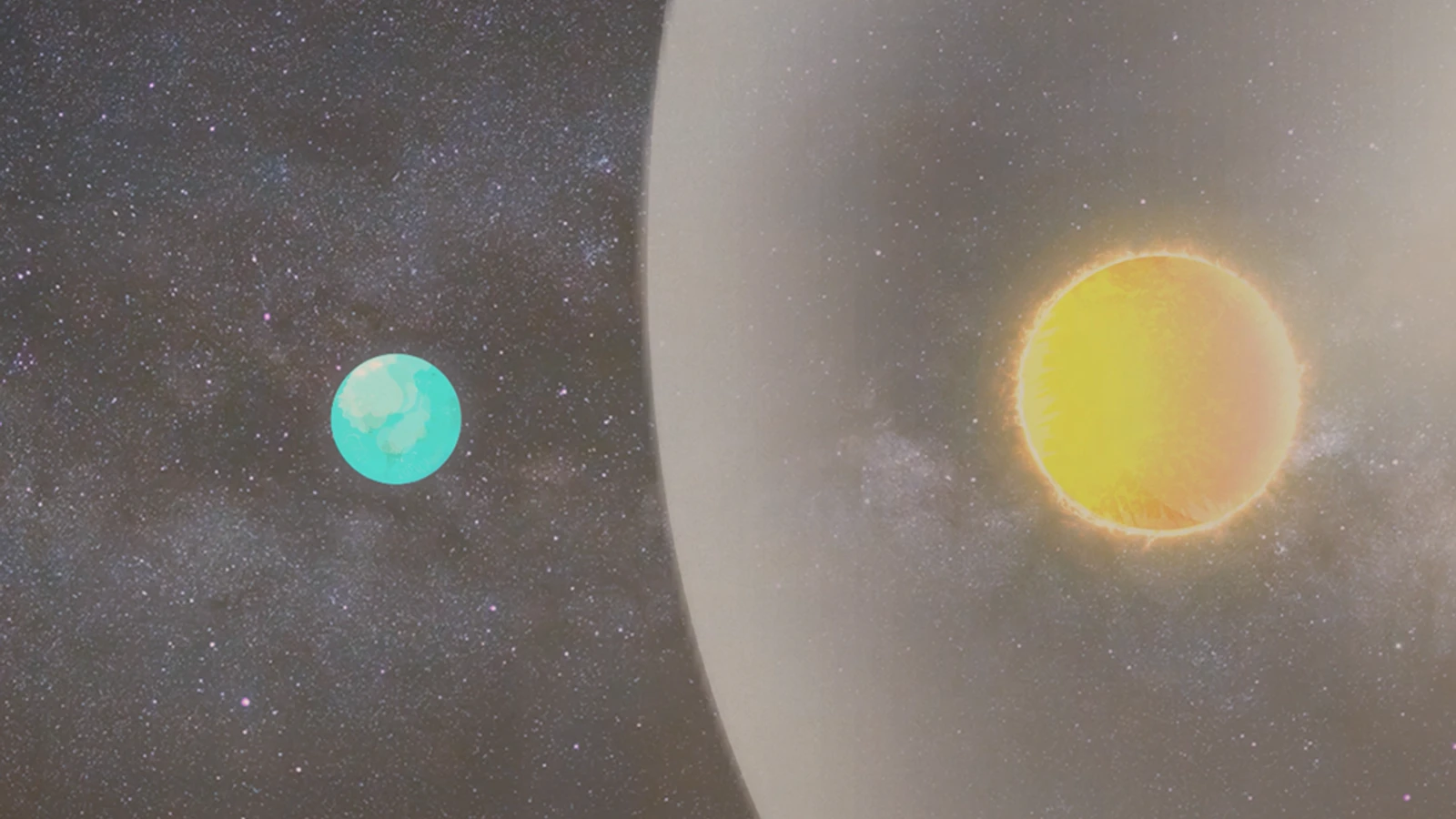
The immediate answer is that a cloud between the stars could have changed Earth's climate indirectly, by changing the size of the heliosphere around the solar system. The heliosphere is the vast bubble formed as the solar wind streams away from the Sun. It is a moving interaction region, not a hard shell: its shape and reach depend on the balance between the outward solar wind and the material, fields and motion of the interstellar medium around it.
Today, the heliosphere extends far beyond the planets in the direction of its nose. The 2026 Annual Review synthesis describes the present bubble as reaching roughly 120 astronomical units there, while the Sun itself moves through the Galaxy at about 19 parsecs per million years. That motion means the Sun does not spend its history in one fixed galactic environment. Thin gas, denser clouds and other structures can change the outside pressure against which the solar wind expands.
NASA's current report separates that long galactic journey from a different line of research about the young Sun's faintness and superflare-rich youth. They may appear in the same story because both concern ancient Earth, but they are not one mechanism. This package follows the interstellar-cloud route: a proposed change in the heliosphere first, a possible change in Earth's space environment second, and a climate interpretation only after those steps are tested.
A cold cloud could push the shield inside Earth's orbit
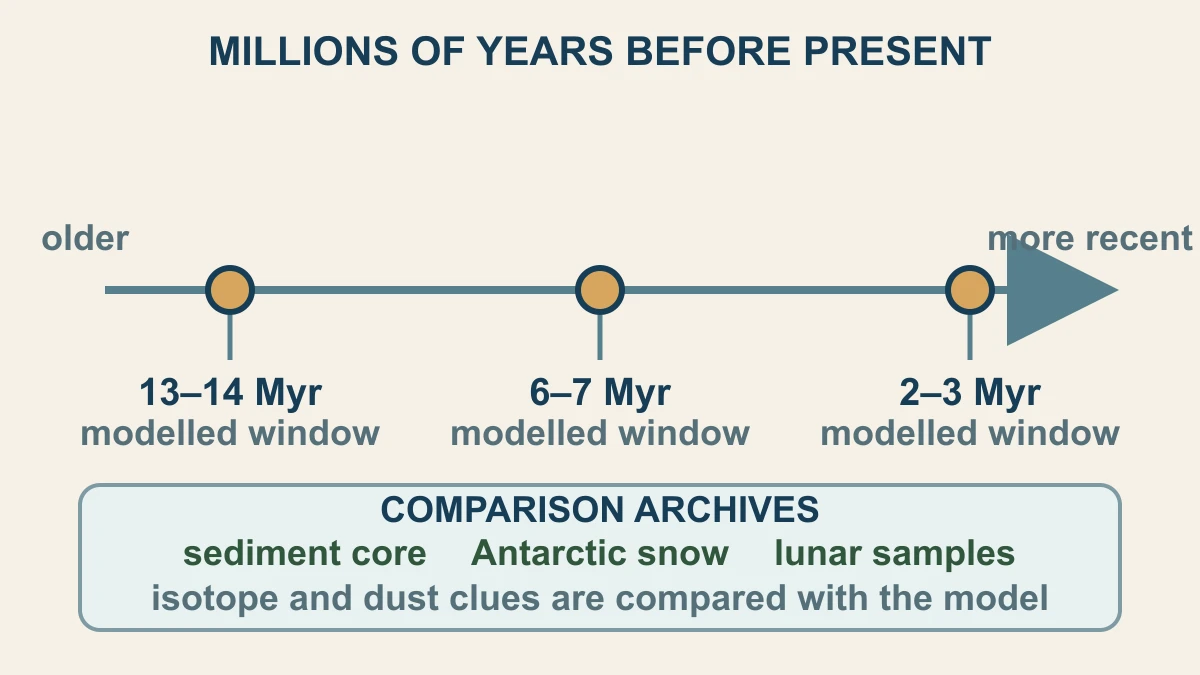
A sufficiently dense, cold interstellar cloud would push inward while the solar wind pushed outward. In one primary modelling study, a possible passage through the Local Ribbon of Cold Clouds was reconstructed from 21-centimetre hydrogen data and a heliosphere simulation. Under that scenario, the heliosphere contracted to about 0.22 astronomical units—inside Earth's orbit—and the modelled neutral-hydrogen density around Earth rose sharply. Those are outputs of a physical model, not a spacecraft measurement of an ancient boundary.
The proposed consequence is an altered space environment. If the protective bubble moved inside Earth's orbit, more interstellar neutral gas and energetic particles could reach the region around Earth than they do under today's conditions. NASA's 2026 synthesis describes modelled increases in water vapour and changes in upper-atmospheric dynamics during cold-cloud exposure. A separate 2026 radiation preprint models increased and variable high-energy-particle exposure. Together they show mechanisms worth testing; they do not supply a completed climate simulation or a single measured temperature response.
The result also depends on assumptions about a cloud's density, temperature, path, magnetic field, duration and the solar wind at the time. A short encounter and a long immersion would not produce the same history, and the atmosphere would need its own chemistry and circulation calculations. Nothing in this reconstruction is a present-day warning about an approaching climate event. It is an attempt to explain how the Sun's past galactic surroundings could have altered conditions during a particular ancient interval.
Models and geological traces are clues, not a climate verdict
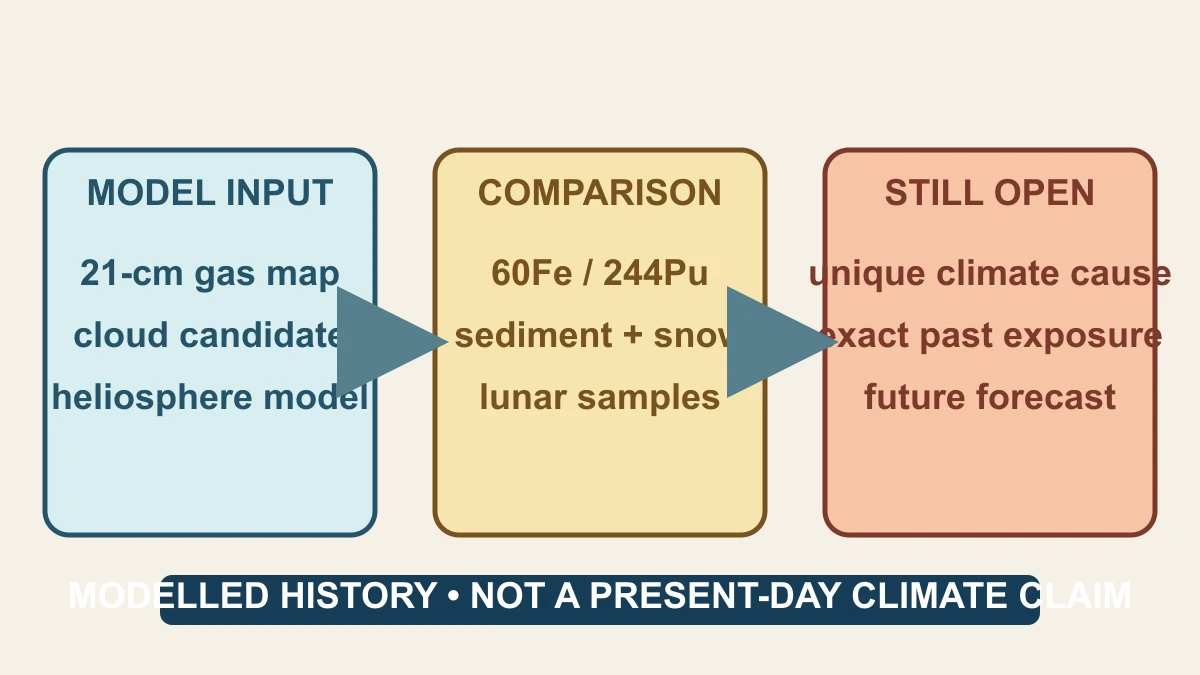
The evidence chain has several layers. A 21-centimetre survey can help reconstruct where neutral hydrogen is and how a candidate cloud moves. A heliosphere simulation can then estimate how that environment would change the solar-wind bubble. Geological material offers a separate time record: NASA's report points to elements associated with interstellar dust in deep-sea sediment, Antarctic snow and lunar samples, while the primary study compares the scenario with measurements of iron-60 and plutonium-244. Each layer answers a different question, so agreement is not the same as direct observation.
The 2026 Annual Review places possible cooling intervals around 13–14, 6–7 and 2–3 million years ago alongside an explicit warning that their driving mechanisms remain debated. That wording matters. A modelled encounter can overlap a geological interval without proving that it caused the cooling, and an isotope signal can show that unusual material reached an archive without identifying every route it took through the solar system and atmosphere. The comparison raises a testable possibility; it does not close the history.
What is established is narrower and useful: the heliosphere changes as the solar system moves through the interstellar medium, published models show that dense-cloud passages could compress it dramatically, and Earth archives can be examined for compatible traces. What remains open is whether a specific cloud encounter happened exactly as reconstructed, how the atmosphere responded, and how much of any ancient climate shift it could explain. The safe conclusion is therefore a question with a mechanism—not a claim that clouds between the stars were the sole cause of Earth's climate.
Sources and further reading
- NASA — NASA Research Shows How Sun's Ancient History Shaped Earth ↗
- Crossref metadata — Understanding the Heliospheric Shield review ↗
- Nature Astronomy via PMC — A possible direct exposure of Earth to the cold dense interstellar medium 2–3 Myr ago ↗
- arXiv — Increased and Varied Radiation during the Sun's Encounters with Cold Clouds in the last 10 million years ↗
- arXiv — Earth's Mesosphere During Possible Encounters With Massive Interstellar Clouds ↗
- NASA — Guidelines for using NASA Images and Media ↗
This article was written for Curiosity Desk. We do not copy other publishers or invent quotes. If a material error is found, we correct it openly.
Read the full standards →One answer should lead to a better question
Bring your curiosity to the group
Curious Minds is our public Facebook community for surprising science, strange history, Australian wildlife and everyday questions. No copied posts, no personal-friend invitations and no link dumping.
- Three self-contained discussion prompts each week
- Sourced answers and honest uncertainty
- Respectful conversation without spam