Roman at a glance
The launch, telescope and first images
- Target launch
- 30 August 2026, 7:20 am EDT
- Rocket
- SpaceX Falcon Heavy
- Launch site
- Kennedy Space Center, Florida
- Primary mirror
- 2.4 metres, the same diameter as Hubble's
- Main camera
- 300-megapixel Wide Field Instrument
- Field of view
- At least 100 times larger than Hubble's
- Destination
- A large orbit around Sun-Earth L2
- First science images
- About three months after launch
- Planned data
- About 1.4 terabytes per day
The launch date remains a target and can change. Science images are expected after commissioning, not immediately after liftoff.
The next great NASA telescope is built to look wide
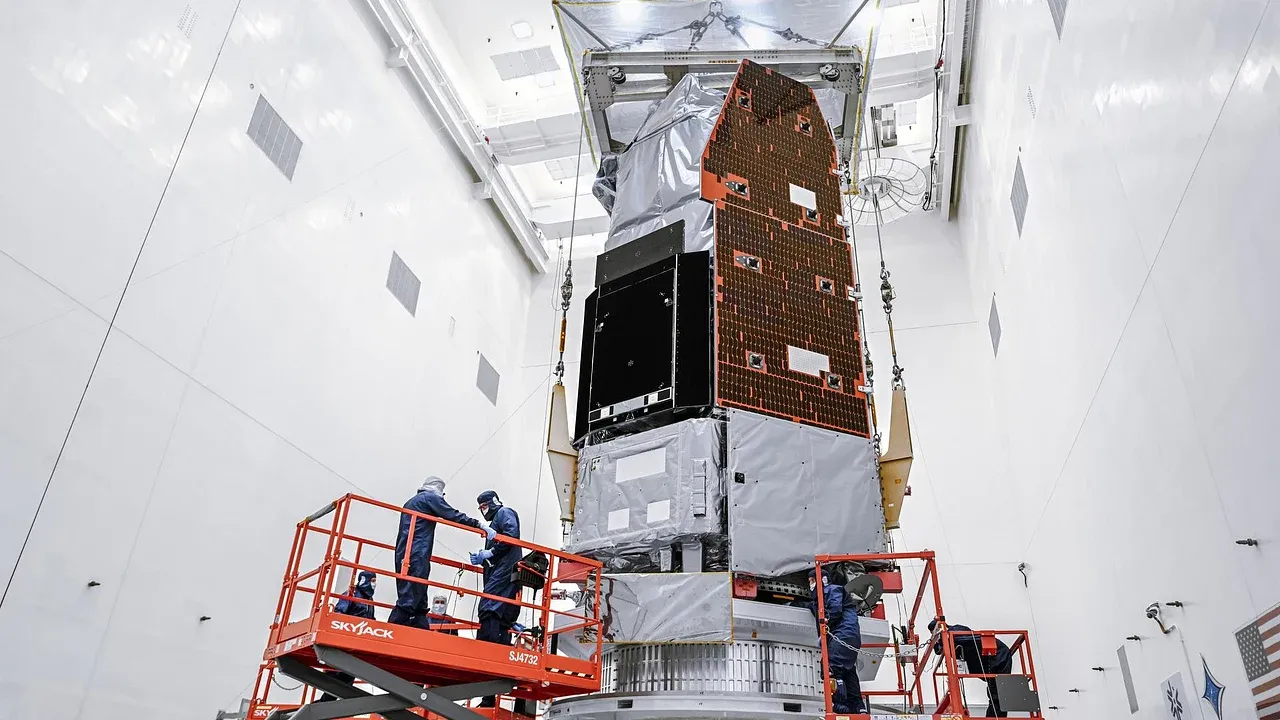
NASA is targeting 30 August 2026 for the launch of the Nancy Grace Roman Space Telescope from Kennedy Space Center in Florida. A SpaceX Falcon Heavy is scheduled to lift the observatory from Launch Complex 39A at 7:20 am EDT. NASA will preview the mission in a public briefing on 29 July, placing Roman at the beginning of a month-long launch-interest window rather than at the end of a one-day announcement.
A target date is not a guarantee. Weather, the rocket, the spacecraft or range operations can move a launch. The reliable claim on 24 July is that Roman is at Kennedy and NASA has published an August 30 target. Curiosity Desk will update this page if the agency changes that plan.
Roman and Hubble begin with mirrors of the same diameter
Roman's primary mirror is 2.4 metres across, the same diameter as Hubble's. That comparison can make the two telescopes sound almost interchangeable, but mirror diameter is only one part of an observatory. The instruments behind the mirror decide how much sky is recorded, which wavelengths are measured and how the incoming light is divided among detectors.
The newer mirror weighs about 186 kilograms, less than one-quarter of Hubble's primary mirror, according to NASA's press kit. Roman combines it with modern infrared detectors, a wide optical design, a large sunshade, communications equipment and a spacecraft built for a very different observing programme.
One Roman exposure covers at least 100 times more sky
Roman's main instrument is a 300-megapixel infrared camera called the Wide Field Instrument. NASA says it will preserve angular resolution comparable with Hubble while covering a field of view at least 100 times larger. In plain language, it can keep fine detail while placing far more of the surrounding sky into one exposure.
That does not mean Roman magnifies an object 100 times more than Hubble. Field of view describes the width of the scene, not the amount of zoom. Roman is closer to a panoramic survey camera, while Hubble can return to an interesting object for the astronomical equivalent of a close portrait.
The 300-megapixel camera is an eighteen-piece mosaic
The Wide Field Instrument uses 18 infrared detectors arranged in an arc that follows the telescope's region of sharpest focus. Each detector contains about 16.8 million pixels. Together they record roughly 300 million measurements of light in an exposure.
Large pixel count alone does not explain scientific value. The detector area, infrared sensitivity, optical stability, filters, observing time and calibration all matter. Roman's advantage is the complete system: a space-based, wide, sharp infrared view that can be repeated across enormous sections of sky.
A survey telescope can turn the universe into a time-lapse
Some Roman surveys will return to the same fields over days, months and years. Aligning those observations will reveal objects that brighten, fade or move: exploding stars, black holes feeding, stars torn apart by black holes and planets that briefly change the light of a background star.
The High-Latitude Time-Domain Survey is expected to uncover around 100,000 transient events. That is a mission forecast, not a count already observed. The value comes from watching a broad area repeatedly enough to catch rare events without knowing their locations in advance.
Roman will map dark matter without photographing it
Dark matter does not emit the light Roman is designed to collect. The telescope will infer its distribution through gravity. Matter bends the path of light from more distant galaxies, very slightly changing their apparent shapes. Measuring that weak gravitational lensing across millions of galaxies can build a three-dimensional map of otherwise invisible structure.
Roman will also trace the universe's expansion with galaxy positions, spectra and type Ia supernovae. Those measurements can test models of dark energy, the name given to whatever is accelerating cosmic expansion. A new telescope does not arrive with dark matter or dark energy solved; it arrives with a much larger, more precise set of observations against which explanations can fail or survive.
Its planet search uses three very different tricks
Roman will search for exoplanets through microlensing, transits and direct imaging. Microlensing occurs when the gravity of a foreground star bends and magnifies light from a background star. A planet around the foreground star can add a short extra signal. This method is especially valuable for worlds farther from their stars, including planets with orbits resembling those in our solar system.
The same repeated observations can reveal transits, small dips produced when a planet crosses its star. NASA expects the dataset to reveal around 100,000 mostly large, close-orbiting transiting worlds and more than 1,000 microlensing planets. These are forecast yields based on the planned survey, not discoveries that should be added to catalogues before the observations happen.
The coronagraph is a technology test, not an alien-life camera
Roman's second instrument is a coronagraph that blocks a star's glare so faint reflected light from nearby planets and dusty disks can be recorded. Flexible mirrors and masks will demonstrate technologies more capable than any coronagraph previously flown for this purpose.
NASA describes the targets as giant worlds that are older, colder and closer to their stars than most planets photographed directly so far. Roman is not expected to photograph an Earth twin or prove that a planet supports life. The demonstration is a step toward future observatories that may attempt that much harder measurement.
Roman is going beyond the Moon to the same neighbourhood as Webb
After launch, Roman will travel toward the second Sun-Earth Lagrange point, or L2, about one million miles from Earth. It will follow a large orbit around that point rather than parking motionless on an invisible spot. The geometry keeps the Sun, Earth and Moon on the same general side of the observatory, helping its sunshade and thermal systems maintain a stable environment.
The James Webb Space Telescope also operates around L2, but the observatories will be kept far apart. Sharing a broad orbital region does not mean they sit beside each other or can visit one another. It means both benefit from an observing location with an open sky and manageable heat and communications conditions.
Do not expect finished space pictures the morning after launch
NASA's post-launch plan allows about three months for deployment, checkout, alignment and calibration before science operations begin. Solar panels and the sunshade are planned to deploy within hours. The high-gain antenna and aperture cover follow, then the instruments are powered, aligned and focused in stages.
Roman's first-look observations are planned for release when commissioning is complete, roughly three months after launch. That timetable can change as engineers learn how the observatory behaves in space. A successful liftoff is the start of commissioning, not the moment the telescope begins its finished survey.
The hardest problem after observing may be moving the data
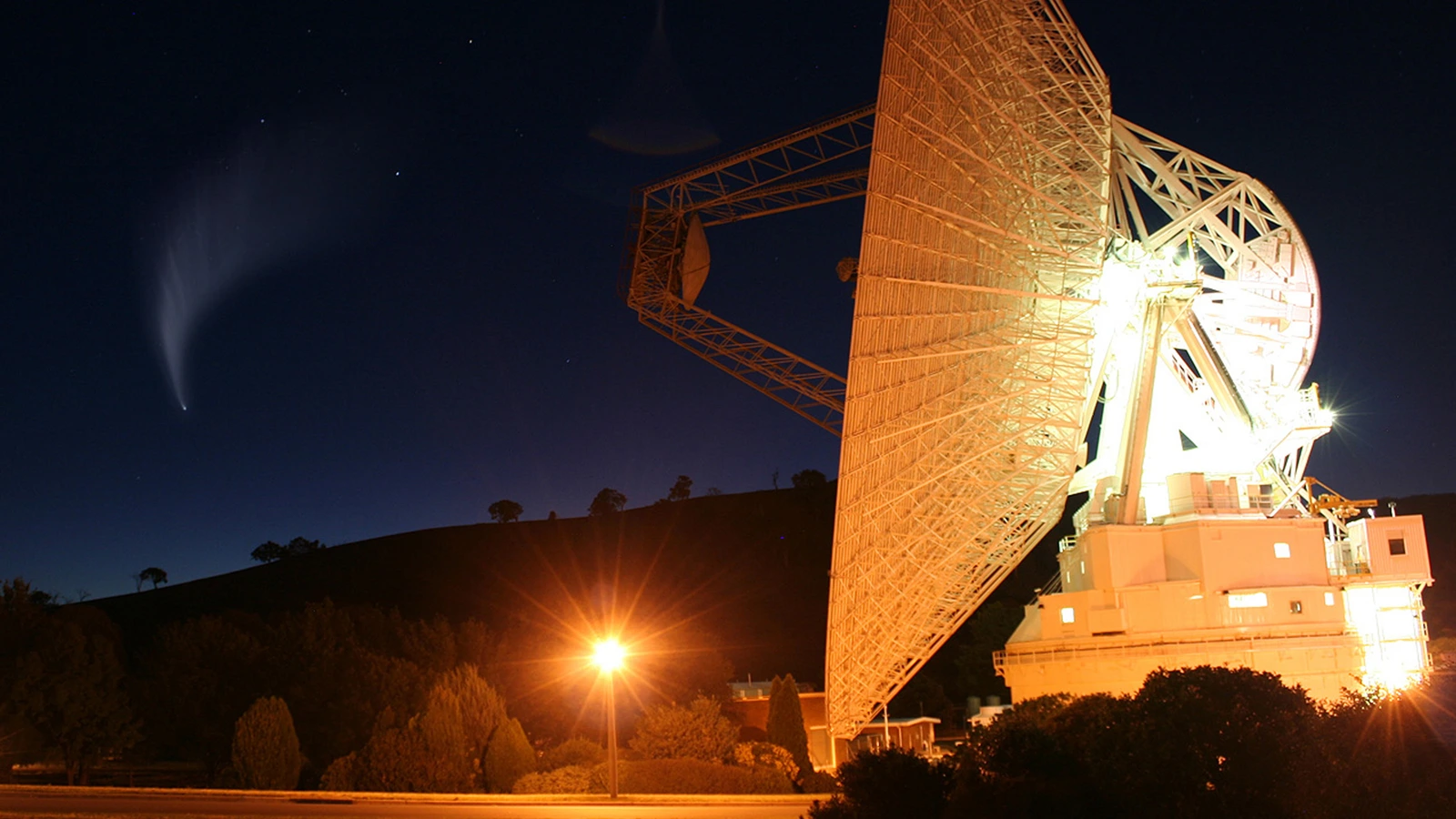
Roman is expected to downlink about 1.4 terabytes of raw science data each day and produce around 20 petabytes of processed data during its five-year primary mission. Ground stations in New Mexico, Australia and Japan will help maintain communication as Earth turns.
NASA plans to make survey data public as soon as it is processed, without an exclusive period for one observing team. Because the archive will be too large for most researchers to download, much of the analysis is intended to happen through a cloud platform called Roman Nexus. The mission is therefore not just a telescope; it is also a public-data and computing project.
Roman, Hubble and Webb answer different parts of the question
Roman's wide surveys can identify rare objects and place them in their larger environment. Webb can examine selected targets with narrower but more powerful infrared and spectroscopic tools. Hubble can add visible, ultraviolet and infrared observations with instruments and a long archive that Roman does not replace.
The useful comparison is wide view versus close investigation, not new telescope versus obsolete telescope. Roman can find the unusual needle and map the haystack. Hubble or Webb can then spend precious time examining the needle in greater detail.
The name remembers the astronomer who helped make Hubble possible
Nancy Grace Roman became NASA's first chief of astronomy in 1959. She helped establish the agency's programme of space observatories and argued for astronomers to have access to instruments above Earth's atmosphere. Her advocacy for a large space telescope contributed to the project that became Hubble.
Naming a wide-field observatory after Roman connects two generations of astronomy. The new mission uses a mirror the size of Hubble's, but its purpose is to survey the cosmic populations and structures that a narrow view can sample only slowly.
What to watch between the briefing and first light
The next evidence points are the July 29 status briefing, NASA's launch updates, the final launch-readiness work at Kennedy and the actual liftoff window. After launch, deployment milestones and commissioning reports matter more than speculative image countdowns.
The most exciting Roman discoveries cannot be responsibly named in advance. The mission's strength is that it will repeatedly photograph broad areas with enough detail to expose objects astronomers did not know to request. The honest promise is not that Roman will solve the universe on August 30. It is that a Hubble-sized mirror is about to begin seeing the universe on a radically wider scale.
Sources and further reading
This article was written for Curiosity Desk. We do not copy other publishers or invent quotes. If a material error is found, we correct it openly.
Read the full standards →One answer should lead to a better question
Bring your curiosity to the group
Curious Minds is our public Facebook community for surprising science, strange history, Australian wildlife and everyday questions. No copied posts, no personal-friend invitations and no link dumping.
- Three self-contained discussion prompts each week
- Sourced answers and honest uncertainty
- Respectful conversation without spam