The rocket did not fall into the ocean by accident
SpaceX launched Starship Flight 13 from Starbase in South Texas on 24 July 2026. The vehicle crossed space on a suborbital path, released 20 next-generation Starlink test satellites and returned through the atmosphere toward a designated part of the Indian Ocean west of Australia. The upper stage then completed a controlled landing burn near the water and tipped onto its side.
That sequence matters because the word splashdown can suggest an uncontrolled fall. The Federal Aviation Administration describes a Starship soft water landing as a manoeuvre in which the vehicle descends to just above the ocean surface and then tips over. The Indian Ocean zone was therefore part of the licensed test profile, not a rescue location chosen after something went wrong.
Remaining intact changed what viewers saw next
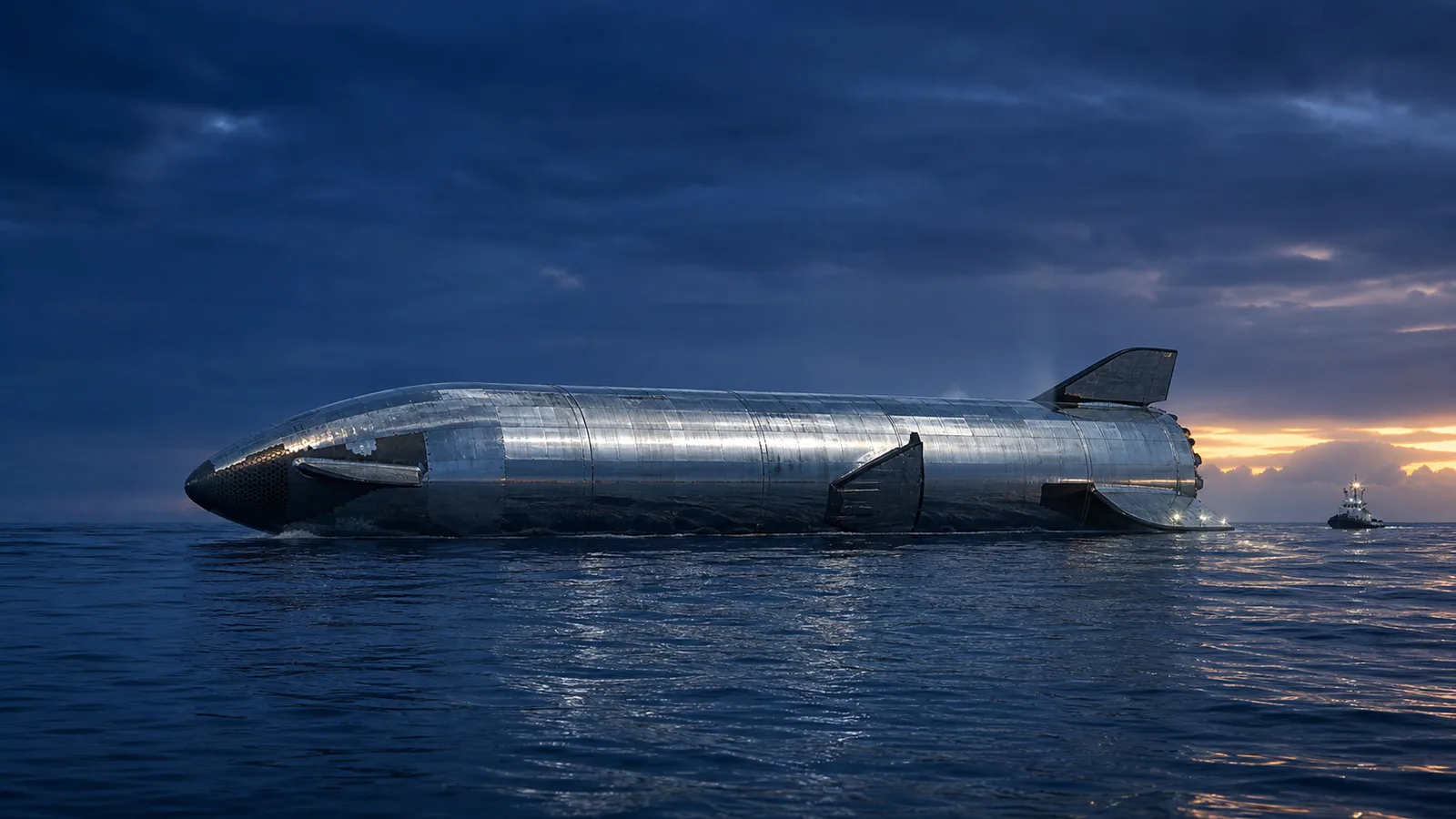
Earlier Starship tests had already attempted controlled ocean endings, but Flight 13 produced an unusually clear result. Current mission reporting showed the spacecraft still intact after it reached the surface, floating horizontally while its cameras continued sending images. Instead of disappearing beneath spray or breaking apart, the huge metal vehicle briefly behaved like an unplanned ship.
The floating scene became more than a dramatic ending. Engineers could observe the exterior after re-entry, inspect imagery of the heat shield and compare the vehicle's real condition with predictions. A test vehicle does not have to be reused to produce valuable evidence. Simply remaining observable can preserve details that would be lost if the structure immediately sank or fragmented.
Steel can float when the whole object displaces enough water
The fact that Starship is built largely from stainless steel does not require it to sink immediately. Ships are also made from materials denser than water. What matters is the average density of the complete object, including the large spaces inside it. According to Archimedes' principle, water pushes upward with a force equal to the weight of the water an immersed object displaces.
An intact, mostly hollow structure can displace a very large volume of seawater before the waterline rises over it. If that displaced water weighs as much as the structure and everything inside it, the upward buoyant force can balance gravity. Seawater is also denser than fresh water, which slightly increases the buoyant force produced by the same displaced volume.
The exact reason it stayed afloat is not public
Buoyancy explains the general possibility, but it does not reveal the precise condition of this spacecraft. The duration of flotation would depend on the vehicle's remaining mass, which compartments stayed sealed, where openings or damage allowed water to enter, how much gas remained trapped and how the horizontal structure settled in the waves. Public reports do not provide a complete flooding map.
That boundary is important. Photographs of an intact hull do not prove that every internal tank or compartment remained dry. Nor does continued telemetry prove that all systems survived. The accurate conclusion is narrower: the vehicle retained enough effective displacement for the observed period. Claims about exact air pockets, fuel-tank pressure or hidden damage require engineering data that has not been publicly released.
Why land in a remote ocean instead of returning to Texas
A test flight can gather re-entry and landing data without asking an experimental upper stage to approach people, property or a launch tower. The FAA's environmental review evaluated remote Indian Ocean landing areas for intact impacts, debris outcomes and soft water landings. Airspace and maritime planning help keep the test corridor away from normal traffic while the vehicle tries demanding manoeuvres.
The ocean ending also lets SpaceX increase difficulty in steps. An upper stage can first prove that it survives heating, controls its attitude, relights engines and reaches a landing point before the programme attempts a catch or landing back at Starbase. Flight 13's result does not eliminate the need for future testing. It adds evidence that several parts of the sequence can work together.
What the floating Starship proved and what it did not
The flight showed that this test article could launch from the United States, deploy payloads, perform in-space objectives, return through the atmosphere and reach its planned ocean zone in unusually intact condition. Floating afterwards made the achievement visually unmistakable, but the most important engineering result was the controlled chain of events that came before the water.
It did not prove that Starship is ready to carry people, make routine land landings or be recovered economically after every mission. Crewed safety, tower catches, rapid reuse and operational reliability each require different evidence across repeated flights. The honest reason the image is so compelling is also the reason it should not be overread: a rocket completed a spaceflight and ended up looking like a ship, but one extraordinary test is still a test.
Sources and further reading
- Federal Aviation Administration: Starship Flight 13 pre-mission airspace advisory ↗
- Federal Aviation Administration: Indian Ocean landing environmental assessment ↗
- Associated Press: Flight 13 launch, payload deployment and intact splashdown ↗
- NOAA Ocean Service: buoyancy and Archimedes' principle ↗
- Federal Aviation Administration: current Starship environmental reviews ↗
This article was written for Curiosity Desk. We do not copy other publishers or invent quotes. If a material error is found, we correct it openly.
Read the full standards →One answer should lead to a better question
Bring your curiosity to the group
Curious Minds is our public Facebook community for surprising science, strange history, Australian wildlife and everyday questions. No copied posts, no personal-friend invitations and no link dumping.
- Three self-contained discussion prompts each week
- Sourced answers and honest uncertainty
- Respectful conversation without spam