The headline is irresistible, but it usually outruns the evidence
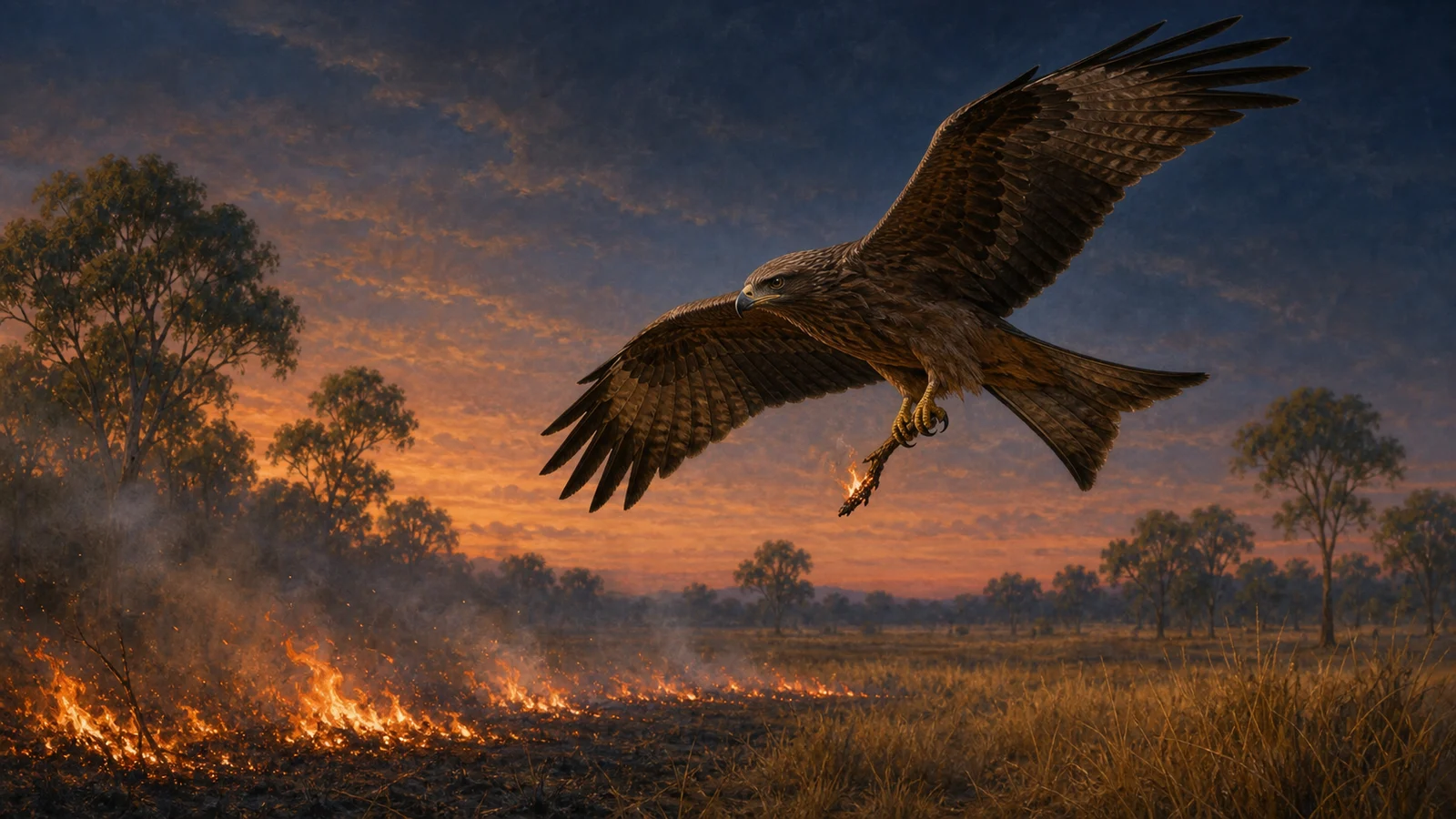
A bird grips a burning stick, flies beyond a firebreak and drops the ember into dry grass. New prey bolts from the fresh flames. That is the astonishing behaviour reported for several raptors in northern Australia, and it is why social posts often call them birds that use fire as a tool.
The careful answer is neither a quick yes nor a dismissive no. A peer-reviewed study records detailed Indigenous Ecological Knowledge and testimony from non-Indigenous witnesses. It does not provide a controlled filmed experiment showing the whole sequence. Understanding that difference makes the real story more interesting, not less.
First separate fire-following from fire-spreading
Black kites gathering around fires is not the controversial part. The Australian Museum describes them soaring above fires and pouncing on insects, reptiles and other small animals flushed into the open. BirdLife Australia likewise notes that the birds search the fire front for escaping prey and burnt remains.
That behaviour is opportunistic hunting. A raptor can profit from a fire without carrying anything or changing where the flames go. The stronger firehawk claim begins only when a bird deliberately picks up burning material, transports it and drops it where another patch can ignite.
The 2017 study documented reports of deliberate transport
Researchers Mark Bonta, Robert Gosford, Dick Eussen, Nathan Ferguson, Erana Loveless and Maxwell Witwer published their investigation in the Journal of Ethnobiology in 2017. Their fieldwork in the Northern Territory ran from 2011 to 2017, and they also received reports from Western Australia and Queensland.
The paper documents observers describing both individual and group attempts to move burning sticks in talons or beaks. Some accounts say the material was carried across barriers into unburnt vegetation and that new fire then produced another hunting opportunity. The authors treated these as structured ethno-ornithological observations, not as a collection of anonymous internet stories.
'Firehawk' is a nickname for three different species
There is no Australian species formally named the firehawk. The study applies the informal label to the black kite, whistling kite and brown falcon. They are separate raptors that share a habit of hunting around fire in tropical savannas.
The black kite is especially familiar at fire fronts. It is a medium-sized dark-brown raptor with a shallow fork in its tail, and its range extends across much of mainland Australia as well as other continents. A black-shouldered kite is a different bird and should not be substituted simply because the names sound similar.
What kind of evidence is this?
The central evidence is testimony: long-held knowledge from Aboriginal communities, interviews with people who work around fire and observations from witnesses the researchers considered credible. Multiple accounts describe similar actions, species and hunting outcomes across a wide region. Peer review means specialists evaluated how that evidence was assembled and argued.
Peer review does not magically turn testimony into a laboratory trial. The paper did not measure how often a random kite carries an ember, compare trained observers under identical conditions or present an unbroken close-up recording of a bird igniting a new patch. Those missing pieces affect certainty about frequency and mechanism, not whether the accounts deserve to be examined.
Why a single photograph would not settle the question
A still image of a bird holding a stick could show transport, but it would not by itself reveal intention. The stick might be glowing or merely dark. The bird might drop it accidentally. A short clip could miss what happened before or after the visible moment.
Intention is inferred from a repeated sequence: selecting burning material, carrying it toward unburnt fuel, releasing it and then hunting around the resulting fire. Detailed eyewitness accounts can preserve that sequence better than one dramatic frame. A clear multi-angle recording would still be valuable, especially when combined with location, fire conditions and independent witnesses.
This knowledge was not suddenly discovered in 2017
The study's authors begin with Indigenous Ecological Knowledge because local Aboriginal people had described the behaviour long before it became a global headline. The publication brought those accounts together with ranger and other non-Indigenous observations in a form that academic readers could evaluate.
Calling the paper a discovery by outsiders erases the people who already knew what to watch for. A more accurate description is that the researchers documented existing knowledge, compared reports and argued that Western fire science should take the observations seriously. Curiosity should not come at the cost of the knowledge holders who made the question visible.
Fire managers care because a firebreak is not the whole boundary
The paper notes that Aboriginal rangers and other people managing burns account for the possibility that raptors can help a fire cross a break. Wind-blown embers, rolling material and incomplete control lines already make fire behaviour complex. Reported bird transport is another possible pathway to consider in the landscapes where it occurs.
That does not mean birds explain Australian bushfires in general. Lightning, people, machinery and escaped burns are far more familiar ignition sources, and weather and fuel conditions control whether an ember grows into a spreading fire. The firehawk evidence concerns a specific reported behaviour in northern savannas, not a licence to blame raptors for every unexplained ignition.
The unanswered questions are exactly what research should test next
Researchers still need better observations of the complete sequence, estimates of how common it is, comparisons among the three species and information about when transport succeeds or fails. Carefully designed field observation could test these questions without encouraging fires or disturbing the birds.
For now, the most defensible conclusion is precise. Three Australian raptors are proven fire followers, and a peer-reviewed study documents substantial Indigenous knowledge and eyewitness evidence that some individuals also spread fire deliberately. The claim is more than folklore, but the internet's most absolute version still promises more certainty than the published evidence can supply.
Sources and further reading
This article was written for Curiosity Desk. We do not copy other publishers or invent quotes. If a material error is found, we correct it openly.
Read the full standards →One answer should lead to a better question
Bring your curiosity to the group
Curious Minds is our public Facebook community for surprising science, strange history, Australian wildlife and everyday questions. No copied posts, no personal-friend invitations and no link dumping.
- Three self-contained discussion prompts each week
- Sourced answers and honest uncertainty
- Respectful conversation without spam