A seed can wait for a message that arrives in smoke
A dry seed beneath Australian bushland can be alive while showing almost no outward activity. Its embryo has the equipment to grow, but dormancy prevents it from committing at the wrong time. Rain alone may not be enough. For some species, chemicals produced as vegetation burns are part of the message that conditions above the soil have changed.
The message is ecological rather than magical. Fire can remove dense vegetation, change light at ground level and create open space for seedlings. Smoke can travel through the surface and dissolve into water. A seed capable of detecting that signal can delay germination until a rare disturbance has created an opportunity.
Cold smoke solved a nursery mystery in Western Australia
In a landmark 1995 experiment, Kingsley Dixon, Simone Roche and John Pate exposed dormant seeds from difficult Western Australian plants to cold smoke. At least one seed provenance responded positively in 45 of the 94 species tested. Twenty-three of the responsive species had previously been considered extremely difficult or impossible to germinate with conventional methods.
The effect did not require a seed to sit in flame. Smoke-fumigated filter paper, smoke water and gaseous smoke could all stimulate germination in test species. Field plots treated with smoke, smoked water or smoked sand also produced responses. That separated the chemical signal from the destructive heat of a fire.
Researchers eventually isolated one tiny messenger
Smoke contains thousands of compounds, so identifying the active ingredient took years. In 2004, Australian researchers reported the structure of a germination-promoting molecule found in smoke made from plants and cellulose. It became known as karrikinolide, or KAR1, one member of a family now called karrikins.
The name draws on karrik, a Noongar word for smoke, acknowledging the Western Australian context of the discovery. Later work showed that plants perceive karrikins through a signalling pathway connected to dormancy and growth. The molecule is not food for the embryo. It is information produced by incomplete combustion.
Smoke is not a universal command to germinate
The famous 45-of-94 result contains an equally important number: most tested species did not show a positive response in that experiment. Some plants respond to particular smoke concentrations or combinations of cues. Others use different dormancy systems, and a dose that helps one species may have little effect or become inhibitory for another.
This is why the slogan that Australian seeds need smoke is wrong. Australia contains many floras, climates and fire histories. Even closely related species can behave differently. A seed's response depends on its coat, physiology, age, storage location and the conditions that follow treatment.
Heat can unlock a physical gate instead
Some soil-stored seeds have a hard, water-impermeable coat. A brief pulse of heat can alter a specialised weak point in that coat, allowing water and gases to reach the embryo. The fire has not awakened the seed by warmth. It has changed the barrier that kept the seed dormant.
A study of ten co-occurring Western Australian species exposed seeds to 60, 80, 100 or 120 degrees Celsius for ten minutes. One or more treatments increased total germination and germination rate in three of the five hard-seeded species. The different responses show that heat has a threshold and a limit, not a universally beneficial temperature.
An opened Banksia fruit is a different mechanism again
Banksias and some other plants can retain seeds in woody fruits on the parent plant. Heat may open the follicles and release seeds onto the changed ground below. That process is called serotiny. It is easy to describe the seeds themselves as fire-germinated, but opening the container and starting germination are two separate events.
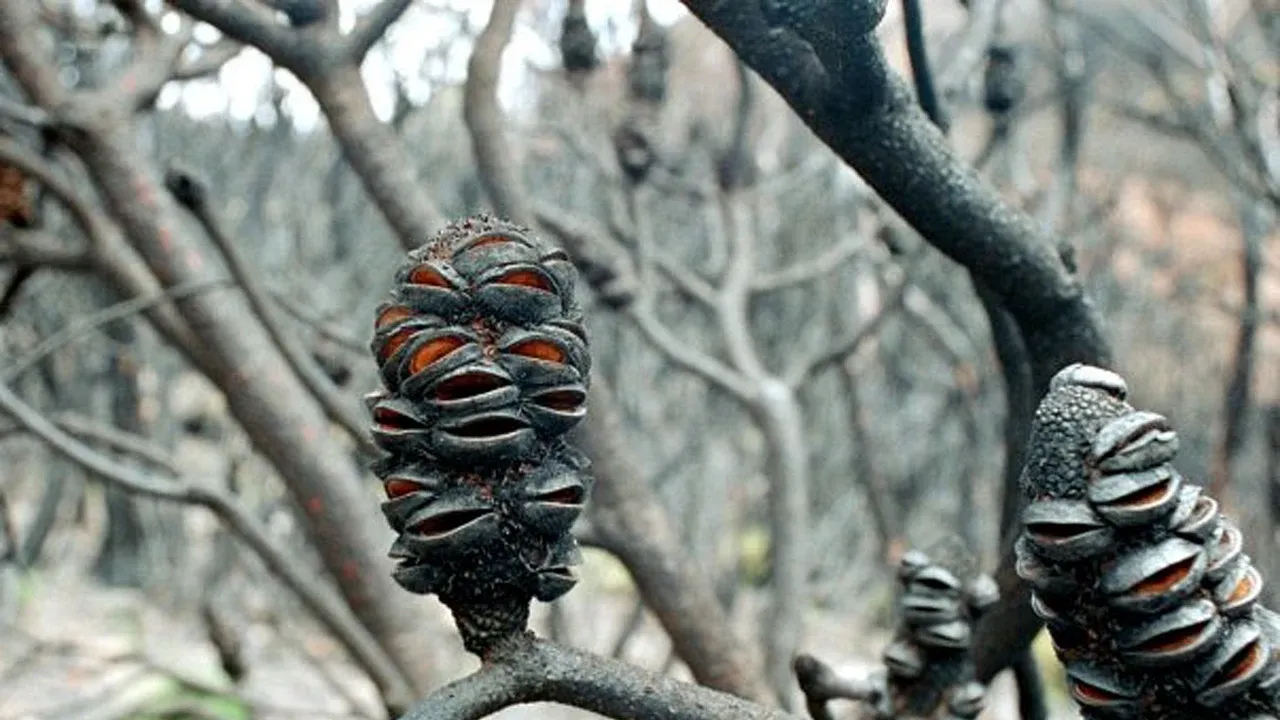
The blackened Banksia cones in the photograph opened after fire in the Blue Mountains. The image records release, not proof that every released seed survived or became a seedling. Moisture, viable embryos, temperature, predators and competition still decide what happens next.
Seven Boronia species refused to follow one recipe
A 2016 experiment tested seeds from seven south-eastern Australian Boronia species using heat shock, smoke and three seasonal temperature regimes. Smoke had a positive effect in every species, either by itself or together with heat. Yet the combined results ranged from neutral to additive, synergistic, dependent on both cues or negative.
In one species, no germination occurred unless heat and smoke were both present. In another, heat reduced the effectiveness of smoke under some conditions. Heat also increased seed mortality in several smaller-seeded species. The same study found that seasonal temperatures changed germination speed and magnitude. A fire signal opens a decision process; it does not cancel the weather.
The opportunity after fire can close quickly
A post-fire landscape may offer more light and less established competition, but it can also be dry, exposed and vulnerable to erosion or grazing. Seeds that respond to smoke still require suitable moisture and temperature. A fast germinator may claim a gap first, while a seed that waits may avoid a false start before rain fails.
Dormancy spreads risk through time. Not every viable seed should germinate after one event, because a single bad season could erase the next generation. Soil and canopy seed banks are therefore both biological archives and bets about future disturbance.
Fire-adapted does not mean fireproof
An obligate seeder is killed by fire and depends on surviving seed for replacement. If another fire arrives before the new plants mature and replenish that store, the population can run out of its recovery mechanism. Researchers call this immaturity risk. Some alpine ash forests, for example, need roughly two decades before young trees develop a reliable seed crop.
Fire intensity, season, size and interval all matter. A very severe fire can kill protected seed. Repeated short intervals can reduce seed-bank diversity, while long exclusion can also alter communities that evolved with recurring disturbance. Adaptation is to a fire regime, not to unlimited burning.
Good fire management cannot be reduced to lighting more fires
Cultural fire management is specific to Country, season, purpose and the knowledge of local Traditional Custodians. Australia's State of the Environment reporting describes it as part of caring for Country, not merely a fuel-reduction technique. Ecological burning also depends on the needs of particular species and communities.
That complexity is the final answer to the seed mystery. Smoke can be a chemical message, heat can open a hard coat, and fire can release seeds from woody fruits. None of those facts makes an uncontrolled fire restorative by default. The extraordinary part is not that Australian plants love fire. It is that different plants have evolved precise ways to read particular kinds of change.
Sources and further reading
- Oecologia: Smoke promotes germination in Western Australian plants ↗
- Science: A compound from smoke that promotes seed germination ↗
- Plant Physiology: How karrikins trigger germination ↗
- Acta Oecologica: Heat pretreatment of soil-stored and canopy-stored Western Australian seeds ↗
- PLOS ONE: Heat, smoke and seasonal temperature effects in seven Boronia species ↗
- Diversity and Distributions: Future fire regimes increase risks to obligate-seeder forests ↗
- Australian State of the Environment: Cultural fire management and caring for Country ↗
This article was written for Curiosity Desk. We do not copy other publishers or invent quotes. If a material error is found, we correct it openly.
Read the full standards →One answer should lead to a better question
Bring your curiosity to the group
Curious Minds is our public Facebook community for surprising science, strange history, Australian wildlife and everyday questions. No copied posts, no personal-friend invitations and no link dumping.
- Three self-contained discussion prompts each week
- Sourced answers and honest uncertainty
- Respectful conversation without spam