A field of blades is solving an invisible problem
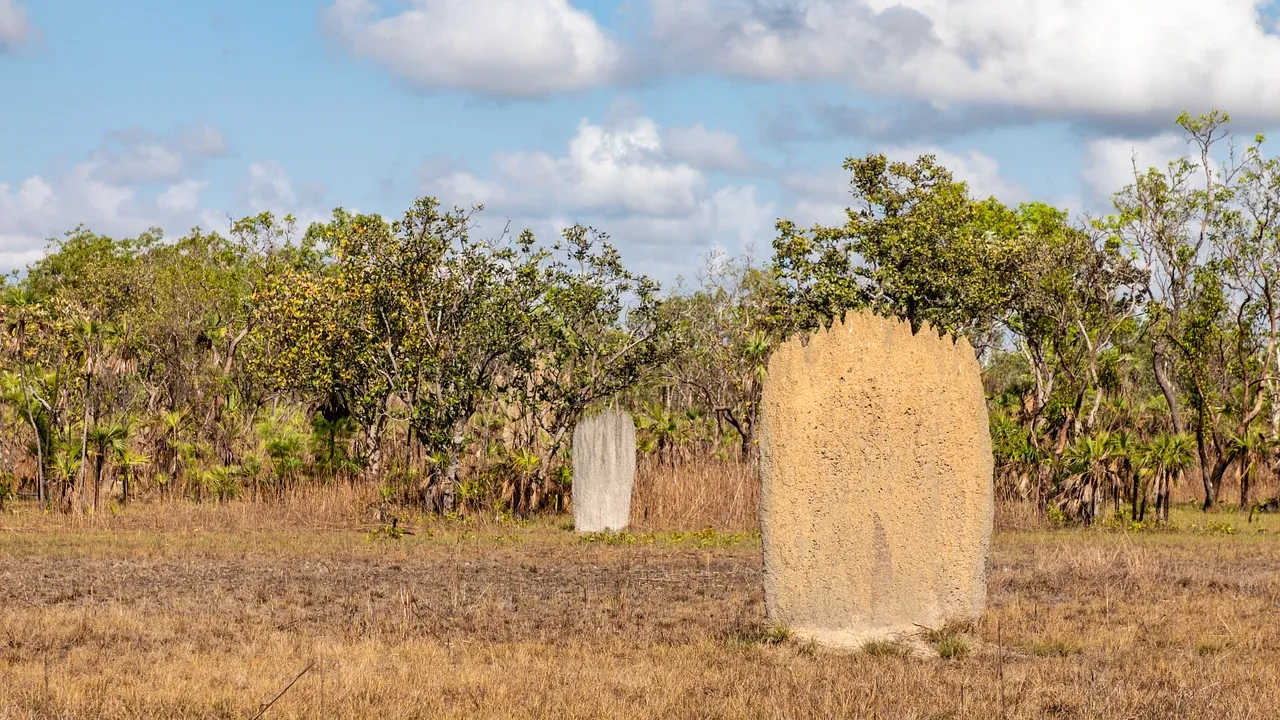
From the boardwalk in Litchfield National Park, the mounds can look like a collection of giant gravestones. Each has a narrow edge and broad faces, and many appear to share roughly the same alignment. The visual effect is so orderly that early observers compared them with compass needles. Yet there is no surveyor and no master plan. Thousands of small insects have produced the pattern one mouthful of material at a time.
The builders include the northern Australian species Amitermes meridionalis and Amitermes laurensis. Researchers call their elongated structures meridional or magnetic mounds. The shape is real, but the popular picture of every tower pointing exactly north and south is too simple. What matters is how each surface meets the local environment through the day.
Magnetic does not mean perfectly north and south
A blade aligned roughly north to south presents its broad faces toward the east and west. The eastern face receives morning Sun, the western face catches more light later, and the thin upper edge limits the surface presented to the strongest midday Sun. That geometry can spread heating across time instead of exposing one large face to the daily maximum all at once.
The apparent compass line also varies from place to place. Peter Jacklyn's field study compared mound orientation across northern Australia and found meaningful geographic differences. Some populations sat closer to a textbook north to south axis, while others were rotated. Those differences were not noise to be ignored. They were the clue that the mound responds to more than one environmental signal.
The eastern face can hold a long temperature plateau
Jacklyn modelled the solar energy reaching mound surfaces and tested how exposure changed when mounds were rotated. The results supported a striking pattern during the dry season: the eastern face could warm in the morning and then maintain a relatively extended temperature plateau. The mound was not simply trying to become as cool as possible. Its orientation altered when and where heat arrived.
That distinction matters. A living colony needs a usable range of conditions, not the lowest temperature at every moment. The broad faces, narrow edge and thermal mass of the mound can slow and redistribute the daily pulse of solar heating. Temperature still changes, and the study did not turn the mound into a perfectly controlled chamber. It showed how shape changes the timing of heat.
Wind and shade can rotate the best answer
If sunlight were the only influence, every mound at the same latitude should settle on nearly the same bearing. Field observations show otherwise. Jacklyn found that geographic variation in average orientation followed long-term patterns in wind speed and shading. In a more exposed or differently shaded habitat, rotating the broad surfaces can help preserve a similar heating pattern.
This is why a photograph should not be used as a compass. The mounds are aligned to local conditions, not stamped from one universal template. A bearing that works on an open floodplain may not be the best bearing near persistent shade or under a different wind regime. The landscape helps write the architecture.
The builders may also read Earth's magnetic field
The name magnetic began as a description of the mound's compass-like appearance, but experiments suggest the insects may use magnetic information too. In a 2002 study, researchers removed mound tops and allowed termites to repair them under the natural geomagnetic field and under artificial fields with altered declinations. They then examined the small elongated cells built into the repaired sections.
Those cells tended to align with the existing mound axis and with cardinal axes in the applied magnetic field. The result is evidence that Amitermes meridionalis can use magnetic cues during construction. It does not reveal a tiny biological compass organ, and it does not mean magnetism alone determines the finished tower. Existing structure, sunlight, wind and shade still matter.
A mound has to manage air and moisture as well as heat
Temperature attracts the headlines, but a dense colony also consumes oxygen, produces carbon dioxide and depends on suitable humidity. Mound walls, pores and internal passages influence how gases and water vapour move. The structure is therefore part shelter, part exchange surface and part thermal buffer. These functions interact rather than operating as separate machines.
A major scientific review warned that classic explanations were often based on a small number of termite species and then repeated as if they applied everywhere. Termites build many forms in different soils and climates. Some mounds are closely connected to underground nest space. Others use prominent chimneys or porous outer regions. The magnetic blade is one solution among many, not the blueprint for all termites.
Another species revealed a completely different airflow engine
Researchers studying Odontotermes obesus in India placed sensors inside mounds and found a daily circulation driven by temperature differences between the outer flutes and the central chimney. As the Sun changed those temperature differences, air moved one way during the day and reversed at night. The cycle could exchange stale, carbon-dioxide-rich air with the surroundings.
That study is often used in broad stories about termite air conditioning, but it did not test Australia's magnetic termites. Its real lesson is more useful: different mound geometries can recruit daily environmental changes to move air. One species uses a tall fluted structure and a thermal cycle. Magnetic mound research focuses on blade orientation, surface temperature, wind and shade. Combining the stories without naming the species creates a myth instead of an explanation.
The air-conditioner comparison hides the best part
A household air conditioner uses powered machinery to hold a chosen set point. A termite mound has no compressor, thermostat or sealed duct network, and its interior conditions are not perfectly constant. Termites also repair walls and alter their structure, so the colony is an active participant rather than a group of passengers inside a finished appliance.
Calling the mound an air conditioner can be a useful first image, but it becomes misleading when treated literally. The more remarkable achievement is passive regulation without a single central designer. Local building behaviour produces a form that works with recurring heat, wind and gas exchange while the colony continues to maintain it.
Human designers should copy the question, not the silhouette
Termite mounds are frequently invoked as inspiration for low-energy buildings. The responsible lesson is not to place a decorative chimney on a roof and claim that nature has solved ventilation. A human building contains large rooms, glass, appliances and occupants with comfort expectations that are very different from the passages inside a mound.
The transferable method is to begin with local forces. Where does morning and afternoon Sun land? Which surfaces need shade? When does outdoor air become useful, and where can thermal mass slow a temperature swing? Magnetic termites do not offer one ready-made building shape. They demonstrate that orientation can be an active environmental tool.
Litchfield is the accurate place to see the famous field
The Northern Territory Government identifies the magnetic termite mounds as one of Litchfield National Park's iconic features. A formal boardwalk crosses the black-soil plain and lets visitors see the aligned structures without walking through the colony field. The park also contains cathedral mounds, which are built by different termites and have a different shape.
Stay on the provided viewing route, follow current park notices and never climb, scrape or break a mound. A small damaged patch can represent a large amount of collective work. From a respectful distance, the alignment becomes more interesting than the old trivia line: not a row of perfect compasses, but a living record of how sun, shade, wind and animal senses meet in one place.
Sources and further reading
- Oecologia: Magnetic termite mound surfaces are oriented to suit wind and shade conditions ↗
- Australian Journal of Zoology: Evidence for the use of magnetic cues in mound construction ↗
- PNAS: Termite mounds harness daily temperature oscillations for ventilation ↗
- Naturwissenschaften: Review of thermoregulation and ventilation in termite mounds ↗
- Northern Territory Government: Litchfield National Park ↗
- CSIRO Publishing: Termites of the Top End ↗
This article was written for Curiosity Desk. We do not copy other publishers or invent quotes. If a material error is found, we correct it openly.
Read the full standards →One answer should lead to a better question
Bring your curiosity to the group
Curious Minds is our public Facebook community for surprising science, strange history, Australian wildlife and everyday questions. No copied posts, no personal-friend invitations and no link dumping.
- Three self-contained discussion prompts each week
- Sourced answers and honest uncertainty
- Respectful conversation without spam