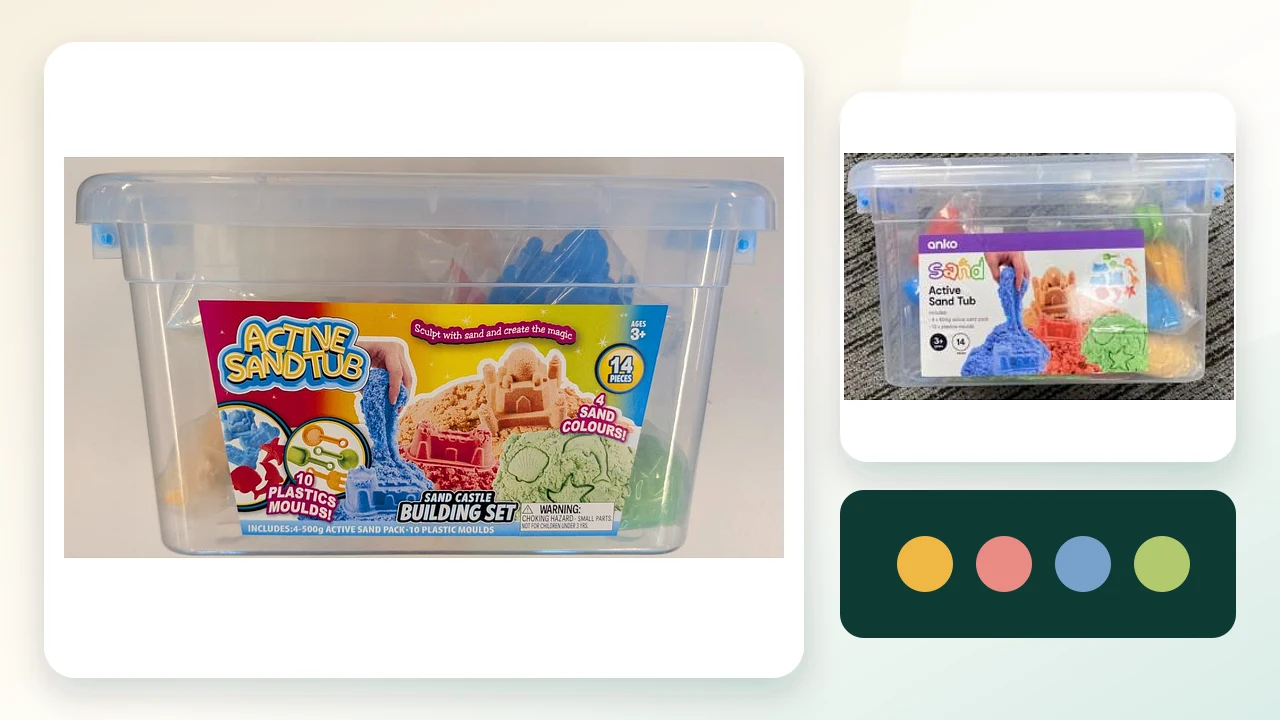
The affected tub has two retailer item codes
The recalled product is the Active Sand tub 14-piece Sand Castle Building Set. It was sold under Kmart item code 42975724 and Target item code 69581984. From June 2025, some stock was labelled Anko Active Sand tub 14-piece Sand Castle Building Set, so the Anko name does not place it outside the recall.
The ACCC lists sales from 19 January 2021 to 15 November 2025 through Kmart stores and online, and through Target stores, online and the app. The recall is national. A product photo can help, but the retailer item code is the strongest quick check when packaging is still available.
The recall covers one set, not every Magic Sand product
Three products were removed from the recall on 4 December 2025 because the ACCC says there was no evidence of asbestos detection in them. They are Blue Magic Sand item 42304364, Green Magic Sand item 42919650 and Pink Magic Sand item 42304371.
Consumers do not need to return or dispose of those three products under this recall. Kmart says it will refund people who disposed of one of them between 16 November and 4 December 2025. Sharing the removed codes alongside the affected codes prevents an accurate warning from becoming a claim about every coloured-sand product.
Why the Active Sand tub was recalled
The ACCC says samples of the recalled 14-piece set tested positive for tremolite asbestos, a prohibited substance in Australia. Consumers should stop using the product immediately and contact Kmart or Target with proof of purchase to arrange a full refund.
The original recall notice also says respirable asbestos was not detected in the samples tested at that time. It described the chance of fibres becoming airborne as low in the product's current state unless the sand was mechanically processed, such as by crushing or pulverising it.
What the July 2026 research found
Auckland University of Technology later simulated play and cleanup using 15 coloured-sand samples. Fourteen test samples had first been confirmed to contain asbestos: ten craft sands and four moulding sands. One additional sample was an asbestos-free control.
The preliminary summary released on 2 July says airborne asbestos fibres were observed during play and cleanup involving nine of the ten craft-sand samples. No airborne fibres were detected from the four moulding-sand samples or the control, even though the four moulding samples had been confirmed to contain asbestos before the simulation.
The study did not name this Kmart product
The official Australian summary does not identify the brands or individual products used in the Auckland study. It does not say that the Kmart Active Sand tub was one of the nine craft-sand samples that released airborne fibres, or that it was one of the four moulding-sand samples that did not.
The full study had not been peer reviewed or published when Australian authorities described the findings. It is therefore accurate to say that the July research changed the wider evidence about some contaminated play sands. It is not accurate to attach the nine-out-of-ten result to this exact tub without a product-level identification from the researchers or regulators.
Why the two official updates are not necessarily contradictory
The ACCC recall notice describes laboratory testing of the named product and the results known in late 2025. The Auckland study asked a different question using a wider group of confirmed contaminated samples: whether fibres could become airborne during simulated play and cleanup.
Different products, sample preparation, testing methods and activities can produce different observations. The new preliminary findings deserve attention, but they do not rewrite an unnamed sample as the Kmart set. Australian authorities are assessing the research and have kept the practical recall and disposal instructions in place.
If the sand is still packaged, keep it contained
Stop using a matching product. The ACCC directs consumers to place packaged sand inside a heavy-duty plastic bag, tape it securely twice, label it clearly and store it in a secure location while arranging disposal. Keep it away from children and do not open it merely to compare the sand with a photograph.
Do not take loose sand into a store. Contact the retailer and check the disposal requirements that apply where you live. An authorised asbestos-disposal facility may have packaging, appointment or quantity rules, so call before travelling with the product.
If it was used or spilled, avoid making dust
Current ACCC guidance says to clean affected areas with wet cloths to avoid generating dust. Wear gloves and preferably a P2 mask. Double bag the sand, gloves, mask and used cloths, then keep the package secure until the correct disposal route is confirmed.
Keep children and other people away from the area until it has been cleaned. Do not dry sweep, blow, vacuum or crush the sand unless an asbestos professional or your regulator gives a specific method. If the spread is extensive or you are uncertain, seek advice from an asbestos professional rather than improvising.
The disposal route depends on your state or territory
The national advice points consumers to authorised disposal facilities and to state or territory requirements. Some jurisdictions allow particular recalled products to be returned to stores, double bagged in domestic bins or taken to low-cost facilities, but those options are not universal.
Check the government instructions for the place where the product is located. A social post saying that every Australian can put the sand in a household bin could be unsafe in a jurisdiction that requires a different route. The ACCC disposal page links to each state and territory authority.
Keep receipts for reasonable handling and cleanup costs
The ACCC says suppliers are expected to reimburse consumers for reasonable costs incurred in safely handling, disposing of and cleaning up recalled decorative or coloured sand containing asbestos. Keep receipts, photographs of the product and packaging, and notes showing which item code you found.
For the product refund, the recall notice tells consumers to contact Kmart or Target with proof of purchase. Kmart lists 1800 124 125 and Target lists 1300 753 567. Quote recall number PRA 2025/20700 if a regulator needs to identify the case.
Current health advice says the risk is very low
The Australian Centre for Disease Control's current enHealth summary says the risk to human health is very low and that no clinical checks are needed. The ACCC likewise says no clinical assessment is recommended for people who may have been in contact with the products based on the information currently available.
That does not make asbestos harmless or cancel the recall. Health effects are generally associated with inhaling very small fibres over long periods. The sensible response is to stop exposure, contain the product and follow the official cleanup and disposal steps without presenting contact with the sand as a diagnosis.
A two-minute identification and action check
Look for the Active Sand tub or Anko Active Sand tub 14-piece Sand Castle Building Set. Match Kmart code 42975724 or Target code 69581984. If it matches, stop use, keep it contained, photograph the label and contact the retailer before following your local disposal route.
If the code is 42304364, 42919650 or 42304371, it is one of the three Magic Sand products removed from this recall. If the label is missing or unreadable, isolate the product and ask Kmart or Target to help identify it. Recheck the official ACCC notice for later updates rather than relying on a cropped screenshot.
Sources and further reading
- ACCC Product Safety - 14-piece Active Sand tub recall and item codes ↗
- ACCC Product Safety - Safe disposal, reimbursement and health information ↗
- Asbestos and Silica Safety and Eradication Agency - Preliminary Auckland play-sand findings ↗
- Australian Centre for Disease Control - Current enHealth advice ↗
- Safe Work Australia - Regulatory response to the Auckland research ↗
- Kmart Australia - Product recall index and July 2026 update ↗
This article was written for Curiosity Desk. We do not copy other publishers or invent quotes. If a material error is found, we correct it openly.
Read the full standards →One answer should lead to a better question
Bring your curiosity to the group
Curious Minds is our public Facebook community for surprising science, strange history, Australian wildlife and everyday questions. No copied posts, no personal-friend invitations and no link dumping.
- Three self-contained discussion prompts each week
- Sourced answers and honest uncertainty
- Respectful conversation without spam