Check the can before using it
Quick Amy's recall check
- Product
- Amy's Organic Lentil Soup, Light in Sodium or Less Sodium
- Lot code
- 60D0924
- Best before
- 04/2027
- U.S. UPC
- 0-42272-00583-3
- Canadian UPC
- 0 42272 90583 6
- Reason
- Easy-open tab or container-integrity defect with potential spoilage
- Scope
- One named product lot, not every Amy's soup
- What to do
- Do not use or serve a matching can. Follow the retailer's return process.
All available identifiers should match the notice for the market where the can was sold. A lentil-soup label or April 2027 date alone is not enough.
The recall names one soup and one lot
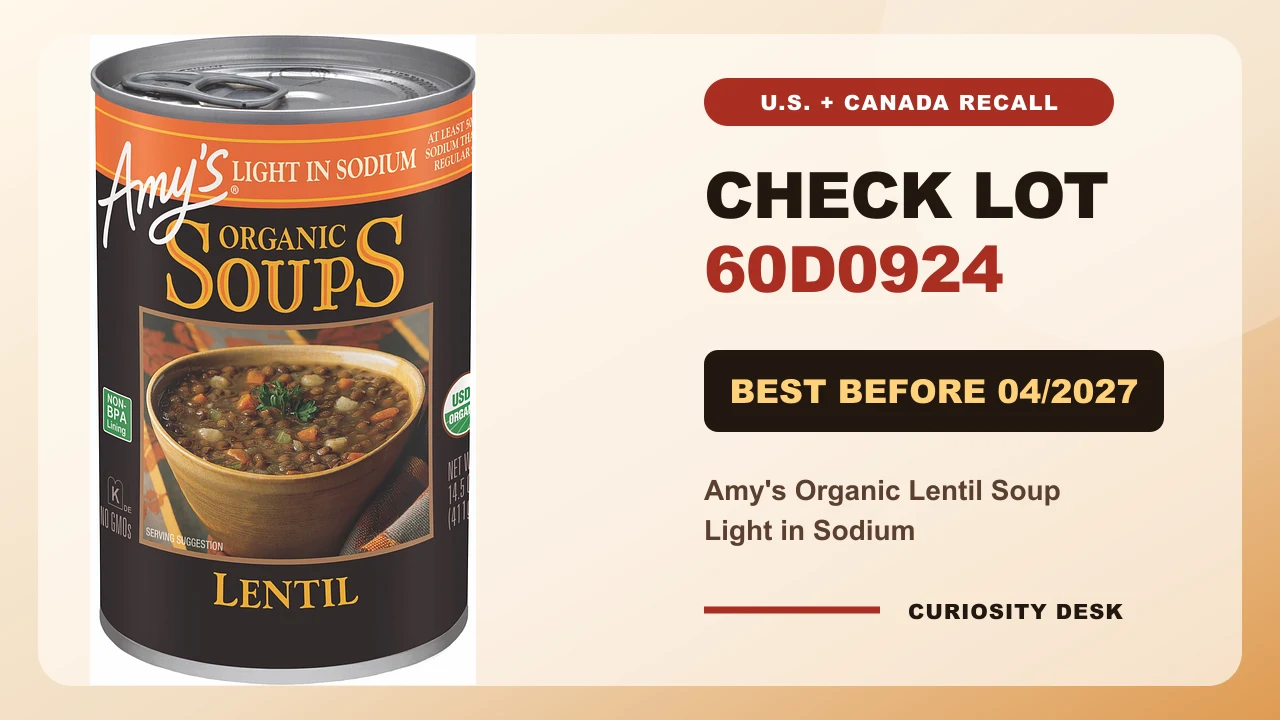
Amy's Kitchen recalled one production lot of its Organic Lentil Soup, Light in Sodium, because a manufacturing defect in the can's easy-open pull tab could allow the product to spoil. The identifying lot is 60D0924 and the best-before date is April 2027.
The narrow scope matters. A brown Amy's can, the word lentil or an April 2027 date by itself does not complete the match. Check the exact reduced-sodium product, lot, date and the UPC used in the country where it was sold before deciding that a can is included.
Use this four-part pantry check
First, confirm that the label says Organic Lentil Soup and Light in Sodium. Second, find lot 60D0924. Third, look for Best Before 04/2027. Fourth, compare the UPC with the correct U.S. or Canadian number. A complete match should not be used or served.
The lot and date may be printed in ink on the can rather than built into the front label. Photograph the full product, lot line and barcode before returning or disposing of it. That record can help a retailer verify the item even if the original receipt is no longer available.
The product wording and size differ slightly by country
U.S. notices identify Amy's Organic Lentil Soup, Light in Sodium, in a 14.5 oz or 411 g can. The Canadian Food Inspection Agency uses the wording Organic Lentil Soup, Less Sodium, and lists the size as 398 mL. Both notices point to lot 60D0924 and best before 04/2027.
Those label and measurement differences do not mean two unrelated products were recalled. They reflect market-specific packaging. They are also a reason to read the actual can instead of comparing it with a cropped social-media photograph from another country.
The U.S. and Canadian UPCs are not the same
For U.S. stock, Wegmans lists UPC 0-42272-00583-3. For Canadian stock, the official federal notice lists UPC 0 42272 90583 6. The numbers are similar enough to invite a mistaken match, but they are not interchangeable.
Start with the UPC appropriate to the market where the can was purchased, then confirm the lot and best-before date. If the barcode matches but the lot does not, the published notices do not identify that can as part of this recall. If printing is unreadable, set the can aside and ask the retailer or Amy's before using it.
The defect involves the easy-open pull tab
Wegmans says a manufacturing defect in the can's easy-open tab has the potential to cause spoilage. The Canadian notice describes container-integrity defects and spoilage. NBC reported an Amy's spokesperson saying the company acted out of caution to protect product quality and safety.
The notices do not name a particular bacterium, allergen or foreign object. Curiosity Desk therefore does not turn a packaging defect into an unsupported claim about botulism, Salmonella or another specific hazard. The practical instruction is simpler: do not use a can that matches the recall identifiers.
A normal-looking can can still match the recall
Visible swelling or leakage is not part of the official product-identification test. A can can match because of its product, lot, date and UPC even if the label looks clean and the lid appears flat. Do not use appearance as a reason to override a complete code match.
General FDA guidance says not to buy cans that are swollen, leaking, rusted along the seams or dented along a seam. USDA guidance says not to taste or use food from leaking, bulging or badly dented containers. Those warnings apply broadly, but the lot-specific recall instruction applies even when no damage is obvious.
Class II in the U.S. and Class 3 in Canada are not a contradiction
The FDA enforcement report categorises the U.S. action as Class II. FDA defines that class as a situation where exposure may cause temporary or medically reversible adverse consequences, or where the probability of serious consequences is remote. It does not mean that every matching can will make someone ill.
Canada's notice lists the action as Class 3 and describes the issue as non-harmful microbial contamination related to quality or spoilage. The two countries use their own classification systems. Comparing the numerals as if they came from one shared scale can make the notices look inconsistent when they are not.
The U.S. distribution list contains 27 states
The recalled U.S. cans were distributed in Arizona, California, Colorado, Connecticut, Florida, Georgia, Iowa, Idaho, Illinois, Indiana, Maryland, Maine, Missouri, North Carolina, New Hampshire, New Jersey, Nevada, New York, Ohio, Pennsylvania, South Carolina, South Dakota, Tennessee, Texas, Virginia, Washington and Wisconsin.
Canada's federal notice says distribution was national. Being outside the listed U.S. states makes a retail purchase less likely to be part of the named distribution, but a code match is stronger evidence than location alone. Products can move between households, and people shop while travelling.
How the reported total reaches 184,200 cans
NBC reported that the FDA record covers 15,350 cases and that each case contains 12 cans. Multiplying those figures gives 184,200 cans. That calculation explains the widely reported headline of more than 184,000 cans without changing the official unit of 15,350 cases.
A large total does not expand the product scope. It remains one named lentil soup lot. The useful consumer question is not whether 184,200 sounds alarming. It is whether the can in the pantry carries the exact product name, lot, date and market-specific UPC.
What to do with a matching can
Do not open, taste, use or serve it. The Canadian notice says not to use, sell, serve or distribute the affected product. Wegmans tells its customers to return the product to the Service Desk for a full refund. Other retailers may use their own return process.
Keep the can away from the normal pantry supply while arranging the return. Amy's dedicated service line listed by Wegmans is 888-943-4207, Monday through Friday from 8 a.m. to 7 p.m. Eastern Time. A retailer can explain its receipt and refund requirements.
Do not turn one lot into a warning about every Amy's soup
NBC reported that an Amy's spokesperson said no other Amy's Kitchen products or lot numbers are affected by this recall. That statement is useful for limiting the warning, but it does not replace checking a can that carries the named lot.
Broad posts saying all Amy's soup is recalled can cause unnecessary disposal and make the accurate warning harder to find. Share the four identifiers instead: Light in Sodium Organic Lentil Soup, lot 60D0924, best before 04/2027 and the correct U.S. or Canadian UPC.
The two-minute final check
Gather Amy's canned soup from the pantry, work bag and emergency food supply. Separate only the Organic Lentil Soup labelled Light in Sodium or Less Sodium. Find lot 60D0924 and Best Before 04/2027, then match the barcode to the U.S. or Canadian UPC.
If all four details line up, do not use or serve the can. Photograph it and follow the retailer's return route or contact Amy's. If the codes do not complete the match, keep the evidence rather than sharing a broad warning. Recheck the official notices for later updates.
Sources and further reading
- FDA - Enforcement report for recall event 99306 ↗
- FDA - Recall classifications and definitions ↗
- Wegmans - Amy's Organic Lentil Soup recall notice ↗
- Canadian Food Inspection Agency - Amy's Organic Lentil Soup recall ↗
- FDA - Safety checks for damaged canned food ↗
- USDA FSIS - Shelf-stable food safety ↗
- NBC New York - Amy's spokesperson, quantity and U.S. distribution ↗
This article was written for Curiosity Desk. We do not copy other publishers or invent quotes. If a material error is found, we correct it openly.
Read the full standards →One answer should lead to a better question
Bring your curiosity to the group
Curious Minds is our public Facebook community for surprising science, strange history, Australian wildlife and everyday questions. No copied posts, no personal-friend invitations and no link dumping.
- Three self-contained discussion prompts each week
- Sourced answers and honest uncertainty
- Respectful conversation without spam