The investigation and recall are still open
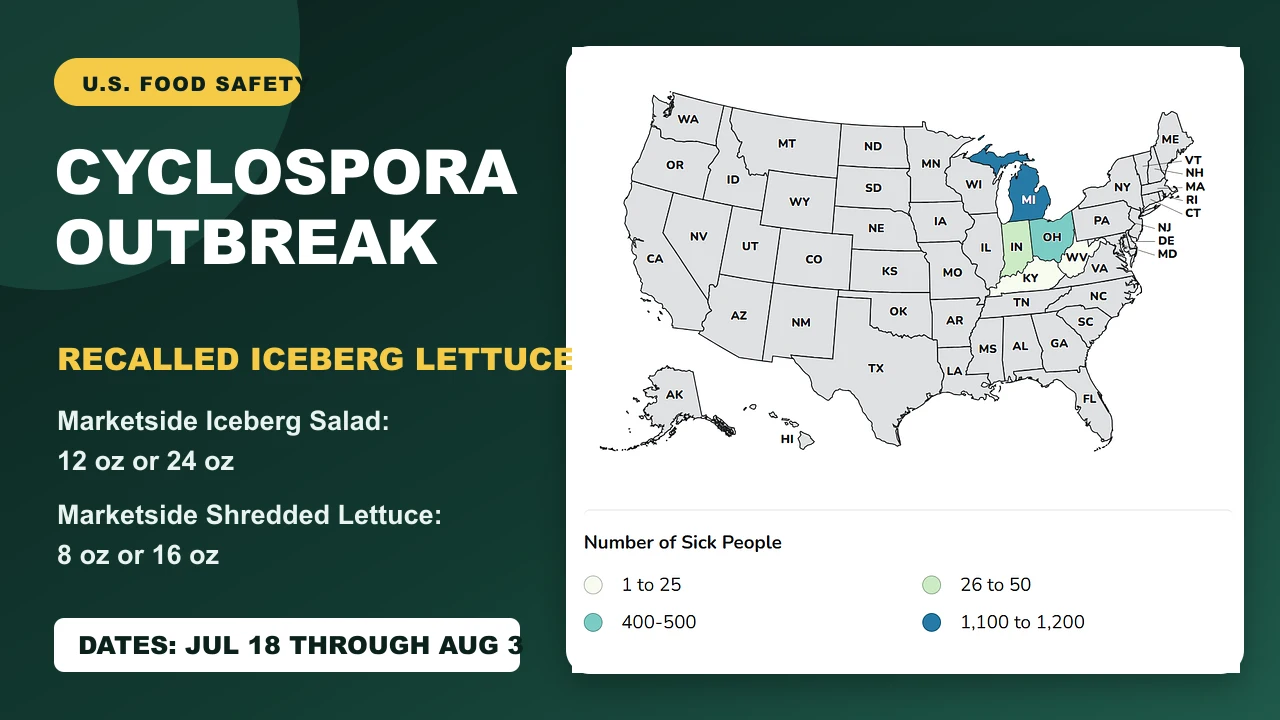
The US Food and Drug Administration and Centers for Disease Control and Prevention are investigating an outbreak of Cyclospora infections linked through epidemiological and traceback evidence to shredded iceberg lettuce. FDA listed 1,644 illnesses, 94 hospitalisations and no deaths in Indiana, Kentucky, Michigan, Ohio and West Virginia as of its July 19 update.
Taylor Farms de Mexico initiated a recall on July 17 covering iceberg lettuce sourced from central Mexico. The action reaches beyond one restaurant chain. It includes selected retail products sold under the Marketside name at Walmart and a longer list of foodservice products supplied to restaurants, retailers and other customers.
Two Marketside product descriptions are named for shoppers
The retail entries in the FDA recall table are Marketside Iceberg Salad in 12-ounce and 24-ounce packages, plus Marketside Shredded Lettuce in 8-ounce and 16-ounce packages. The table identifies the retail brand with the abbreviation MKTSD, while FDA's outbreak advisory spells out the Marketside name.
A Marketside label alone does not identify every lettuce product as recalled. The product description, package size and Best if Used By date must fit the notice. Whole heads of lettuce, other salad types and products from a different supplier are not automatically included simply because they were sold by the same retailer.
The Best if Used By window runs through August 3
For the 12-ounce and 24-ounce Iceberg Salad, the listed Best if Used By dates run from July 18 through August 3, 2026. For the 8-ounce and 16-ounce Shredded Lettuce, the table gives the same July 18 through August 3 window in a slightly different date format.
These dates are especially useful because fresh lettuce may have been removed from store shelves while an old bag remains in a household refrigerator. Photograph the front, back and date panel before discarding or returning a matching package. The official notice offers a full refund at the place of purchase.
Walmart lists sales in 15 states
FDA says the recalled Marketside iceberg products were sold at select Walmart stores in Alabama, Arkansas, Florida, Georgia, Indiana, Kansas, Kentucky, Louisiana, Missouri, Mississippi, Oklahoma, Tennessee, Texas, Virginia and West Virginia. Walmart's corporate recall page carries the same notice and links to its affected-store information.
The state list is a screening tool, not proof by itself. A shopper in a listed state still needs the right product and date. A shopper elsewhere should not ignore an exact package match if the lettuce travelled, was delivered across a state line or came through another channel. FDA notes that known distribution can expand as an investigation continues.
Foodservice distribution is much wider than the five case states
Taylor Fresh Foods says shredded iceberg products were distributed from June 29 through July 16 in 27 states: Alabama, Arkansas, Connecticut, Florida, Georgia, Iowa, Illinois, Indiana, Kansas, Kentucky, Louisiana, Massachusetts, Maryland, Michigan, Missouri, Mississippi, North Carolina, New Hampshire, New Jersey, Ohio, Oklahoma, Pennsylvania, South Carolina, Tennessee, Texas, Virginia and Wisconsin.
The full recall table contains abbreviated foodservice brands such as CV, JB, MARK, PK, SUB, SY and TF, with different cut styles, case sizes and date ranges. Restaurants and institutional kitchens need to check supplier records and case labels against that table. A consumer article cannot safely replace the complete business inventory list.
The five illness states and the sale states answer different questions
Indiana, Kentucky, Michigan, Ohio and West Virginia are the five states reporting the outbreak cases included in the federal count. They should not be mistaken for the complete distribution area. Lettuce was sold or distributed in many additional states even though no linked case was listed there in the July 19 snapshot.
In a Michigan subset, investigators reviewed ingredient information from 190 people who reported eating at Taco Bell and found that 90 percent reported iceberg lettuce. FDA's traceback investigation also converged on one supplier. Those findings support the public-health action, but they do not mean every person who ate lettuce became ill.
The corrected laboratory result does not cancel the recall
FDA reported an important correction on July 19. Laboratory experts re-reviewed a lettuce sample that had initially been described as positive and concluded that the signal was false amplification. The agency said there were no confirmed positive Cyclospora results from product testing as of that update.
That correction should be reported clearly, but it does not mean the outbreak or recall disappeared. FDA kept the investigation open and continued to cite the epidemiological pattern and traceback evidence. The careful conclusion is that no product sample had been confirmed positive at that time, while the recall and consumer instructions remained active.
Not every Taco Bell location is named as unsafe
The investigation focused on Taco Bell locations in the five case states that received lettuce from the implicated supplier. Taco Bell told FDA it was no longer using lettuce from Taylor Farms de Mexico as of July 17. That is different from saying every Taco Bell restaurant in the United States served recalled lettuce.
FDA advises people not to eat recalled lettuce at a Taco Bell or another restaurant. If the source is unknown, ask the restaurant. The practical question is the supplier of the iceberg lettuce, not the restaurant logo alone.
Do not try to wash a recalled bag into safety
CDC says recalled lettuce should be thrown away or returned to the store. Washing fresh produce is normally useful, but it cannot guarantee removal of Cyclospora. FDA also warns consumers not to use soap or bleach on produce, and notes that the parasite can resist standard chlorine-based sanitisers.
Keep a matching bag away from ready-to-eat food. Wash containers, refrigerator surfaces, cutting boards and utensils that may have touched it with hot, soapy water or use a dishwasher where appropriate. Never mix cleaning chemicals, and follow the surface or appliance maker's care instructions.
Symptoms can begin well after the meal
CDC says symptoms usually begin about one week after infection, although the reported range extends from two days to two weeks or more. Watery diarrhoea is the main symptom. Loss of appetite, weight loss, cramps, bloating, gas, nausea and fatigue are also common, and symptoms can seem to improve before returning.
Without treatment, illness can last from a few days to a month or longer. Older people, children and people with weakened immune systems may face more severe dehydration or complications. The timing is why investigators may ask what an ill person ate during the two weeks before symptoms began.
A routine stool test may not include Cyclospora
CDC advises contacting a healthcare provider if symptoms develop, especially after possible exposure to shredded iceberg lettuce. Its outbreak notice says people may need to ask specifically about testing because routine stool tests do not always screen for Cyclospora.
Stay hydrated and seek prompt care for severe, persistent or worsening symptoms. Tell the clinician about the possible food exposure and the date it happened. This article can help identify the recall, but it cannot diagnose an infection or recommend individual treatment.
Use this five-part refrigerator check
First, look for the Marketside name. Second, match Iceberg Salad or Shredded Lettuce. Third, confirm 12 or 24 ounces for the salad, or 8 or 16 ounces for the shredded product. Fourth, check for a Best if Used By date from July 18 through August 3, 2026. Fifth, compare the purchase location with the official Walmart and FDA notices.
If every product detail matches, do not eat the lettuce. Photograph the package, return it for the stated refund or discard it so nobody else can consume it, then clean items it touched. If the bag is gone, check the receipt or online order history and ask the retailer rather than guessing from the purchase date alone.
Sources and further reading
- FDA - Ongoing five-state Cyclospora outbreak investigation and corrected laboratory update ↗
- FDA - Taylor Fresh Foods recall table with retail and foodservice dates ↗
- CDC - Cyclospora outbreak notice, symptoms, testing and consumer actions ↗
- FDA - Cyclospora transmission, produce washing and cleaning guidance ↗
- Walmart - Current corporate product recall notices ↗
This article was written for Curiosity Desk. We do not copy other publishers or invent quotes. If a material error is found, we correct it openly.
Read the full standards →One answer should lead to a better question
Bring your curiosity to the group
Curious Minds is our public Facebook community for surprising science, strange history, Australian wildlife and everyday questions. No copied posts, no personal-friend invitations and no link dumping.
- Three self-contained discussion prompts each week
- Sourced answers and honest uncertainty
- Respectful conversation without spam