Check before you act
Quick recall check
- Recall announced
- 22 July 2026
- Reason
- Possible Salmonella Enteritidis contamination
- Amount
- 1,589,577 dozen eggs
- Retail brands
- Kroger, Simple Truth, Brookshire's, Country Morning and Sunups
- Plant code
- P-1950 or 840962
- Julian date
- 157 through 184
- Best-by or sell-by
- 20 July through 17 August 2026
- What to do
- Do not eat matching eggs. Return them to the original retailer for a full refund.
Match every available detail against the linked official notice. A brand or state alone does not prove that a carton is recalled.
The recall covers nearly 1.59 million dozen eggs
Midwest Poultry Services voluntarily recalled 1,589,577 dozen white shell eggs and brown cage-free shell eggs on July 22, 2026 because they may be contaminated with Salmonella Enteritidis. That quantity is equivalent to 19,074,924 individual eggs if expressed as twelve-egg dozens, although the official product list also includes larger retail and foodservice packs.
The scale makes the headline sound like every egg in several states is unsafe. That is not what the notice says. The recall is limited by producer, plant code, production date, brand, pack size and distribution. Midwest Poultry Services says no other products are included and that it was not aware of any specific illnesses linked to the recalled eggs when the notice was published.
Five retail brand names appear in the FDA product list
The consumer cartons listed by the US Food and Drug Administration carry Kroger, Simple Truth, Brookshire's, Country Morning and Sunups branding. The table covers several sizes, from six and twelve eggs to larger 18, 24, 30 and 60-egg packs. It also lists bulk foodservice cases under generic grade and size descriptions.
A familiar brand name does not complete the match. Some Kroger and Simple Truth products have multiple sizes and UPCs, while other eggs sold under the same store brand may come from a different producer or production window. Keep the carton beside you and compare all of the identifying details on the official FDA page.
The eggs were sold across eight named states
The recalled eggs were produced at farms in Texas between June 6 and July 3, 2026. They were shipped to foodservice and retail customers in Texas, Oklahoma and Louisiana. The announcement says consumers could find them at Kroger stores in Texas and Louisiana and at Brookshire Grocery stores in Texas, Oklahoma, Arkansas, Louisiana, New Mexico and Mississippi.
The notice also mentions smaller retail outlets, so the two large chains are not the complete distribution list. At the same time, a purchase in one of those states is only a reason to check the carton. It is not proof that every carton sold in that state is affected.
Start with the plant code printed on the side
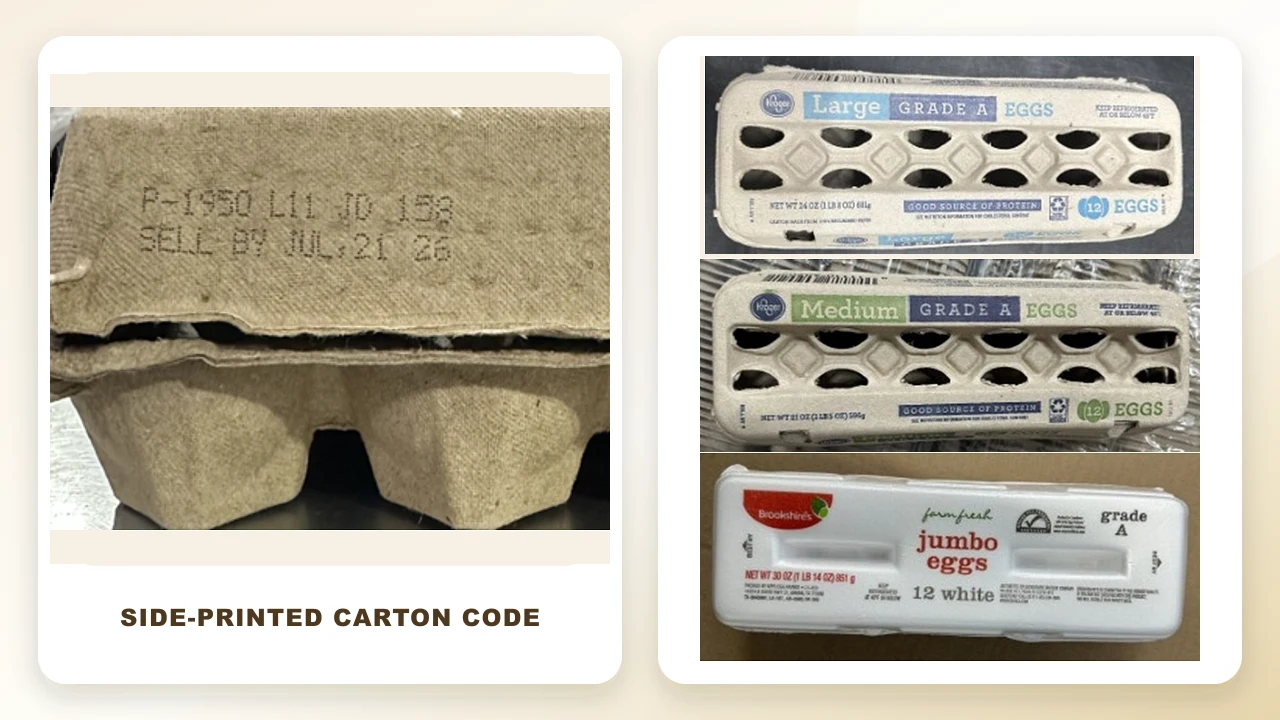
The identifying ink appears on the left or right side of the carton. The FDA product table lists plant code P-1950 or 840962. The paragraph above the table displays the second number with an added leading zero, while carton printing may omit punctuation. That is why the code should be checked together with the date range, brand, size and UPC rather than treated as a one-number test.
The official FDA photograph shows how a plant code and date are printed in a faint dot-matrix line on the cardboard. Curiosity Desk uses that exact recall photograph and the regulator's product photos on this page. A generic carton illustration would not help a reader recognise where the real code sits.
Julian dates 157 through 184 identify the production window
Beside the plant code, look for a three-digit Julian date from 157 through 184. A Julian date counts days from the beginning of the year. In 2026, day 157 is June 6 and day 184 is July 3, matching the production window stated in the recall.
Do not confuse that short production code with the consumer-facing sell-by or best-by date. The recalled cartons have sell-by or best-by dates from July 20 through August 17, 2026. An affected carton needs the listed plant code and Julian range, not merely an August date printed somewhere on the package.
Use four checks before deciding that a carton is recalled
First, find the exact brand and pack size in the FDA table. Second, compare the UPC where one is listed. Third, match plant code P-1950 or 840962. Fourth, confirm a Julian date from 157 to 184 and a best-by or sell-by date between July 20 and August 17, 2026.
The full combination matters because social posts often compress a long recall into one brand logo or one date. A Kroger carton with the wrong plant code is not identified by this notice. A carton with the right plant code but a Julian date outside the stated range also fails the published match.
Do not eat a matching carton or try to cook around the recall
The company announcement tells consumers to avoid eating recalled eggs and return them to the original place of purchase for a full refund. Do not serve them to another person, donate them, move them into a different carton or crack them before returning or discarding them.
Ordinary egg-safety advice says thorough cooking reduces Salmonella risk, but a recall instruction is more specific. Cooking is not a substitute for removing a product that the producer has recalled. Leave matching eggs in the carton, separate them from food that is ready to eat and follow the retailer's return process.
A missing carton makes reliable identification harder
If the eggs were moved into a refrigerator tray, the plant code, Julian date, UPC and brand may no longer be available. Do not guess from shell colour because the recall includes both white and brown eggs. Shell colour cannot identify the farm, production date or retail label.
Check a receipt, online order history or loyalty-app purchase record, then contact the retailer or Midwest Poultry Services before using eggs that may fit the distribution window. If the origin still cannot be established, ask the retailer how it is handling loose or repacked eggs rather than assuming that every unlabelled egg is recalled or safe.
Clean places that may have touched leaked raw egg
A closed, clean carton does not require panic-cleaning of the entire kitchen. Focus on any refrigerator shelf, drawer, container, utensil or work surface that contacted a broken egg or raw egg residue. Wash hands and surfaces with hot, soapy water, then follow the surface manufacturer's and FDA's sanitising guidance.
Do not mix cleaning chemicals. In particular, never combine chlorine bleach with ammonia, acids or another cleaner. Keep food away from wet cleaning products, use ventilation where the label requires it and allow food-contact surfaces to reach the label's safe final condition before returning food.
No linked illness was reported, but symptoms still matter
The recall announcement says the company was not aware of specific illnesses linked to these products. That is reassuring about reports known at publication, but it does not prove that a matching carton is safe or cancel the return instruction. Preventive recalls are intended to remove possible hazards before more people are exposed.
The Centers for Disease Control and Prevention says Salmonella symptoms usually begin six hours to six days after infection. Common symptoms include diarrhoea, fever and stomach cramps, with nausea or vomiting possible. Most illnesses last four to seven days, but young children, older adults and people with weakened immune systems face a greater risk of severe infection.
Know when illness needs medical advice
CDC advises contacting a doctor for diarrhoea or vomiting lasting more than two days, bloody stool or urine, fever above 102 degrees Fahrenheit, or signs of dehydration such as very dark or little urine, intense thirst, dry mouth, dizziness or light-headedness. Repeated vomiting that prevents fluid intake also needs prompt attention.
Tell the healthcare professional about the possible recalled-egg exposure and retain a photograph of the carton code if it can be handled safely. This page cannot diagnose infection, and an absence of symptoms immediately after eating does not rule it out because the usual onset window extends over several days.
Foodservice operators should check bulk descriptions too
Restaurants, cafeterias and other food businesses should not stop at the consumer brand photographs. The recall table includes bulk Grade AA and Grade A cases in several sizes, including 15-dozen and 30-dozen packs. Those entries may not have a retail UPC.
Operators should review supplier records, receiving dates, plant codes and case labels, stop using matching stock and contact their distributor. They should also identify food prepared with a confirmed recalled product and follow local health-department and FDA guidance rather than quietly substituting a new carton.
The five-minute carton check
Put the carton on a well-lit surface and photograph both sides. Find the brand and pack size, then locate the side-printed plant code and Julian date. Match those details and the best-by date against the current FDA table. If everything matches, do not eat the eggs and use the retailer's full-refund route.
If one detail is unclear, isolate the carton and check the official notice directly. This order avoids the two most common mistakes: throwing away the identifying carton before recording the code, and treating a brand name or state as proof that every egg is recalled.
Sources and further reading
This article was written for Curiosity Desk. We do not copy other publishers or invent quotes. If a material error is found, we correct it openly.
Read the full standards →One answer should lead to a better question
Bring your curiosity to the group
Curious Minds is our public Facebook community for surprising science, strange history, Australian wildlife and everyday questions. No copied posts, no personal-friend invitations and no link dumping.
- Three self-contained discussion prompts each week
- Sourced answers and honest uncertainty
- Respectful conversation without spam