The dramatic headline leaves out the most important detail
A peer-reviewed study published on 23 July 2026 describes two striking encounters in Mexico's Gulf of California. In each one, an orca held a sharp-tail sunfish while another orca accelerated into it. The impact broke tissue into pieces that spread through the water.
The videos are real, but this was not a newly discovered killing blow. The researchers reported that both sunfish were already dead and their viscera had been removed before the ramming began. That shifts the central question from how the orcas killed the fish to why they processed an existing carcass with such force.
This was a sharp-tail sunfish, not just any mola
The prey in both recordings was a sharp-tail sunfish, Masturus lanceolatus. It belongs to the molid family alongside the better-known ocean sunfish, Mola mola, and the giant sunfish, Mola alexandrini. All three have been recorded in the Gulf of California.
A sharp-tail sunfish has a pointed extension on its clavus, the structure at the rear of the body where a conventional fish tail might be expected. The 2026 paper suggests that this pronounced structure may give an orca a useful place to grip while another animal approaches.
The first recording had an unusually clear sequence
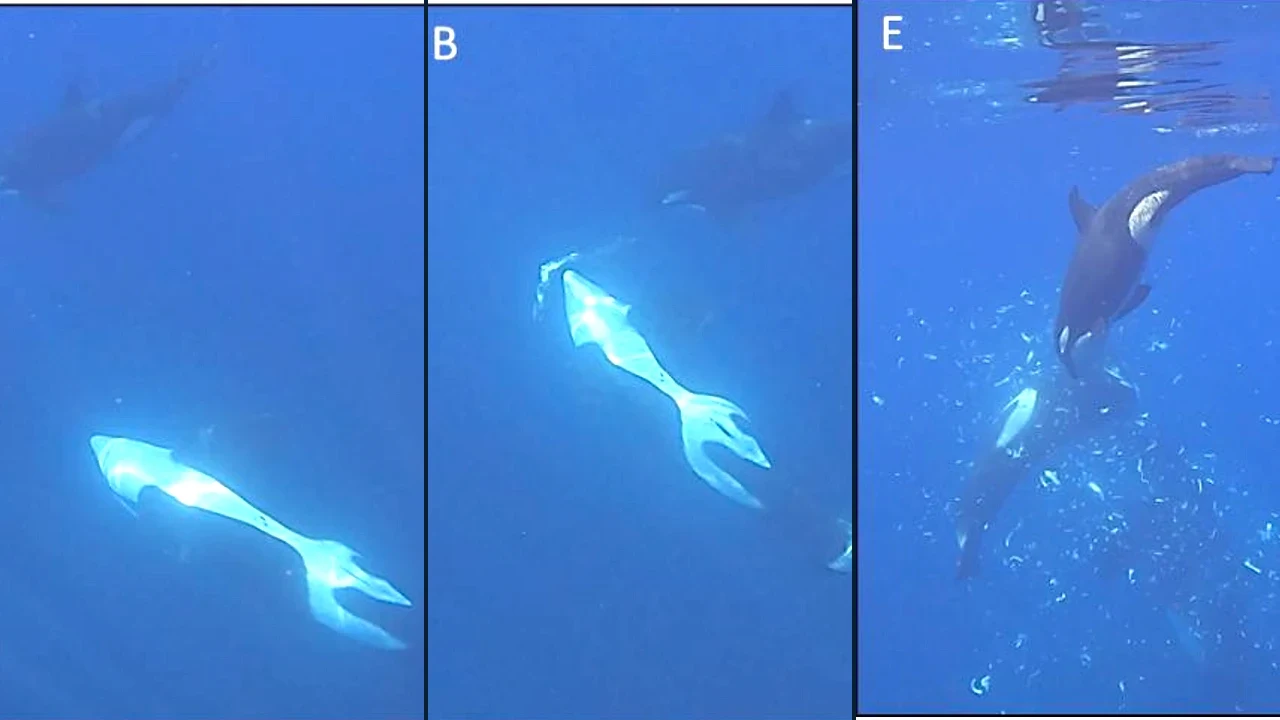
The first encounter was filmed off Baja California Sur on 29 July 2024. A group containing three adult females, an adult male and a juvenile had already been observed catching and eating a spine-tail devil ray. An adult female then held a dead sharp-tail sunfish by its clavus.
The male accelerated toward the carcass while turned belly-up. The female released it just before impact. After an audible collision, a juvenile ate small fragments suspended in the water while the adults continued feeding on larger remains. The researchers did not observe the adults eating those smaller pieces.
A second encounter repeated the basic pattern
The second recording came from 7 September 2025 near Isla Cerralvo. Three adult females and a calf were present. One adult stabilised a dead sharp-tail sunfish, a second rammed it, and a third later joined the feeding. The calf was also recorded extracting tissue from the carcass.
The group had been observed preying on a shortfin mako shark earlier that day. That detail does not prove why the sunfish was rammed, but it places the behaviour inside a longer period of active foraging rather than an isolated collision with an unfamiliar object.
Food processing is the strongest explanation
Because the prey had already died, the paper interprets the collision as a processing technique rather than a way to deliver the final blow. Breaking a large carcass into smaller portions could make particular tissues easier to reach, share or swallow.
Sunfish bodies also have an unusual structure. Beneath the outer skin is a thick, gelatinous collagen layer that is mostly water. The researchers propose that the sharp-tail sunfish's tissue may respond to high-energy impact differently from other prey, although two recorded events are not enough to establish a general biomechanical rule.
Were the adults helping younger orcas eat?
The juvenile in the first encounter consumed the small fragments while the adults fed on the larger remains. That pattern is consistent with facilitation feeding: adults may have made food more manageable for a younger animal. The calf's presence during the second encounter makes the possibility worth investigating.
It is still a hypothesis. The study did not compare groups with and without calves, measure how much each animal ate or show that ramming always occurs when a young orca is present. The observations support a sensible idea, but they do not prove a universal lesson-teaching strategy.
Play and feeding do not have to be opposites
The authors also identify social interaction and play as possible functions. In animal behaviour, play does not necessarily mean an action is useless. A vigorous movement can process food, practise coordination and create a stimulating group interaction at the same time.
The recordings reveal sequence, body position and feeding. They do not reveal an orca's private intention or emotional state. Describing the animals as amused, cruel or deliberately putting on a show goes further than the evidence allows. The scientifically useful answer may involve several overlapping benefits rather than one human-style motive.
Orcas eating sunfish is not the new discovery
Sunfish have appeared in the orca diet for decades. A 2012 study found bones consistent with an ocean sunfish in the stomach of a stranded killer whale in Ireland and noted earlier field observations elsewhere. A later global review assembled 73 orca-molid interactions recorded between 1961 and 2022.
That review classified 42 interactions as predation, 29 as non-predation and two as uncertain. The records clustered in Oceania, the eastern Pacific and waters off South Africa. The new finding is the clearly documented stabilise-and-ram sequence that caused extensive fragmentation, not the basic fact that orcas sometimes eat molids.
The helpless-sunfish meme is misleading
Sunfish are often portrayed online as passive drifters. Research reviewed by the Orca Research Trust instead describes strong swimming and surprisingly agile evasive manoeuvres, including rapid turns, rolling and keeping the rear of the body toward an approaching orca.
Those defences cannot be judged from footage of an already dead carcass. The videos show what a coordinated orca group can do during processing, not that a living sunfish makes no attempt to escape or that every molid species would fragment in the same way.
Two videos are evidence, not a universal rule
A regional study published in 2026 reported 21 orca-molid predation events in the southwestern Gulf of California between 2013 and 2024. Photographs suggested that at least four distinct orca groups were involved, and calves were present in eight events. That broader record makes sunfish a genuine local prey item rather than a one-off accident.
Even so, the spectacular ramming sequence has been described from only two opportunistically filmed encounters in one region. It may be a local technique, a behaviour that spreads socially or a response to a particular prey structure. More observations are needed before any of those possibilities can be treated as established.
What the evidence can actually tell us
We can say that the orcas coordinated their positions, struck already dead sharp-tail sunfish and then fed on the remains. We can also say that smaller animals gained access to tissue after the impacts. Those points come directly from the recorded sequences.
We cannot yet say that every impact was play, that adults were consciously teaching, or that all orca populations use the tactic. The viral clip is astonishing, but the careful version is better: it captures a highly coordinated feeding behaviour whose full purpose may combine processing, sharing, learning and play.
Sources and further reading
- Frontiers in Ethology - Fragmentation of sharp-tail sunfish caused by high-impact ramming behavior in orcas ↗
- Regional Studies in Marine Science - Orca and ocean sunfish interactions in the Gulf of California ↗
- Biodiversity Journal - Global review of orca interactions with ocean sunfishes ↗
- Biodiversity Journal - First records of orca predation on sharp-tail sunfish ↗
- Marine Biodiversity Records - Killer whale predation on ocean sunfish ↗
This article was written for Curiosity Desk. We do not copy other publishers or invent quotes. If a material error is found, we correct it openly.
Read the full standards →One answer should lead to a better question
Bring your curiosity to the group
Curious Minds is our public Facebook community for surprising science, strange history, Australian wildlife and everyday questions. No copied posts, no personal-friend invitations and no link dumping.
- Three self-contained discussion prompts each week
- Sourced answers and honest uncertainty
- Respectful conversation without spam