The first clue was an empty radar beam
Astronomers expected near-Earth object 1998 SH2 to pass through the Goldstone radar beam on 26 August 2025. Its predicted position came from observations made between 1998 and 2016, combined with the gravitational effects of the Sun and planets. The radar did not find it where that calculation placed it.
That absence was not evidence of a sudden threat or a failed telescope. When an observatory in Brazil recovered the object on 31 August, it was 153 arcseconds from the gravity-only prediction. The large offset showed that a small, persistent force had accumulated during two unobserved trips around the Sun.
Gravity was not the only force moving it
Researchers rebuilt the orbit with precise optical astrometry. More than 200 additional observations and a successful radar measurement on 2 September confirmed a transverse acceleration of about 1.4 times 10 to the minus 11 metres per second squared.
That is an extremely small acceleration, but it was about ten times larger than the maximum thermal recoil expected from the Yarkovsky effect for an object of this size. The stronger explanation was cometary outgassing: sunlight was warming hidden ice, gas was escaping and the object was receiving a gentle push in the opposite direction.
Powerful telescopes found the tail
The motion suggested a comet before the object looked like one. Teams then used the Canada-France-Hawaii Telescope, the Danish Telescope in Chile and the European Southern Observatory's Very Large Telescope to search for visible activity during the close approach.
Those images resolved a faint coma extending at least 10 arcseconds and a narrow tail at least 20 arcseconds long. The object received the additional comet designation P/1998 SH2. The study's dust modelling indicated that the tail was dominated by grains roughly 400 micrometres across, released over days rather than in one brief impact.
Why the comet could hide as an asteroid
1998 SH2 is estimated to be about 380 metres across and very dark, reflecting only a small fraction of the light that reaches it. Its elongated orbit resembles that of a Jupiter-family comet, but earlier images had not shown an obvious coma or tail. To most observatories it still looked like a point of light.
The object passed closest to the Sun on 21 July 2025, yet the detectable activity strengthened weeks later. The researchers say a delayed response is compatible with heat taking time to reach ice below a poorly conducting surface. A comet does not have to switch on at the same point of every orbit or produce a spectacular naked-eye tail.
This gives dark comets a testable clue
Astronomers use the term dark comet for an object that looks asteroid-like but moves as though gas is escaping from it. Other mechanisms must be considered, so unusual motion alone is not final proof. In this case, motion generated a prediction and sensitive imaging supplied the visual confirmation.
The paper describes 1998 SH2 as the first object whose cometary activity was predicted from non-gravitational motion and then confirmed by targeted observations. That does not prove every dark comet has the same explanation, but it suggests that some larger outer dark comets may reveal faint activity when geometry and telescope sensitivity are favourable.
The planetary-defence lesson is precision, not panic
The object passed safely about 3 million kilometres from Earth in August 2025. The study reports that its probability of hitting Earth over the foreseeable future remains zero even after the extra acceleration was included. Near-Earth describes an orbital category; it does not mean an impact is imminent.
Classification still matters. Gas jets can make a comet's future path less predictable than a gravity-only model suggests, and a porous icy body may respond differently to a deflection attempt than a rocky asteroid. Continuous tracking helps researchers identify those differences before they matter in any real hazard assessment.
What the image on this page actually shows
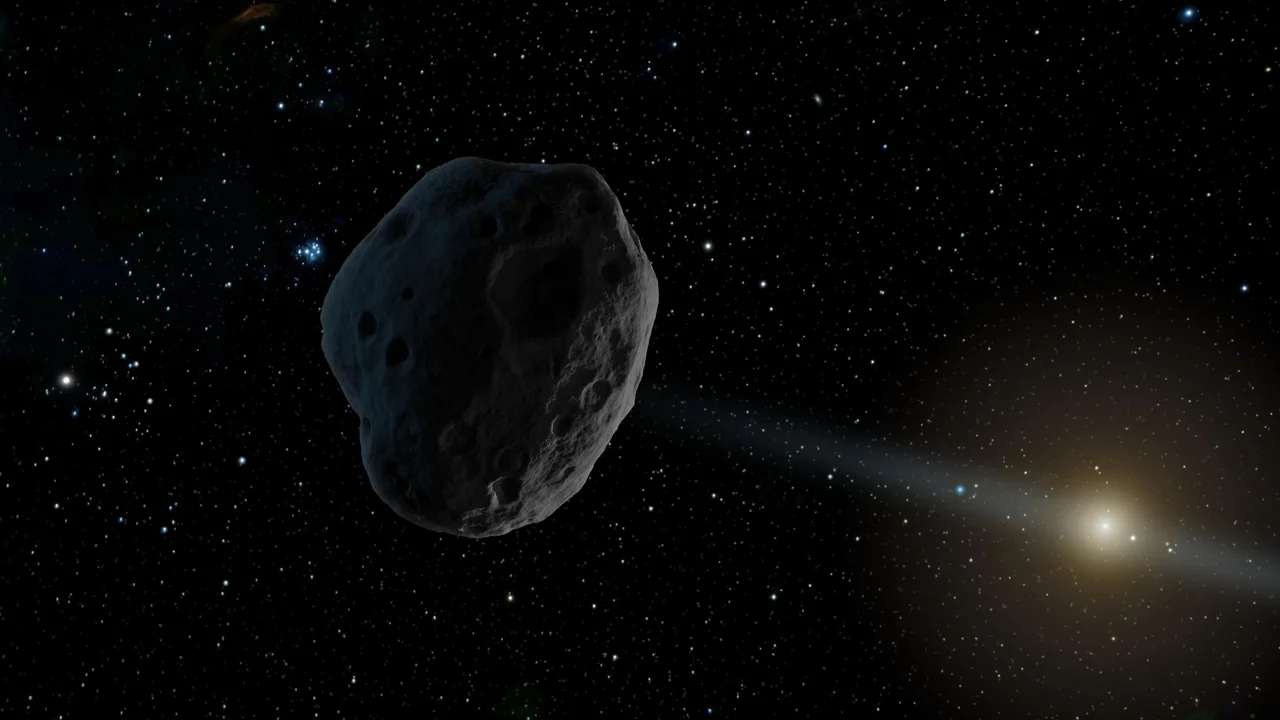
The main image is a NASA/JPL-Caltech artist's concept of a different dark small body, 2016 WF9. It is used to explain how an apparently asteroid-like object can travel on a comet-like orbit. It is not a telescope photograph of 1998 SH2, and the label beside the image identifies it as an illustration.
That distinction is part of the story. The real evidence was less cinematic: a missed position, a carefully fitted acceleration and a tail so faint that large observatories were needed to see it. The discovery came from measurements agreeing with one another, not from one dramatic picture.
Sources and further reading
This article was written for Curiosity Desk. We do not copy other publishers or invent quotes. If a material error is found, we correct it openly.
Read the full standards →One answer should lead to a better question
Bring your curiosity to the group
Curious Minds is our public Facebook community for surprising science, strange history, Australian wildlife and everyday questions. No copied posts, no personal-friend invitations and no link dumping.
- Three self-contained discussion prompts each week
- Sourced answers and honest uncertainty
- Respectful conversation without spam