The discovery at a glance
What the catfish cancer study actually found
- Animal
- Brown bullhead catfish (Ameiurus nebulosus)
- Main study site
- Lake Memphremagog, on the Vermont and Quebec border
- Disease
- Malignant melanoma that can invade other tissues
- What spreads
- The cancer-cell lineage itself, not a proven virus
- Why scientists are convinced
- Tumours in different fish are genetically closer to one another than to their hosts
- First
- First documented transmissible cancer in a fish and in freshwater
- Human risk
- The research team reports no known risk to people
- Still unknown
- How it transfers, where it began and how it affects fish populations
The finding concerns a clonal cancer lineage in brown bullhead catfish. It does not show that ordinary human cancers are contagious.
The contagious part is the cancer cell itself
Most cancers begin when cells inside one body acquire mutations and multiply without control. They may spread to other organs in that same body, but they do not normally pass to another individual. The immune system of the second animal would recognise foreign cells, and the cells would also have to survive outside their original host long enough to enter new tissue.
The brown bullhead discovery is different. The study published in Nature on 22 July 2026 found that tumour cells in separate fish belong to one clonal lineage. The living cancer has outlasted its original host and appears to move into new fish, behaving less like a conventional tumour and more like a cellular parasite.
The mystery began with black growths in a cross-border lake
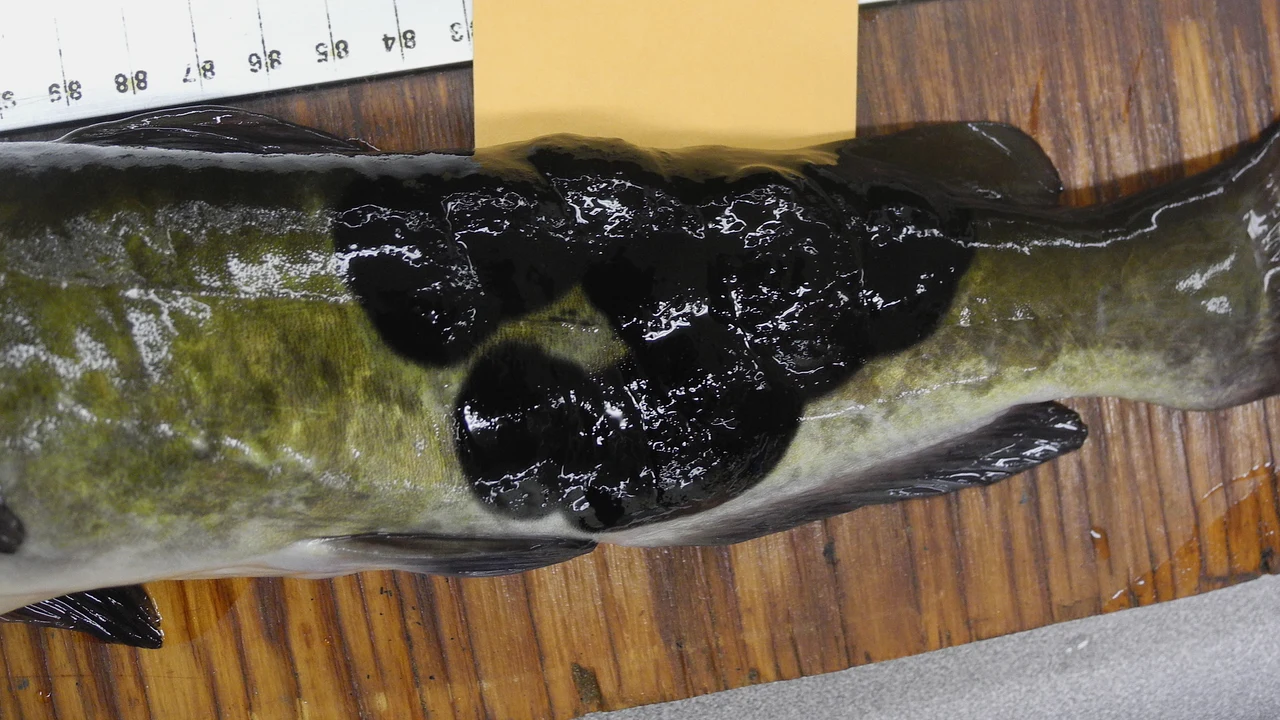
Anglers and biologists began reporting brown bullheads with conspicuous black patches and raised growths in Lake Memphremagog in 2012. The lake stretches across Vermont in the United States and Quebec in Canada. Microscopic examination later identified the lesions as malignant melanoma, a cancer of pigment-producing cells.
US Geological Survey surveys from 2014 to 2017 found visible lesions in about 30 percent of adult bullheads at two lake sites. Some lesions invaded muscle, bone and other organs. A cluster that large made several explanations plausible, including pollution, a virus, another pathogen or an inherited vulnerability in the local fish.
Each explanation predicts a different family tree
If every fish developed its own ordinary cancer, the DNA in a tumour should mostly match the healthy DNA of that fish. Each tumour would carry its own set of new mutations, but it would remain a branch of its host's genetic family tree. A cancer-causing virus could trigger many tumours and still produce that host-matched pattern.
A transmissible cancer predicts the opposite. Tumours taken from different fish should resemble one another because they descend from the same ancestral cancer cell. Their genomes should form a separate family, distinct from the fish bodies in which they are now growing. That is the pattern the researchers tested with whole-genome sequencing.
The tumour DNA kept grouping with other tumours
The team compared melanistic tissue with healthy tissue from affected fish and with unaffected reference fish. Tumour mitochondria carried a shared set of changes that was absent from the matched healthy tissue. In the nuclear genome, the tumour samples also formed one distinct clade rather than pairing with their individual hosts.
In an analysis of 16 tumour and normal-tissue pairs, the researchers identified 245,189 tumour-specific single-nucleotide variant sites. Most were not private mutations in one fish. Fifty-nine percent were shared by at least 14 of the 16 tumours. Large structural changes in the DNA and copy-number patterns told the same story.
Why hundreds of thousands of shared variants matter
Independent cancers can sometimes acquire the same useful mutation by chance or natural selection. That is not enough to explain hundreds of thousands of shared variants spread across the genome, together with shared mitochondrial and structural changes. The simplest explanation is common ancestry: these cancer cells inherited the pattern from an earlier cancer lineage.
The result does not mean the researchers watched a cell pass from one fish to another. It is genomic evidence, much like reconstructing a family relationship from DNA. Several independent parts of the genome converge on the same conclusion, which is why the paper describes the lineage as a transmissible melanoma rather than a collection of similar-looking tumours.
Pollution may shape vulnerability without being the infectious agent
Brown bullheads are used as indicators of environmental quality, and the lake's cancer cluster initially raised understandable concern about contaminants. A separate 2026 USGS-led study found higher concentrations of seven metals, including arsenic and zinc, in skin with melanistic lesions than in visibly normal skin. It also documented signs consistent with oxidative damage.
Those findings do not overturn the genomic result. A contaminant could damage tissue, suppress immunity or help an existing cancer lineage establish itself without being the thing that moves between fish. The current evidence does not prove that arsenic created the lineage, that one pollution source caused the outbreak or that contaminated water transmits the cancer.
Scientists still do not know how one fish gives it to another
For a cancer lineage to spread, cells must leave one animal, stay alive, enter another and evade immune rejection. Brown bullheads have no scales, live close to the bottom and gather closely during spawning. Direct contact, damaged skin, spawning behaviour and cells surviving briefly in sediment or water are all possible routes.
They remain hypotheses. The Nature study did not identify a confirmed transfer event or calculate how long tumour cells survive outside a fish. Researchers noted that the disease appears mainly in larger, spawning-age animals, but that pattern alone cannot distinguish between contact, age, accumulated exposure or several factors working together.
This is the first fish case, but not the first animal case
Naturally transmissible cancers were already known in dogs, Tasmanian devils and several marine bivalves such as clams and mussels. Dogs mainly pass a tumour during mating. Tasmanian devils spread facial tumour cells through biting. Bivalve cancer cells can move through seawater.
The bullhead melanoma is the first documented example in any fish and the first in a freshwater setting. Scientists sometimes call it the fourth broad type of naturally occurring transmissible cancer, grouping the many bivalve lineages together. The count sounds small because the biological barriers are formidable, not because every cancer has been exhaustively tested for transmission.
The discovery does not make human cancer contagious
The research team reports no known risk to people. A tumour lineage adapted to brown bullhead tissue is not expected to survive in a human body, and the study found no route from lake water or fish to humans. Lake Memphremagog supplies drinking water to more than 175,000 people, which makes that distinction especially important.
This paper is about a rare wildlife cancer in one species, not a change in how ordinary human cancers behave. It also is not a general fish-consumption advisory. People should continue to follow the fishing and consumption guidance issued for their location, which may address contaminants or other health questions that are separate from this cancer lineage.
The lineage may be older and wider than one lake
The tumour genomes were more closely related to reference fish from New Hampshire and Maine than to the sampled healthy fish from Vermont. The authors interpret that as evidence that the lineage may have originated outside Lake Memphremagog. Related melanistic disease has now been recorded in other northeastern water bodies, but wider genomic sampling is needed to establish which lesions belong to the same lineage.
Historical reports add an intriguing clue, not proof. Early twentieth-century researchers described black tumours in bullheads and could induce small growths after exposing healthy fish to tumour material. The University of Vermont team is even examining nineteenth-century descriptions by Henry David Thoreau of bullheads with extensive black disease. Old words cannot provide DNA, but they may point scientists toward useful waters to sample.
A visible tumour is not automatically the transmissible lineage
Brown bullheads have developed liver and skin tumours in other places, sometimes in association with polluted sediments. Not every black spot is melanoma, and not every melanoma in the species has been shown to belong to this clonal cancer. The new paper concerns genetically tested lesions from the affected populations.
That boundary matters for headlines. The finding is not that every catfish can now infect every other catfish with cancer. It is that one remarkable melanoma lineage has crossed a barrier that almost all cancers never cross. Confirming its geographic range will require the same combination of pathology and genomic evidence used in the Nature study.
The next questions are bigger than the first
Researchers now need to learn where the lineage began, how long it has existed, how it transfers and whether it reduces survival or reproduction. Heavily affected fish can live for years, so visible disease does not immediately reveal the population effect. Sampling more lakes and comparing tumour genomes could reconstruct the lineage's movement across the region.
The wider scientific value lies in watching cancer evolve as an independent organism. A transmissible lineage has to solve problems of survival, entry and immune evasion repeatedly across hosts. Understanding those solutions may reveal why almost every other cancer remains trapped within the body where it began, and why a rare few escape.
Sources and further reading
- Nature: Brown bullhead catfish melanoma represents a novel transmissible cancer ↗
- USGS: Melanoma and other melanistic lesions in brown bullhead, identification of risk factors ↗
- USGS: Malignant melanoma of brown bullhead in Lake Memphremagog ↗
- University of Vermont: Scientists discover transmissible cancer in catfish ↗
This article was written for Curiosity Desk. We do not copy other publishers or invent quotes. If a material error is found, we correct it openly.
Read the full standards →One answer should lead to a better question
Bring your curiosity to the group
Curious Minds is our public Facebook community for surprising science, strange history, Australian wildlife and everyday questions. No copied posts, no personal-friend invitations and no link dumping.
- Three self-contained discussion prompts each week
- Sourced answers and honest uncertainty
- Respectful conversation without spam