The headline sounds broader than the confirmed incident
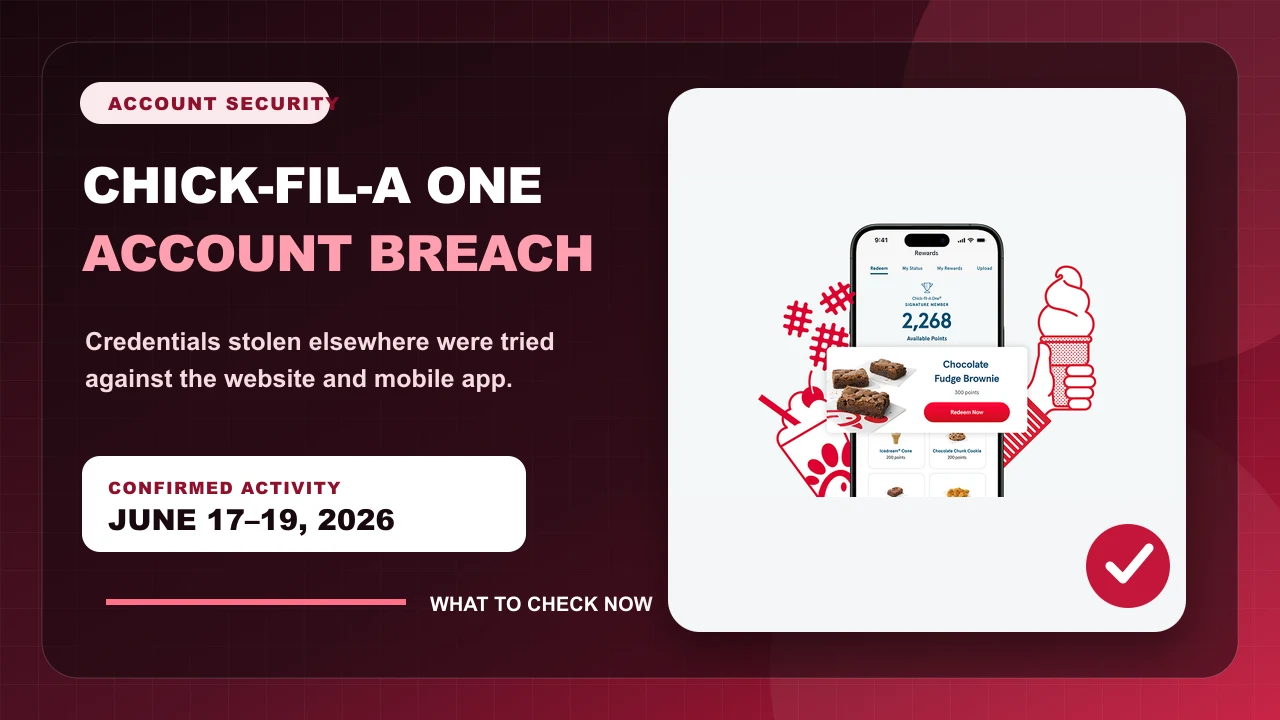
Chick-fil-A is notifying customers after unauthorised parties accessed some Chick-fil-A One loyalty accounts. The company notice filed in Massachusetts describes an automated attack against its website and mobile app, not a claim that every customer account or every Chick-fil-A payment was exposed.
The distinction matters because the attackers arrived with email addresses and passwords obtained from a third-party source. They then tried those credentials against Chick-fil-A. That method is called credential stuffing. A person who used one unique password only for Chick-fil-A faces a different situation from someone who reused the same password for email, shopping and banking.
The confirmed timeline runs from June 17 to July 20
According to the customer notice, the automated login activity took place between June 17 and June 19, 2026. Chick-fil-A says it investigated the suspicious activity and determined on July 13 that unauthorised parties may have accessed information stored in affected Chick-fil-A One accounts.
The notification letter is dated July 20. Chick-fil-A said it forced affected accounts to log out, removed stored payment methods, reset passwords, restored impacted Chick-fil-A One balances and added rewards to affected accounts. Those actions explain why a customer may suddenly need to sign in again or see a password-reset message.
What information may have been visible
The information varied with the contents of each account. The notice lists names, email addresses, Chick-fil-A One membership numbers, mobile pay numbers, QR codes, the amount of Chick-fil-A credit and the last four digits of a stored credit or debit card. If the customer had saved them, the month and day of birth, phone number and address may also have been available.
That list should be read literally. A field being named means it may have been accessible in an affected account; it does not prove that every attacker viewed or used every field. It also does not mean that every Chick-fil-A One member stored all of those details.
What the notice does not say was exposed
The filed notice refers to the last four digits of a payment card, not a complete card number or security code. It does not list Social Security numbers, driver's licence numbers or bank-account credentials among the affected fields. Those limits are important and should not be replaced with a broader claim that all financial or identity data was stolen.
Partial card digits and contact details can still be useful in a convincing phishing message. An attacker may combine a real name, brand, email address or balance reference with a request to sign in. The appropriate response is vigilance and direct account checking, not panic about information that the notice does not identify.
How to tell whether your account was affected
A direct notification from Chick-fil-A is the clearest signal that the company identified your account as affected. A forced logout, removed payment method or password reset may be consistent with the company's response, but those signs alone are not a public breach lookup and do not establish exactly what someone viewed.
If an email or text creates doubt, do not use its sign-in button. Open the Chick-fil-A app yourself or type the official website address into the browser. The company does not provide a public page where anyone can enter an email address and receive a definitive affected-or-not-affected result, so be suspicious of a third-party page claiming to perform that check.
First, replace the Chick-fil-A password through an official route
Use the official app or Chick-fil-A One sign-in page and select the password-reset option. Chick-fil-A says the emailed reset link is valid for 24 hours. Create a new password that is not a variation of the old one and is not used for any other account.
A password manager can generate and store a long, random password without requiring you to memorise it. The Federal Trade Commission recommends a strong password or passphrase and a different password for each account. NIST likewise notes that distinct passwords help prevent password-stuffing attacks from travelling from one service to another.
Second, find every other place where that password was reused
Changing only the Chick-fil-A password closes one door. If the old password, or a close variation, is still used elsewhere, the same credential list can be tested against those services. Search your password manager or browser's password check for reused or compromised credentials rather than relying on memory.
Protect the email account first because password-reset links for many other services arrive there. Give it a unique password and turn on two-factor authentication. The FTC explains that a second factor can stop a login even when an attacker knows the password. Use the strongest method the account offers, and never share an unexpected verification code.
Third, inspect the rewards account instead of checking only the bank
Chick-fil-A's official suspicious-activity guidance says customers can review up to one year of transaction history. Check unfamiliar orders, gifted or redeemed rewards, a changed balance, altered contact details and any payment method you do not recognise. Take screenshots of suspicious entries before correcting them so there is a useful record.
A loyalty account can hold spendable value even when it is not a bank account. Points, credit balances, QR codes and saved order details give an intruder several ways to use or understand the account. That is why an empty bank statement does not complete the review.
Fourth, deal with unauthorised orders, funds or card activity
Chick-fil-A directs customers with suspicious account activity to remove stored payment methods, correct inaccurate profile information and use its support process for fraudulent orders or rewards. If funds were loaded from a payment card without authorisation, the company also tells customers to verify the transaction with their financial institution.
Contact the bank or card issuer using the number on the card or its official app, not a number supplied by an unexpected message. A merchant-side rewards problem and an unauthorised card transaction may require separate reports. Preserve dates, amounts, order locations and support reference numbers.
Fifth, match the protective step to the information involved
Review bank and card statements and your credit reports for activity you do not recognise. IdentityTheft.gov provides a guided plan for information that was exposed and a separate recovery process when someone has actually opened an account, made a purchase or used your identity.
A credit freeze can make it harder for someone to open new credit in your name, but the 2026 Chick-fil-A notice does not list Social Security numbers or full payment-card data. Consider your wider exposure, including other breaches and any evidence of misuse, rather than treating one generic checklist as proof that every customer faces the same risk.
Expect breach-themed phishing while the story is in the news
A fake message can copy the real incident and then invent a refund, free reward or urgent verification deadline. Warning signs include a request for a password, card number, verification code or payment, as well as a sign-in page hosted anywhere other than Chick-fil-A's official domain.
Do not let a recognisable logo or accurate breach date establish trust. Open the app independently, check the sender's full address and use the company's published support page. A legitimate security notice can be followed by an unrelated scam that borrows its facts.
Do not mix this event with the older Chick-fil-A incident
Chick-fil-A disclosed another credential-stuffing incident in 2023 involving activity from December 18, 2022 to February 12, 2023. The Massachusetts filing for that event identified more than 71,000 affected people nationally. The new filing describes separate activity on June 17 to June 19, 2026.
Articles and posts that combine the old national total with the new dates create a false picture of the current event. Chick-fil-A has described the 2026 incident as affecting a limited number of loyalty accounts, but a complete national total had not been publicly disclosed when this guide was checked.
The ten-minute account check
Open Chick-fil-A through the official app or a typed address. Reset the password, make it unique, and replace the old password anywhere else it was reused. Secure the connected email account with a unique password and two-factor authentication. Then review one year of orders, rewards, balance changes, payment methods and profile details.
Save evidence of anything unfamiliar, contact Chick-fil-A through its official suspicious-activity route and contact the card issuer for an unauthorised financial transaction. Keep watching for phishing messages that use the real breach as bait. That sequence addresses the confirmed risks without turning a limited account incident into a claim that every customer lost every piece of financial information.
Sources and further reading
- Massachusetts: Chick-fil-A 2026 customer data-breach notice ↗
- Chick-fil-A: What to do after suspicious account activity ↗
- Chick-fil-A: Official password-reset instructions ↗
- Chick-fil-A: Report fraudulent orders or rewards ↗
- Chick-fil-A: Official app information ↗
- FTC: Use two-factor authentication ↗
- FTC: Create strong, unique passwords ↗
- IdentityTheft.gov: What to do after information is exposed ↗
- NIST: Why distinct passwords prevent password stuffing ↗
- Massachusetts: Chick-fil-A's separate 2023 notice ↗
- BleepingComputer: 2026 incident reporting and state counts ↗
This article was written for Curiosity Desk. We do not copy other publishers or invent quotes. If a material error is found, we correct it openly.
Read the full standards →One answer should lead to a better question
Bring your curiosity to the group
Curious Minds is our public Facebook community for surprising science, strange history, Australian wildlife and everyday questions. No copied posts, no personal-friend invitations and no link dumping.
- Three self-contained discussion prompts each week
- Sourced answers and honest uncertainty
- Respectful conversation without spam