The dangerous place is often outside the cupboard
A locked cupboard is essential, but it cannot protect a bottle left on the bench. Queensland's Poisons Information Centre warns that many poisonings happen while a product is outside its normal secure location, including just after purchase, during use, while moving house or when visiting another home. Storage safety is therefore a chain, not a piece of furniture.
Follow the bottle through its whole journey: the shopping bag, the car, the room where it is used, the cleaning caddy, the cupboard and eventually the disposal service. The chain fails wherever an open, leaking or unattended product becomes reachable. The safest routine is to take out only what the task needs, close it between steps and return it immediately when finished.
The original container is part of the safety system
Keep household cleaners in the container supplied by the manufacturer. The bottle and label travel together for a reason. They identify the product, hazards, directions, first aid, storage limits and a contact number that may matter during an exposure. The packaging is also selected for that product's chemistry and intended use.
Never pour cleaner into a soft-drink bottle, food jar, cup or unmarked spray bottle. Writing one word on a drink container does not make it safe for a young child, a visitor, a person with impaired vision or someone responding to an emergency. If an original container is damaged or leaking, do not improvise a permanent replacement. Isolate access and ask the manufacturer, local hazardous-waste service or Poisons Information Centre for product-specific advice.
Use high and locked storage, not high or locked
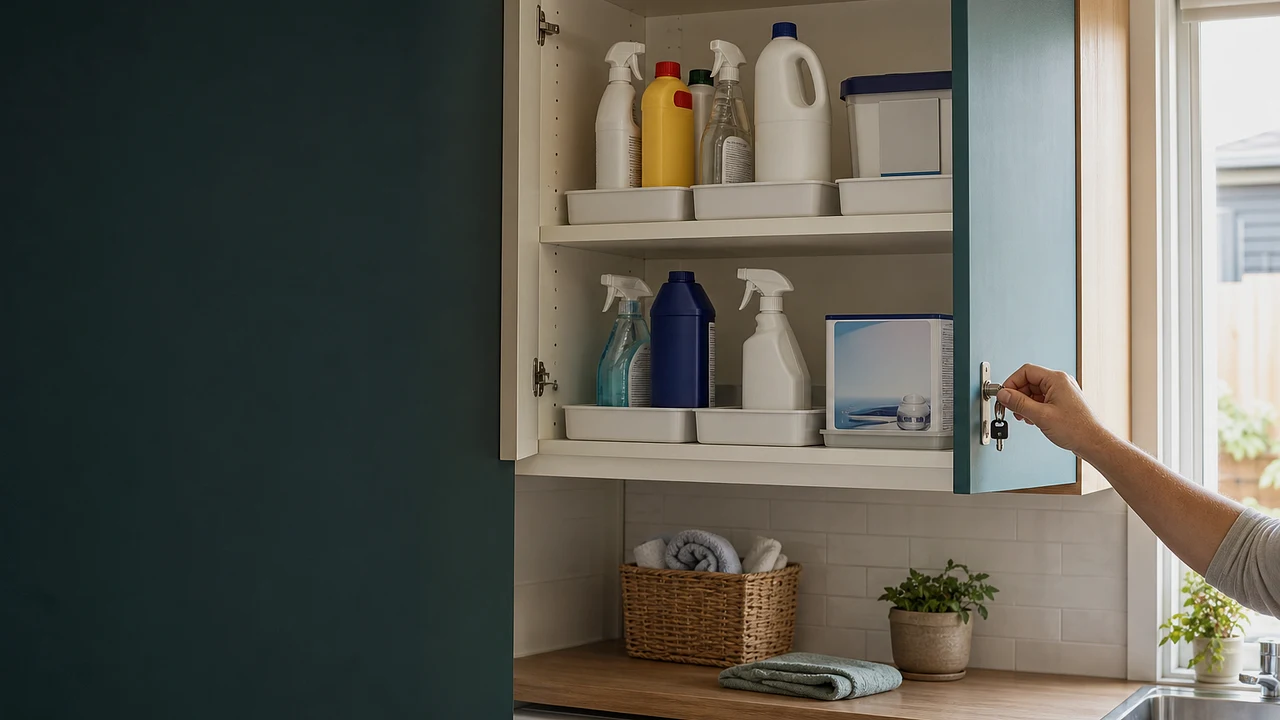
Australian Product Safety guidance says household poisons should be stored out of sight and reach, high in a cupboard and behind a child-resistant lock when a cupboard is accessible. Healthdirect similarly recommends a high locked cupboard for medicines, chemicals and cleaning products. Height slows access. A functioning lock adds another independent barrier.
Do not rely on a child being too young, a pet being uninterested or a visitor knowing the house rules. Children climb, pull chairs and copy adults. A high shelf with no door is not secure, and a low cupboard with a weak adhesive latch may not remain secure. Test the lock after closing it, keep keys inaccessible and reconsider the location as children grow or household circumstances change.
Child-resistant packaging is not childproof
A child-resistant closure can delay access, but it does not make the contents harmless or impossible to open. The ACCC has warned that these closures are not a substitute for secure storage. They work only when the cap is fully re-engaged after every use and the complete package is put away.
Check the click, alignment or locking action instead of resting the cap loosely on top. Wipe residue from the outside only as the label permits, because cleaner left around the neck can transfer to hands. Replace a damaged cap or container through the manufacturer or an approved disposal route. Do not keep a hazardous product merely because the remaining liquid seems small.
The put-away step belongs inside the cleaning task
Do not treat storage as something to do after the room is finished. Close and return each product as soon as its part of the job is complete. A phone call, crying child, delivery or smoke alarm can interrupt the best plan. US EPA poison-prevention guidance specifically recommends re-closing products when an application is interrupted.
If you must step away, secure the product before answering the interruption. Do not leave a bucket, toilet cleaner, dishwasher tablet, laundry capsule or open caddy on the floor. Empty and store equipment according to its instructions when the job ends. The final safety check is simple: every chemical is accounted for, closed and back behind the lock.
Let the label choose the storage conditions
There is no universal cupboard suitable for every household chemical. Labels may require a cool dry place, ventilation, protection from sunlight, separation from heat or ignition, or a particular temperature range. Aerosols, pool chemicals, solvents, pesticides and concentrated caustic cleaners can have requirements unlike a mild detergent.
Keep chemicals separate from food, drink, animal feed and medicines. Do not store them above food where a leak could drip onto it. Avoid a cupboard beside a stove, heater, pilot light or strong direct sun unless every relevant label explicitly permits that location. If a product's storage warning cannot be met in your home, ask the manufacturer or local hazardous-waste service rather than guessing.
Do not invent an incompatibility chart from bottle colour
Two cleaners that look similar may contain very different ingredients, while two unlike packages may react dangerously. Never arrange or combine products based only on brand, colour, smell or the room where they are used. Read the label for incompatibilities. For workplace quantities or unusual use, Safe Work Australia points to the safety data sheet for more detailed handling, storage and reaction information.
Never mix leftovers to save space. CDC guidance says household bleach should not be mixed with ammonia or any other cleaner because dangerous vapours can be released. Acids, oxidisers, alkalis, solvents and pool chemicals can create other risks. The practical household rule is stronger than memorising a short list: unless the label explicitly directs a mixture, do not combine products.
Store bottles upright and contain a leak without hiding it
Close caps and triggers, stand liquids upright and use stable shallow trays to limit the spread of a small leak. A tray is secondary containment, not permission to ignore damage or place incompatible products together. Do not pack so tightly that a bottle falls forward when the door opens or labels become impossible to read.
Inspect the shelf for staining, corrosion, swelling, brittle plastic, loose caps and unreadable labels. Do not touch an unknown residue with bare hands or sniff it to identify it. Keep people and animals away, ventilate only when doing so does not place you in danger, and obtain product-specific advice. A bulging, hot, hissing or strongly fuming container can be an emergency rather than a tidying job.
Laundry capsules need the container around them
Laundry capsules are concentrated detergent wrapped in a film that can release when wet. Their small size and bright appearance can attract young children. ACCC guidance says to keep them in the original fully closed container, out of sight and reach, preferably high or behind a child-resistant cupboard lock.
Do not leave a capsule on the washing machine, in a scoop, in a loose basket or within a child's view while preparing a load. Handle it with dry hands, place it directly into the machine as directed and close the outer tub immediately. A decorative glass jar may look organised, but it discards the safety information and can make the contents resemble confectionery.
A cleaning caddy is transport, not permanent storage
A caddy can reduce walking and help keep the right tools together, but it usually has no child-resistant lid or fixed lock. Load only the products needed for the current job. Keep every product in its original container and never carry open bottles where they can tip onto cloths or incompatible residues.
Keep the caddy with the responsible adult while it is in use. Do not park it in a hallway, bathroom floor, vehicle or doorway. Separate used cloths and brushes from unopened products, then clean or launder the tools as their care instructions require. Return the chemicals to permanent locked storage before putting the empty caddy away.
Routine changes create predictable weak points
Moving day, holidays, renovations, illness and visitors disrupt ordinary storage. A box labelled laundry may sit open on the floor. A grandparent's bag may contain medicines. A newly bought drain cleaner may remain in the car or on a bench. Queensland poison-prevention guidance highlights these changes because the normal barriers are temporarily missing.
Make a chemical plan before the disruption. Pack products upright in a separate secured container, keep them away from passengers and food, and unlock the final cupboard only when the products can go straight inside. Ask visitors to place bags with medicines, nicotine products or chemicals out of reach. Check a holiday rental or host's home rather than assuming it uses the same safeguards.
Pet safety needs more than a closed bottle
Store cleaning products and pesticides where animals cannot reach them. Keep them away from pet food and water, and prevent access to bait products, treated surfaces and spills for the full period stated on the label. A closed low cupboard may still be vulnerable to a determined animal or a door that does not latch.
If an animal may have been exposed, keep the product label and contact a veterinarian or animal poison service promptly. Do not use a home remedy or induce vomiting unless a qualified professional directs it for that exact product and animal. Human Poisons Information services and veterinary services have different roles, so keep the veterinarian's number accessible too.
Unwanted cleaner does not belong in another bottle
Buying only what you can use reduces the years a hazardous product spends in storage. When a cleaner is no longer wanted, read its disposal directions and check the current program for your council, state or territory. Australian services differ. NSW Household Chemical CleanOut and Victoria's Detox Your Home accept specified household chemicals under their own limits and schedules.
Do not pour concentrated leftovers into a drain, toilet, garden, stormwater system or ordinary rubbish unless the label and local authority explicitly allow that exact method. Never mix small leftovers into one container. Improper disposal can expose workers, damage wastewater systems, pollute waterways or allow incompatible chemicals to react.
Transport to disposal is part of safe storage
Keep products in their original well-sealed containers wherever possible and check the collection service before leaving home. NSW EPA guidance says unknown contents should be identified as unknown rather than guessed. Secure liquid containers in sturdy bags and then buckets or trays so a leak cannot move freely through the vehicle.
Use the empty boot or cargo area, away from passengers, food and pets. Keep containers upright and prevent them rolling. Do not smoke, open packages, decant or mix products during the journey. Go directly to the approved service and follow on-site instructions. Commercial quantities and business waste can require a different licensed service.
Run the seven-point cupboard audit
Check seven things: every product is identifiable; every label is readable; every cap is fully closed; liquids are upright; storage is high and locked; food and medicines are elsewhere; and no container is leaking, swollen or corroded. Then inspect the route between the cupboard and the jobs where products are used.
Remove duplicate products you no longer need through the correct disposal pathway. Move the key if a child can find it. Replace a failing lock. Put the Poisons Information Centre number, 13 11 26 in Australia, into the phones of adults and carers. A useful audit ends with fewer weak points, not merely a more photogenic shelf.
Know what to do after an exposure
If someone has collapsed, stopped breathing, is having a seizure or is in immediate danger, call Triple Zero on 000. Otherwise, call the Australian Poisons Information Centre on 13 11 26 promptly, even if symptoms have not appeared. Take the original package or label to the phone because the exact product changes the advice.
Do not make a person vomit or give food, drink or a home neutralising remedy unless the poison specialist directs it. For eye, skin or inhalation exposure, move away from danger and follow the product label plus emergency advice without exposing yourself. The reason to preserve the original container is suddenly clear: in the worst moment, it tells the responder what happened.
Sources and further reading
- Queensland Poisons Information Centre: Household poisons, prevention and first aid ↗
- ACCC Product Safety: Chemical and poison risks for children in the home ↗
- Healthdirect Australia: Swallowed substances and high locked storage ↗
- Healthdirect Australia: Poisoning symptoms, first aid and urgent help ↗
- ACCC: Child-resistant closures do not replace secure storage ↗
- ACCC: Safe storage and handling of liquid laundry capsules ↗
- Safe Work Australia: Hazardous-chemical labels, storage and safety data sheets ↗
- Safe Work Australia: Managing risks and incompatible hazardous chemicals ↗
- US CDC: Never mix bleach with ammonia or another cleaner ↗
- NSW EPA: Household Chemical CleanOut storage, transport and disposal ↗
- Victoria: Detox Your Home hazardous-chemical disposal ↗
- US EPA: Household hazardous-waste storage and disposal ↗
- US EPA: Labels, storage and ventilation for household products ↗
- US EPA: Product labels and household-cleaner safety around pets ↗
This article was written for Curiosity Desk. We do not copy other publishers or invent quotes. If a material error is found, we correct it openly.
Read the full standards →One answer should lead to a better question
Bring your curiosity to the group
Curious Minds is our public Facebook community for surprising science, strange history, Australian wildlife and everyday questions. No copied posts, no personal-friend invitations and no link dumping.
- Three self-contained discussion prompts each week
- Sourced answers and honest uncertainty
- Respectful conversation without spam