Why deep-space missions need giant dishes
A deep-space spacecraft does not call Earth through one always-open channel. Its radio signal spreads as it travels, arrives faint compared with background noise and can be heard only while a ground antenna is accurately pointed at the spacecraft. The Deep Space Network, or DSN, is the ground system that receives science data and telemetry, sends commands and helps track missions. The giant dish is therefore part of a carefully timed communications chain, not a simple broadcast tower.
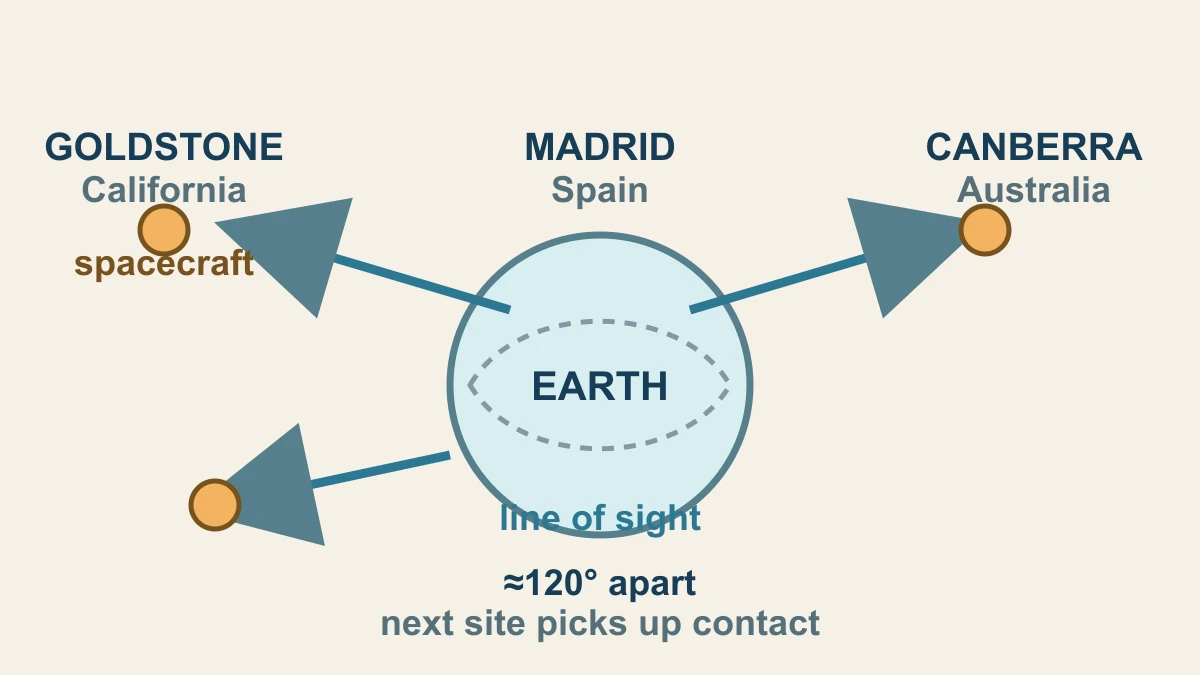
NASA's DSN places major complexes at Goldstone in California, Madrid in Spain and Canberra in Australia, roughly 120 degrees apart in longitude. As Earth turns and one site loses a spacecraft's line of sight, another can take over. That geometry is the first reason a distant mission can remain contactable across a long pass: the network spreads the antennas around the rotating planet instead of asking one location to see every direction at every hour.
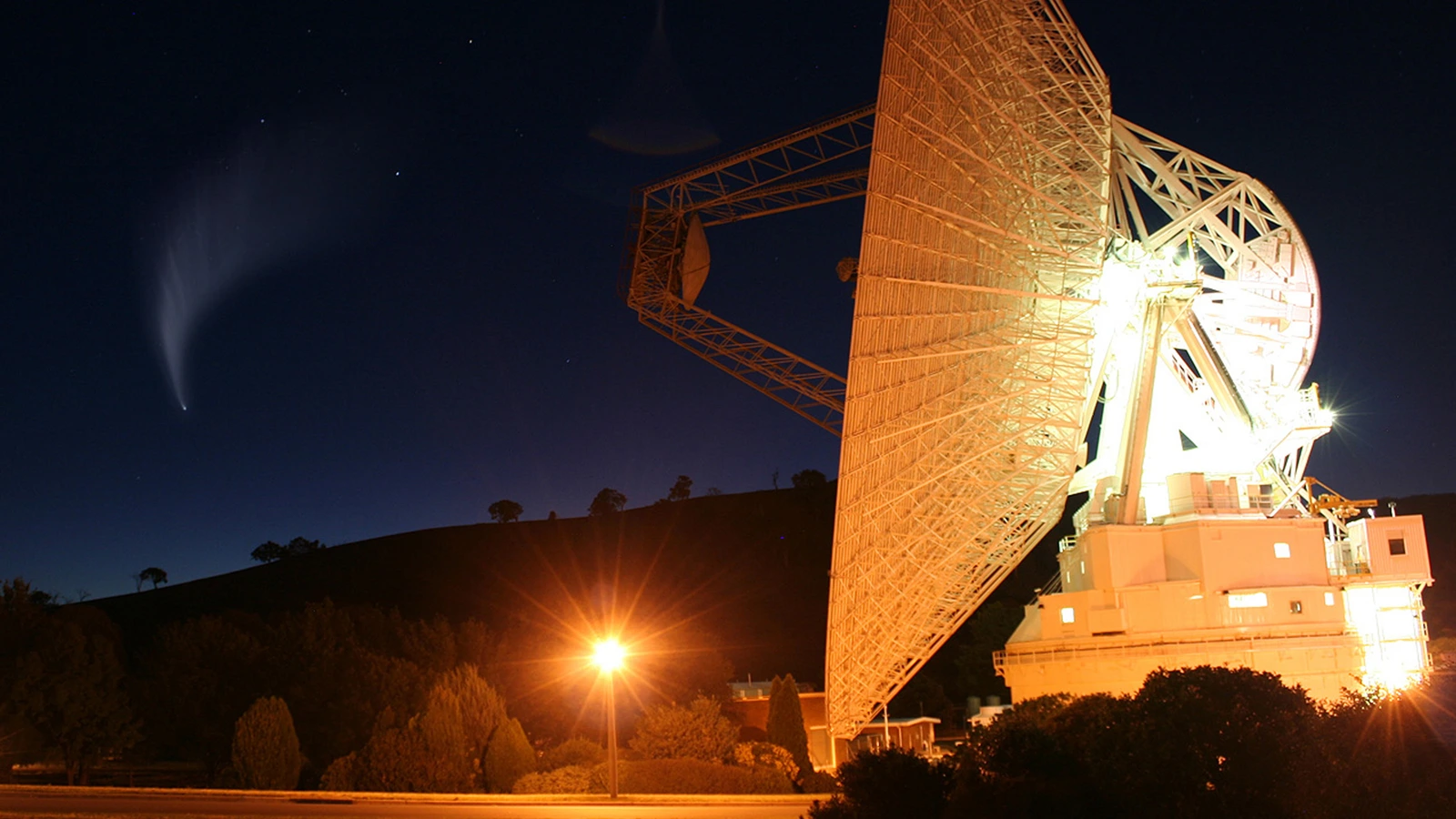
The dish also concentrates power. When receiving, a large reflector gathers more of a weak incoming signal; when transmitting, it focuses radio energy toward a narrow part of the sky. NASA describes the 70-metre antennas as the largest and most sensitive DSN dishes, while 34-metre antennas provide a more numerous and flexible layer. Their usefulness depends on pointing, signal processing, the mission's radio system and the contact schedule as much as on diameter alone.
How a beam-waveguide antenna routes signals
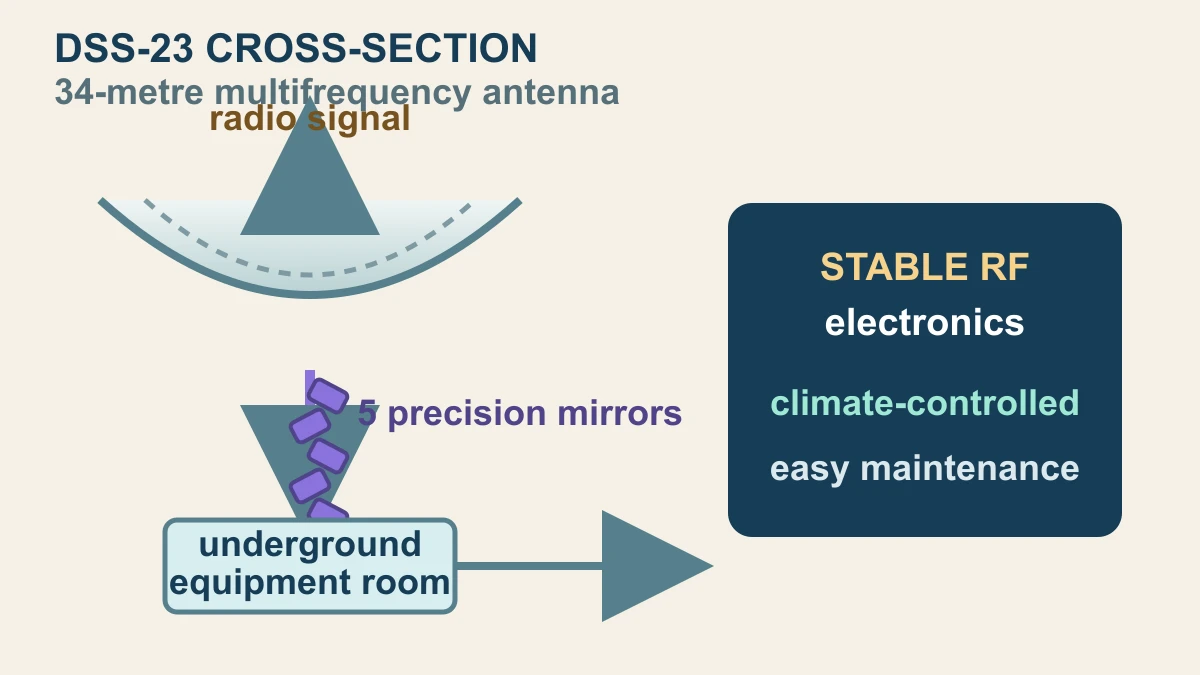
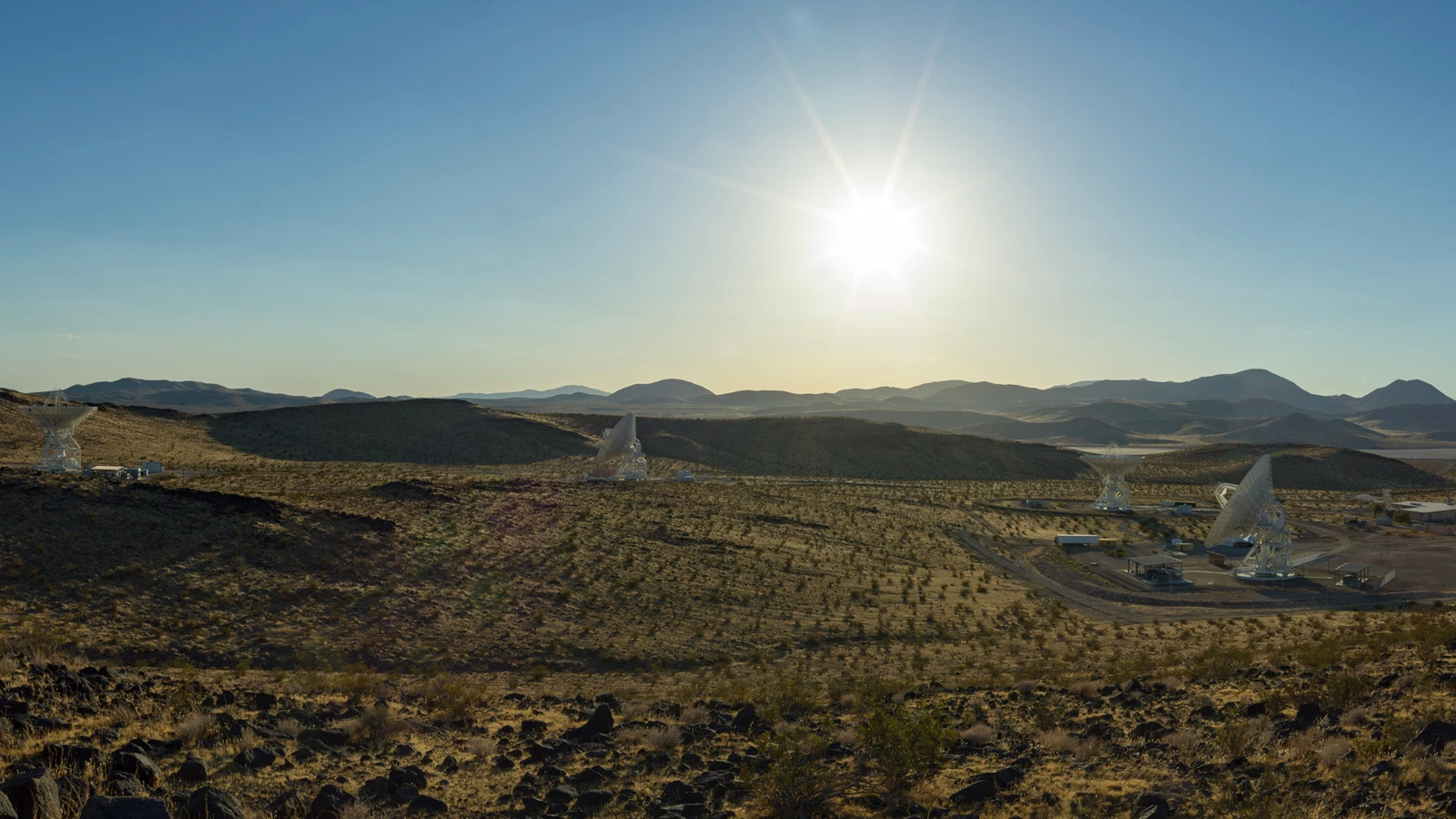
DSS-23 is a new 34-metre multifrequency beam-waveguide antenna at the Goldstone complex near Barstow, California. In this design, the dish reflects radio-frequency energy toward a set of five precision mirrors. The mirrors send the signal along a tube to a room below the antenna, so heavy and sensitive radio equipment can stay in a stable, climate-controlled environment rather than riding at the centre of the moving dish.
That separation changes the maintenance problem. The antenna still has to move and point with extraordinary accuracy, but technicians can reach the receivers and related electronics in a fixed room. NASA's antenna description says the beam-waveguide configuration makes maintenance and future modifications easier. The data path remains two-way: the ground system receives the faint spacecraft transmission, and the same kind of radio-frequency chain can send commands back after the network has scheduled and prepared the contact.
The signal is not useful merely because it reached a dish. At each complex, control systems point the antenna, receive and process the data, transmit commands and generate navigation data before the processed information travels over a ground network to NASA's Jet Propulsion Laboratory. Pointing, amplification, noise control, coding, timing and mission operations turn a faint radio wave into a reliable engineering record.
What more capacity does—and does not—change
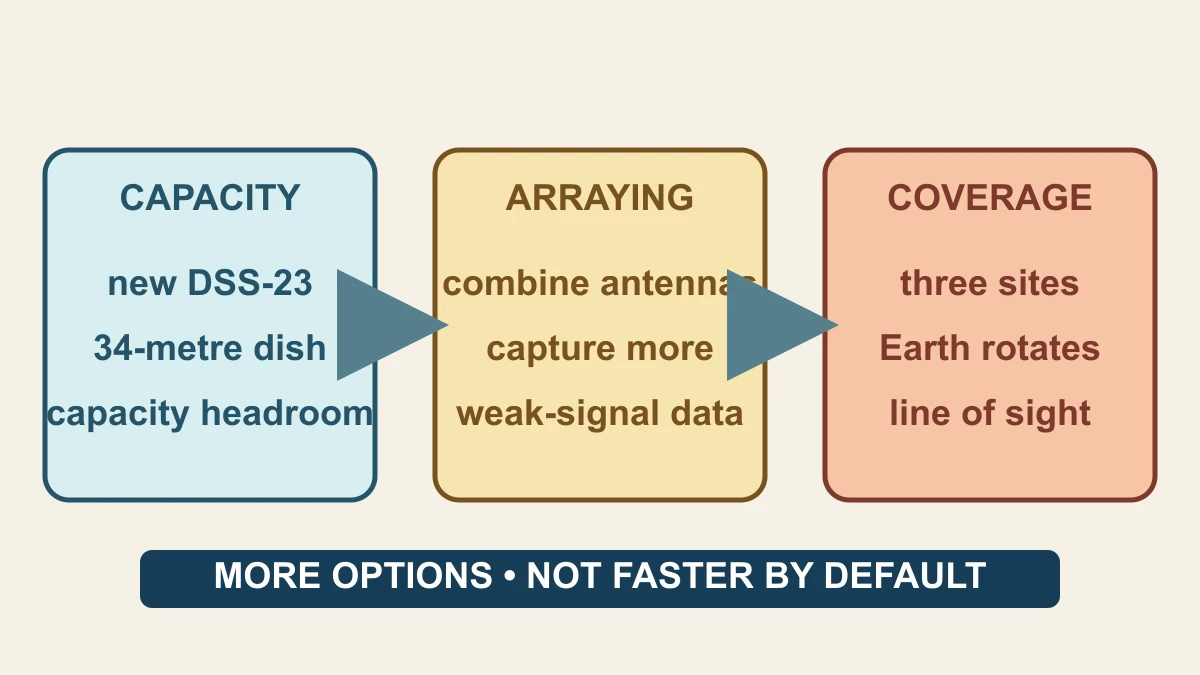
NASA says DSS-23 completed a testing campaign from May through July and began operations on 3 August 2026, first tracking the Chandra X-ray Observatory and then communicating with missions including Mars Reconnaissance Orbiter, Psyche, Juno and Voyager 1. It is the fifth antenna added through the Aperture Enhancement Project. The immediate change is an additional mission-ready asset at Goldstone, giving the network another dish to schedule, maintain and coordinate.
More assets can create useful headroom when several missions need support or when an older antenna needs maintenance. NASA also says 34-metre antennas can be arrayed—combined and operated together—to improve reception of weak signals, and that the project is expected to reach thirteen 34-metre antennas when a sixth enhancement-project antenna comes online at Canberra in 2029. Those capabilities are network options, not a universal promise that every spacecraft will send data faster.
Coverage and delay remain different problems. Three global sites help preserve line of sight as Earth rotates, but a spacecraft's position, antenna pointing, radio link, mission priority and available schedule still determine when a contact can occur. The distance to the spacecraft also imposes signal travel time that a new ground dish cannot remove. The defensible conclusion is precise: DSS-23 strengthens the DSN's capacity and flexibility, while communication remains a coordinated, finite and physics-bound service.
Sources and further reading
This article was written for Curiosity Desk. We do not copy other publishers or invent quotes. If a material error is found, we correct it openly.
Read the full standards →One answer should lead to a better question
Bring your curiosity to the group
Curious Minds is our public Facebook community for surprising science, strange history, Australian wildlife and everyday questions. No copied posts, no personal-friend invitations and no link dumping.
- Three self-contained discussion prompts each week
- Sourced answers and honest uncertainty
- Respectful conversation without spam