A burn changes an orbit's shape
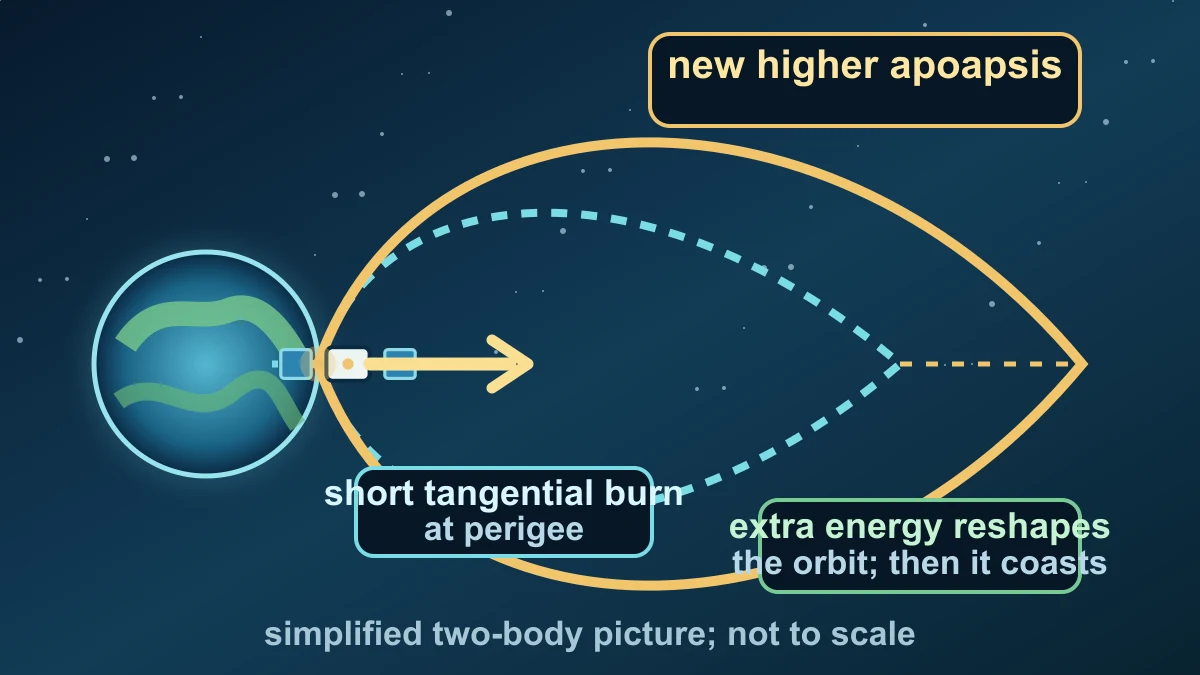
The short answer is that a servicing spacecraft does not lift an observatory straight upward. It changes the observatory's velocity at a carefully chosen point in the orbit. In NASA's simplified orbital-mechanics explanation, adding energy at perigee—the closest point to Earth—raises the opposite point, called apoapsis. The resulting path is a taller ellipse, not a vertical jump. The same principle can be used in reverse when mission controllers need to lower an orbital high point or bring a vehicle toward re-entry.
That timing matters because the burn changes the shape of the path the spacecraft will follow after the engines stop. NASA's trajectory guide describes a brief tangential acceleration at periapsis that raises the far side of an orbit, followed by a coast. A real mission can require several manoeuvres, navigation updates and checks, and the exact plan depends on the target orbit, vehicle capability, remaining propellant and uncertainty. Controllers would compare the predicted path with tracking data after each manoeuvre before committing to the next one. The useful mechanism is therefore precise: a velocity change adds orbital energy at one point so the spacecraft reaches a different altitude later. The diagram shows that general relationship, not Swift's flight plan or a measured trajectory.
Matching orbit comes before capture
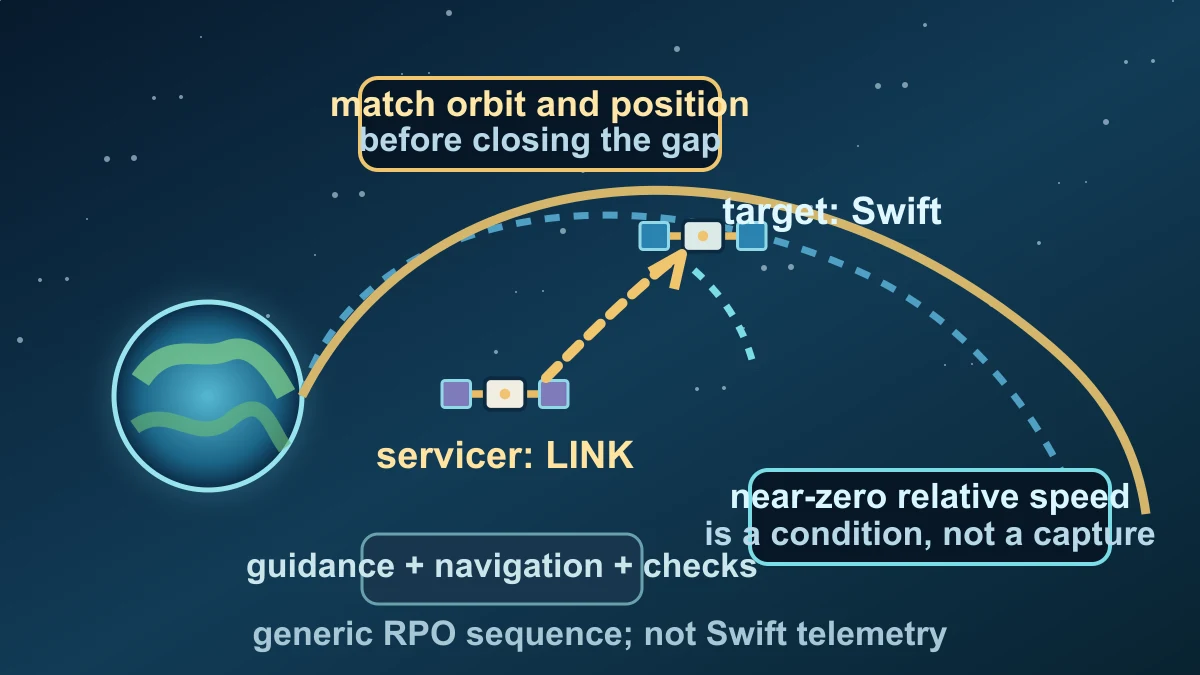
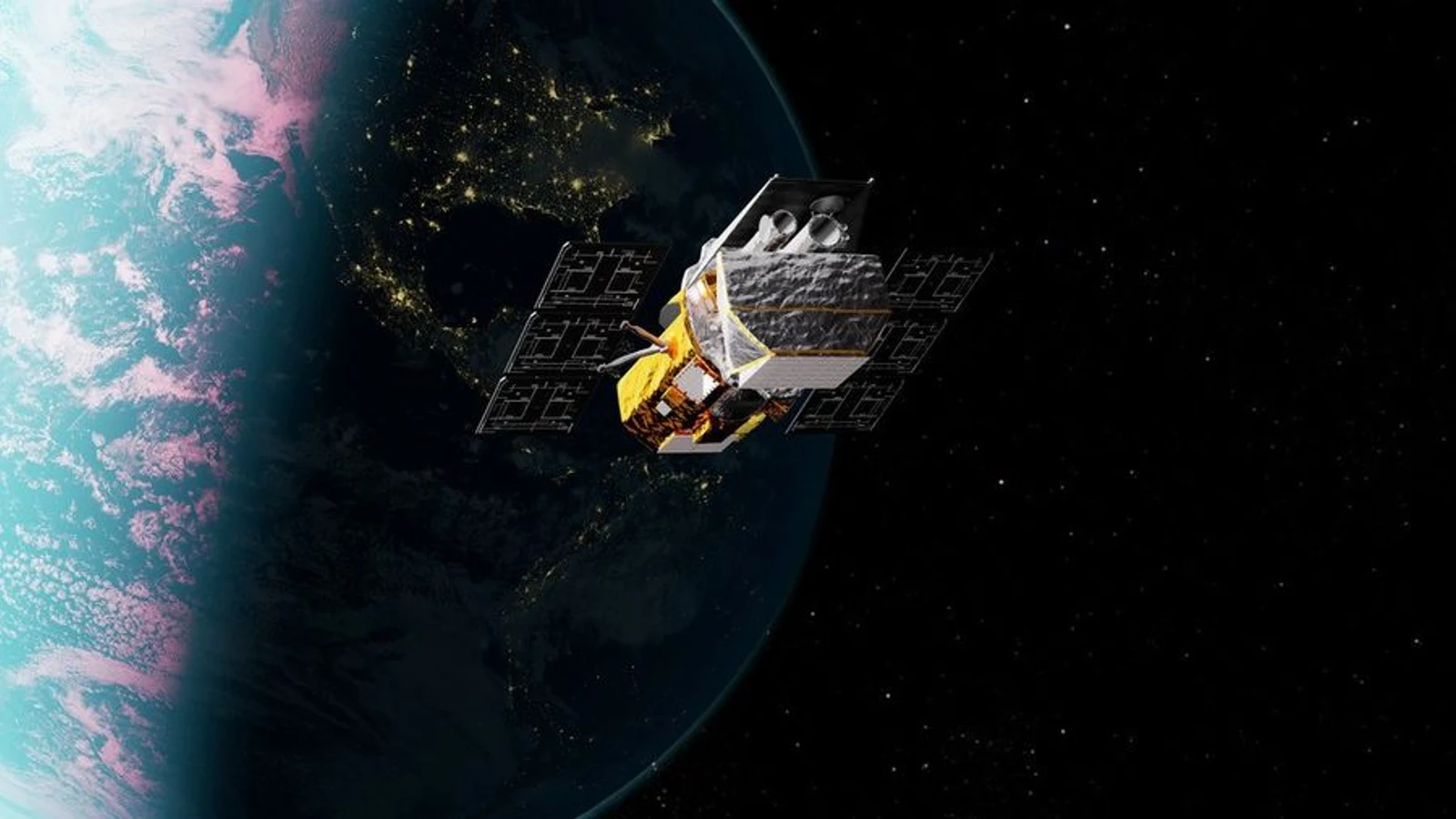
An orbit raise is only one part of servicing another spacecraft. Before LINK could safely touch Swift, the two vehicles would have to rendezvous: arrive in the same orbital neighbourhood with their positions, orientations and relative motion controlled. NASA Johnson Space Center describes rendezvous and proximity operations as a guidance, navigation and control problem that includes flight targeting, collision-avoidance tools, maneuver plans and analysis of robotic capture. Altitude alone is not enough. Two spacecraft can pass through a similar height while moving along different paths and at unsafe relative speeds.
The practical sequence is closer to matching a moving lane than to catching a thrown ball. A servicer first changes its orbit to meet the target at the right time, then uses smaller corrections to manage the closing direction and speed. Guidance systems also need a safe retreat or separation option if navigation, attitude or target motion falls outside the approved envelope. Cameras, ranging sensors and tracking data help the team test whether the planned relative position is actually being achieved. A stable close approach can demonstrate useful capability without becoming a capture. That distinction is central to the Swift story: NASA's latest status record says LINK will still attempt rendezvous and proximity operations, but it will not capture or boost Swift as originally planned.
Swift's latest update changes the claim
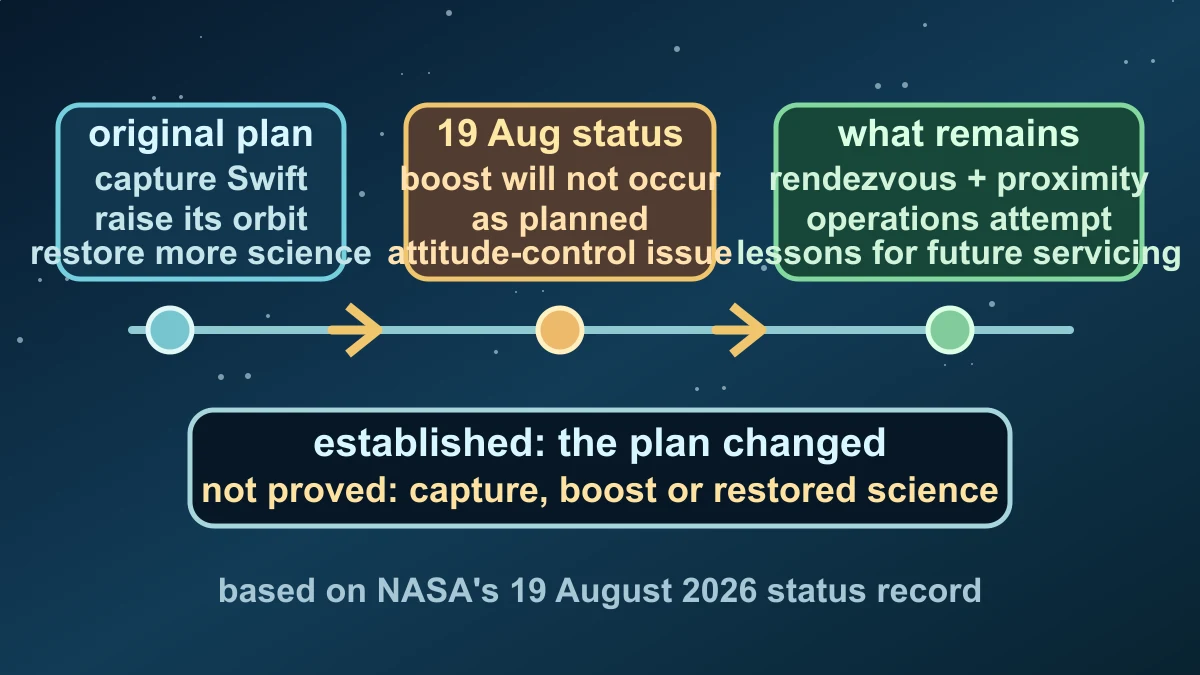
NASA's 19 August 2026 release says an ongoing attitude-control issue means LINK will not capture or boost the Neil Gehrels Swift Observatory to a higher altitude as planned. NASA and Katalyst Space still intend to attempt rendezvous and proximity operations, in part to demonstrate capabilities and gather lessons for future satellite servicing. The same release says Swift has spent more than 20 years studying cosmic objects and that increased solar activity accelerated the decay of its low Earth orbit. NASA anticipates that, without intervention, Swift is likely to re-enter later this year. That is a mission-status statement, not a prediction of an exact date, trajectory or public-safety consequence.
So the established answer has two layers. In general, a spacecraft raises an orbit by making a controlled velocity change at the right place, and safe servicing requires a carefully verified rendezvous before capture. In this specific mission, the original capture-and-boost plan is no longer the expected outcome; an RPO attempt and its lessons are the remaining claim. What is not proved by the current records is a capture, an orbit raise, restored Swift science, or the result of any future rendezvous. Keeping those boundaries visible is what turns an exciting servicing idea into a trustworthy frontier explanation.
Sources and further reading
This article was written for Curiosity Desk. We do not copy other publishers or invent quotes. If a material error is found, we correct it openly.
Read the full standards →One answer should lead to a better question
Bring your curiosity to the group
Curious Minds is our public Facebook community for surprising science, strange history, Australian wildlife and everyday questions. No copied posts, no personal-friend invitations and no link dumping.
- Three self-contained discussion prompts each week
- Sourced answers and honest uncertainty
- Respectful conversation without spam